Thailand pushes jasmine rice to Chinese consumers at CAEXPO as exports to China fall 58.94%
Thailand's Department of Foreign Trade promoted seven groups of Thai rice at the 23rd China-ASEAN Expo in Nanning on 17-21 September 2026, drawing more than 3,000 visitors to its stand. The campaign runs against a sharp contraction in volumes: shipments to China reached 191,953 tonnes in January-August 2026, down 58.94%, versus an average of 579,585 tonnes a year in 2022-2025.
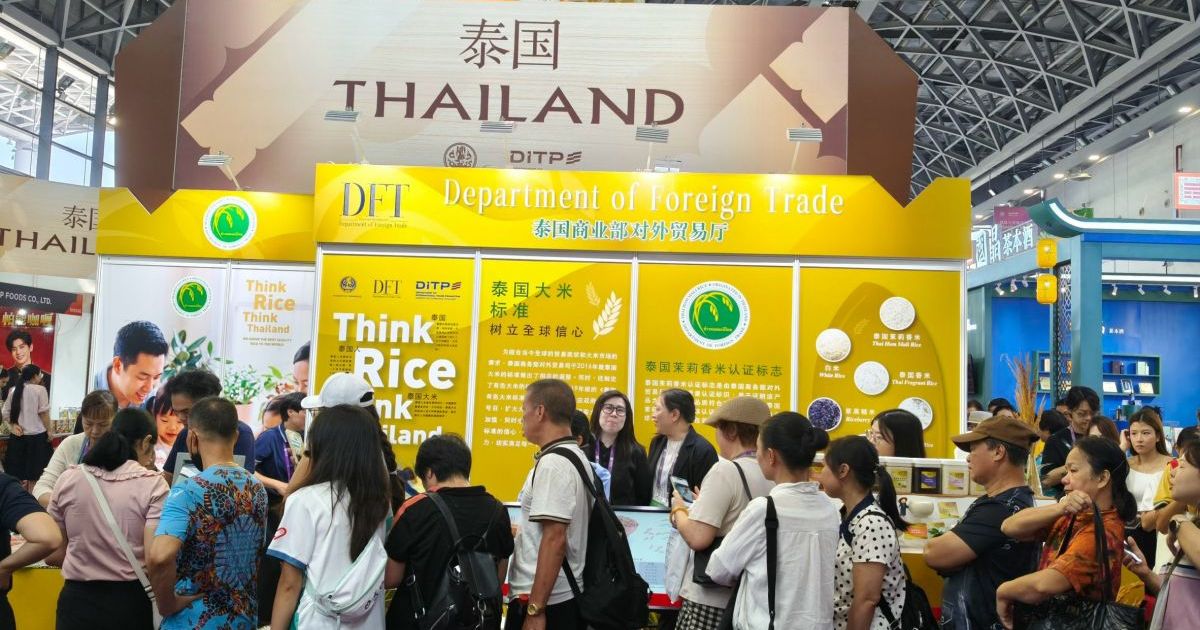
Thailand's Department of Foreign Trade has wrapped up a rice promotion campaign at the 23rd China-ASEAN Expo (CAEXPO) in Nanning, Guangxi Zhuang Autonomous Region, where its stand drew more than 3,000 visitors between 17 and 21 September 2026. According to Commerce News Agency, the department said the activity met its targets for building awareness of Thai rice among Chinese traders, importers and consumers.
The campaign comes as volumes shrink. Department figures cited by Commerce News Agency put rice exports to China at 191,953 tonnes in the first eight months of 2026, a decline of 58.94%, against an average of 579,585 tonnes a year over 2022-2025.
Seven groups of rice in the Thailand Pavilion
The department ran its programme inside the Thailand Pavilion organised by the Department of International Trade Promotion. Seven groups of rice were on display, selected to show the range of Thai origin, its nutritional properties and its quality standards:
- Thai hom mali rice, marketed internationally as jasmine rice
- white rice
- glutinous rice
- Thai fragrant rice
- specialty rices: Riceberry, Hom Nil and Sangyod
Alongside the display, staff explained how to identify and select genuine Thai hom mali rice and ran a quiz with souvenir prizes. Thai dishes were cooked on site and handed out for tasting, including chicken stir-fried with holy basil, som tam papaya salad, chicken with cashew nuts, mango sticky rice and pork stir-fried with garlic, so that visitors could judge the aroma and texture of hom mali rice directly. Commerce News Agency reported that visitors praised the taste, softness, aroma and quality of Thai rice, and said they were interested in buying hom mali and Thai glutinous rice to cook at home with their families or to give as gifts on important Chinese occasions.
Shipments to China down 58.94%
The export numbers frame the effort. The 2022-2025 average of 579,585 tonnes a year compares with 191,953 tonnes in the eight months to August 2026 - roughly a third of a normal annual volume - a drop the department puts at 58.94%.
Even at reduced volumes, China remains a significant destination. White rice, glutinous rice and hom mali rice are the main lines shipped, which the department reads as evidence of diversified Chinese demand rather than a single commodity trade, with further room in food manufacturing, confectionery and industrial applications.
From export commodity to everyday staple
Arada Fuangthong, Director-General of the Department of Foreign Trade at the Ministry of Commerce, said participation in CAEXPO was not only about communicating the quality, standards and variety of Thai rice but also an opportunity to meet Chinese businesses, importers and consumers, to learn where demand is heading and to position Thai rice in line with changing consumption behaviour. The stated objective is to move Thai rice beyond its status as an export commodity and into the meals and daily routines of Chinese consumers, while keeping bilateral rice trade cooperation growing.
CAEXPO is the main annual trade and services fair for the China-ASEAN region and carries high-level Chinese political backing. This year's edition was opened by Ding Xuexiang, Vice Premier of China's State Council, who delivered a keynote address at the ceremony. The Department of Foreign Trade attends the expo every year to promote Thai rice and reinforce confidence in its quality and standards among Chinese consumers and businesses, and said it will continue the promotion drive in the Chinese market and expand marketing channels.