Thai floods kill 3.25 million layer hens, cutting egg supply by millions a day
Flooding in Chachoengsao, Chonburi, Nakhon Nayok and Prachinburi killed more than 3.25 million layer birds, according to damage figures presented by Thailand's Department of Livestock Development. Official estimates put the output loss at 2.2–2.5 million eggs a day, while traders cited by Thansettakij say more than 7 million eggs a day are missing from the market. Farmgate size 2 eggs are trading 30–40 satang above the reference price, a segment with no official quotation.
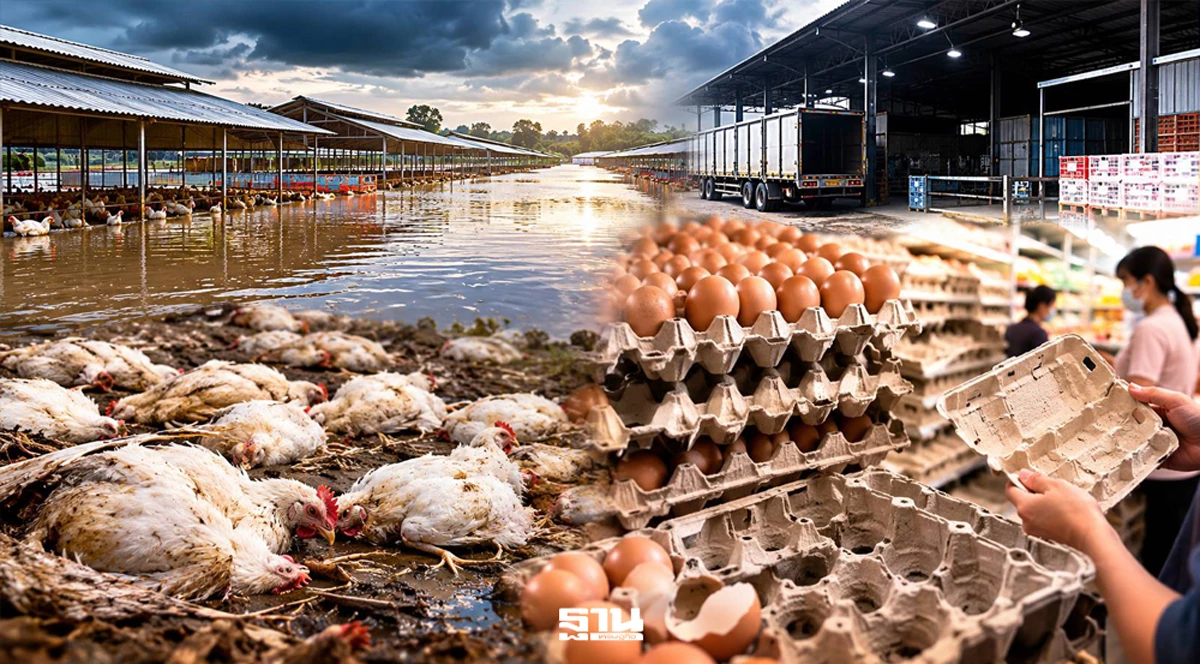
Flooding in four eastern provinces of Thailand has killed more than 3.25 million layer birds and taken millions of eggs a day out of the domestic market, Thai business daily Thansettakij reported, citing damage figures presented by the Department of Livestock Development. Collectors and wholesalers describe a market in which buyers have cash but cannot secure volume.
Losses concentrated in four provinces
At an urgent meeting on egg price stability convened by the Department of Livestock Development on 2 October 2026 and chaired by a deputy director-general, officials reported flood damage as of 1 October 2026 in Chachoengsao, Chonburi, Nakhon Nayok and Prachinburi. Bird losses across age groups exceeded 3.25 million head.
- 2,760,094 hens in production
- 483,228 replacement pullets
- 12,378 parent-stock birds
In Chachoengsao alone, 14 layer farms were affected and three were reported as total losses. The parent-stock figure is small in volume terms but sits upstream of future pullet placements, so its effect on supply arrives later than the immediate drop in table-egg output.
Two estimates of the daily shortfall
The Department of Livestock Development puts the production loss at about 2.2–2.5 million eggs a day below normal levels. Estimates from the egg trade cited by Thansettakij are far higher, at more than 7 million eggs a day, and the publication frames the overall disruption as a range of 2 million to 7 million eggs a day. Some collectors report that incoming volumes have fallen by more than half. Consumption has continued at its usual pace, leaving the market tight from farm to retail shelf.
Graded eggs trade above the reference price
The sharpest price move has been in size-graded eggs sold at the farm gate. Traders told Thansettakij that farmgate size 2 eggs have risen to 30–40 satang per egg above the reference price, compared with a normal discount of around 10 satang below it.
That shift is difficult to track officially. The state monitors the farmgate price of ungraded mixed eggs, but there is no official central quotation for graded farmgate eggs, so transactions are set by local supply and demand. Market participants are asking who effectively sets the graded farmgate price when eggs are unavailable.
Costs pass down the chain as recovery lags
With limited volume available, buyers are competing for supply and price increases are moving stage by stage from farms to collectors, packing houses, wholesalers and retailers, each carrying its own transport, grading, shrinkage and administrative costs. Traders are also absorbing higher freight after switching to more distant sourcing areas, while labour, rent and operating expenses continue despite lower throughput. Some businesses have begun discussing cost reductions with employees, including voluntary resignation and wage cuts.
The Department of Livestock Development is pursuing three main lines of action to stabilise the market. Among the measures referenced in the report are extending the productive life of existing flocks and reducing exports to keep more eggs inside the domestic system.
Recovery depends on restocking, which cannot replace a large loss of hens immediately. Traders say they cannot confirm when egg prices will ease, even after the festival period, and the flood situation remains uncertain. If hen numbers and output stay below normal, prices are likely to hold at elevated levels. Industry participants are calling for disclosure along the full chain — farms damaged, birds lost, output lost, mixed and graded farmgate prices, collector purchase prices, wholesale and retail prices — so that price transmission becomes visible rather than disputed.