Thai cassava groups seek national action as mosaic disease deepens raw material shortage
Four Thai cassava associations have called for cassava mosaic disease to become a national priority as output falls short of domestic processing demand. The government aims to reduce the affected area by 30% in 2569 through six disease-control measures.
Industry warns of record-low supply
Thailand’s cassava industry is pressing the government for a coordinated national response to cassava mosaic disease and a severe shortage of roots. Four industry associations said the crisis is affecting farmers, processors and the country’s competitiveness across food, bioenergy and bioplastics markets.
Thai Post reported that a production and trade survey for the 2569/70 season forecast cassava output at about 18.757 million tonnes, described by the associations as a record low. Domestic processors require an estimated 37–45 million tonnes of fresh roots annually. With available supply far below that range, many factories are operating at only 20–30% of capacity, while some cassava collection yards have closed or temporarily suspended operations because they cannot obtain enough raw material.
The four organizations are the Thai Tapioca Trade Association, the Thai Tapioca Products Factory Association, the Thai Tapioca Starch Association and the Northeastern Tapioca Producers Association. They identified shortages of healthy planting material, cassava mosaic disease, witches’ broom disease and climate change as major constraints on yields. The survey found that average yield per rai had declined even though planted area increased by more than 2.29%, highlighting the effect of poor-quality and insufficient planting stems.
Export earnings expected to fall
The associations said the value of Thailand’s cassava product exports had already moved sharply below its 2565 peak. Export value reached 155.498 billion baht that year but is expected to fall below 70 billion baht in 2569. They estimated that the country has lost more than 85 billion baht in economic value.
The supply gap has consequences beyond growers. Cassava roots and starch are inputs for food manufacturing, animal feed-related products, ethanol and other bioenergy applications, and bioplastics. Low factory utilization raises unit costs and may reduce processors’ ability to serve customers consistently. Collection-yard closures also weaken local purchasing networks and leave farmers with fewer marketing channels.
Associations propose a three-year recovery
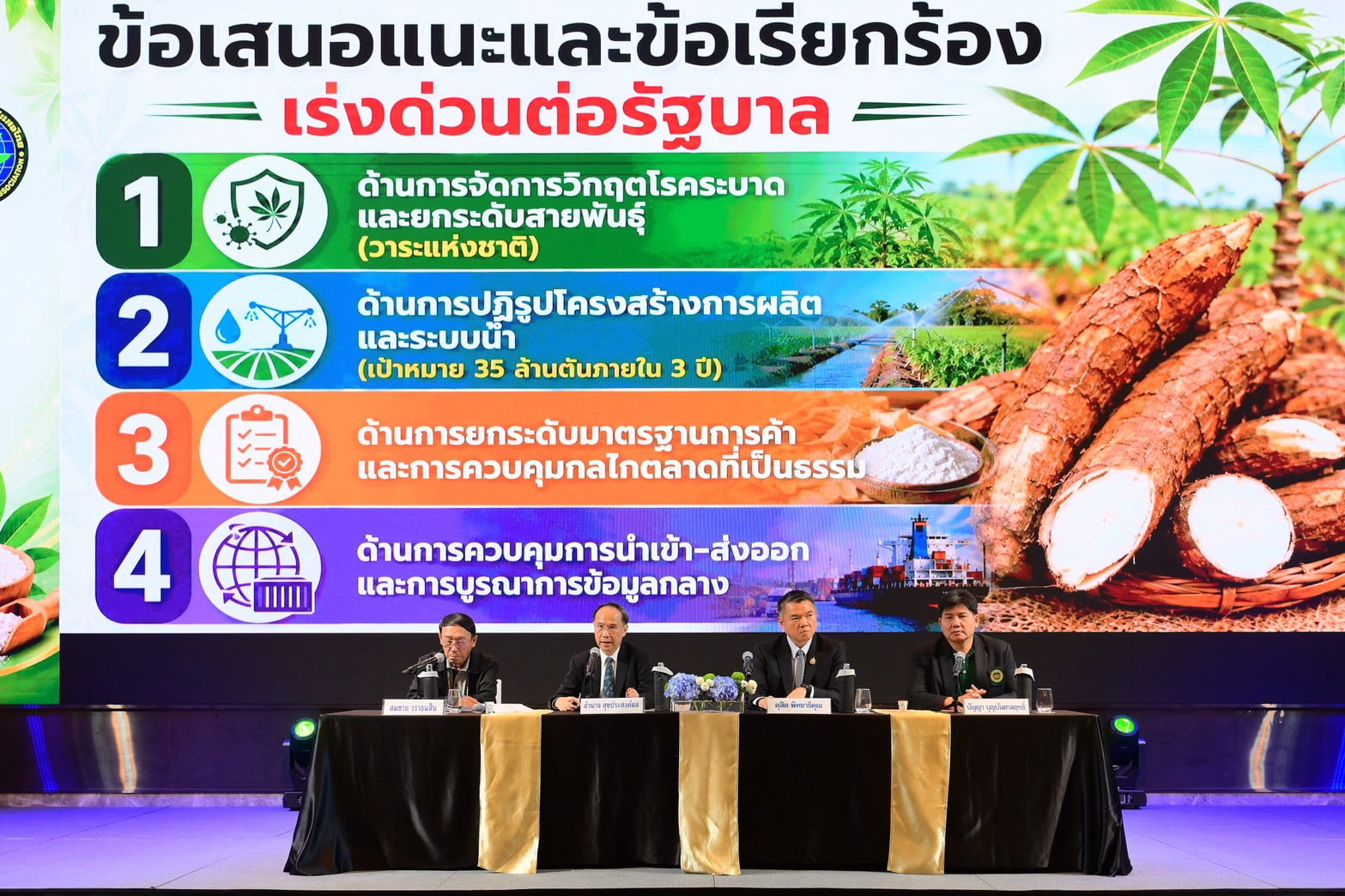
The industry groups asked the government to declare control of cassava mosaic disease a national priority. Their proposals include rapidly producing and distributing clean and disease-resistant planting stems, investing in water systems and production technology, and allocating funds to restore output to 35 million tonnes within three years.
They also called for stronger trading standards and fairer market mechanisms for farmers. Further proposals cover tighter supervision of imports and exports and a central industry database intended to improve coordination throughout the supply chain.
Government targets a 30% reduction in affected area
Bangkok Biz News reported that the Department of Agricultural Extension has introduced six measures intended to reduce the area affected by cassava mosaic disease by 30% in 2569. Fields are to be inspected every 2–4 weeks, infected plants removed and buried, and tobacco whiteflies—the disease vector—controlled. The program also promotes clean and resistant varieties, regulates the movement of planting stems, establishes community stem banks and demonstration plots, and coordinates work among public agencies, farmers and other participants.
Recommended varieties include Itthi 1, Itthi 2 and Itthi 3, alongside tolerant varieties Kasetsart 50, Huay Bong 60 and Rayong 72. The Phu Pradu Phatthana large cassava farming group in Kanchanaburi is being used as a model. Its practices include subsoil ploughing, wider planting ridges, mechanical planting, drone spraying, growth-stage fertilizer application and measures to increase starch content.
The Kanchanaburi project also uses green manure, reduces field burning, organizes collective marketing and connects farmers with buyers. A five-year plan covering 2570–2574 aims to develop the group into a farmer-owned company. The immediate test, however, is whether clean planting material and disease control can raise yields quickly enough to narrow the gap between the 18.757-million-tonne crop forecast and annual domestic demand of 37–45 million tonnes.