Sudan and FAO sign $616 million framework to rebuild war-hit farming
Sudan's Ministry of Agriculture and Irrigation has signed a 2026-2028 country programming framework with the UN's FAO to mobilize more than $616 million for its war-damaged farm sector. The plan targets irrigation, drought-resistant seed, value chains and smallholder support in a country where farming is 44% of output and key export crops include gum arabic and sesame.
Sudan signs $616 million agricultural framework with FAO
Sudan's Ministry of Agriculture and Irrigation has signed a programmatic framework with the United Nations Food and Agriculture Organization (FAO) to mobilize more than $616 million in agricultural investment and assistance, the ministry announced in Khartoum, according to Sudan Tribune. The Country Programming Framework covers the period 2026-2028 and is aimed at supporting the recovery of a farm sector battered by war.
The agreement was reached hours after the government announced the creation of a 3 trillion Sudanese pound bank financing portfolio to support the agricultural season. That season faces multiple obstacles, including a lack of financing, shortages of improved seed and fertilizer, and rising fuel prices and production costs, the ministry said.
What the framework funds
According to the ministry statement, the framework is designed to support recovery and reconstruction by delivering urgent assistance to producer households and protecting agricultural and livestock assets from further deterioration. It also backs:
- Development of irrigation projects and improved crop and livestock production systems;
- Supply of basic inputs, including drought-resistant improved seed;
- Support for value chains to help products reach local and regional markets;
- Direct support to smallholder farmers and producers, with jobs targeted at youth and women.
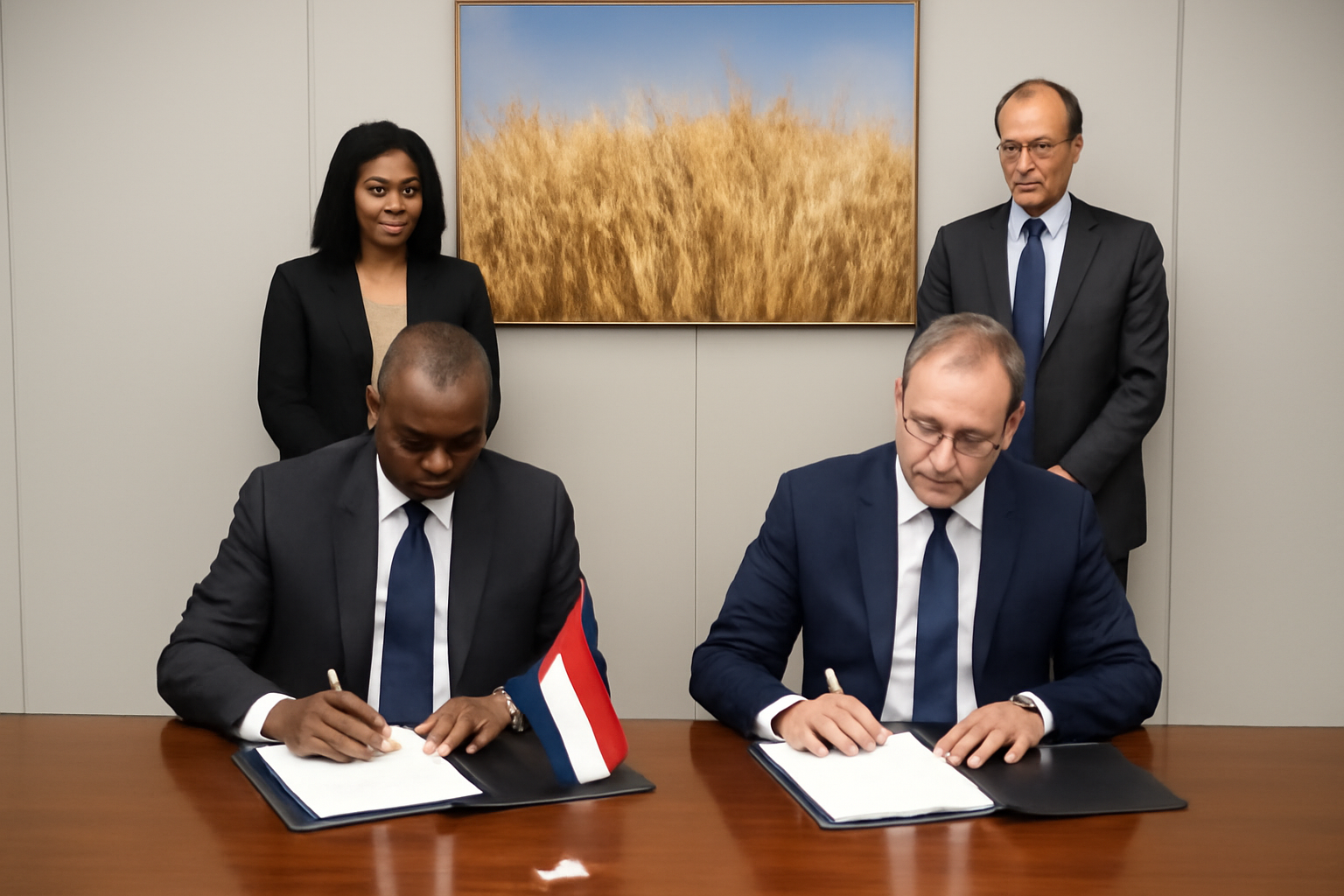
The framework was signed by Agriculture Minister Esmat Gurashi and FAO Resident Representative in Sudan Hongjie Yang, in the presence of the organization's Regional Representative for the Near East and North Africa, Abdul Hakim Elwaer. Elwaer said he had visited Gezira and Sennar states to assess the sector's needs.
The crops at stake for trade
Agriculture is a cornerstone of Sudan's economy. Counting both crops and livestock, the sector accounts for about 44% of national output, while more than 60% of the population relies on sorghum and millet as staple foods and around 65% of Sudanese work in agricultural activities.
Traditional farmland covers an estimated 20 million feddans, concentrated in the west and south and parts of central Sudan. These areas produce roughly 90% of the country's millet, 48% of its groundnuts, 28% of its sesame and 11% of its sorghum, along with the entirety of Sudan's gum arabic — commodities central to both domestic supply and export. The framework is intended to support value chains that move these products to local and regional markets, and officials said a stronger Sudanese harvest would also help the food security of neighboring countries.
A wide financing gap
Officials framed the partnership around national priorities: food security, higher output and productivity, resilience for rural communities, and sustainable management of natural resources. The FAO's resident representative said the program focuses on building resilience and contributing to peace and stability through food security.
The $616 million target sits against a broader shortfall. In March, the FAO said it needed $230 million to carry out an emergency and resilience plan running through 2028 to support 12.4 million Sudanese. The new framework mobilizes investment rather than disbursing it directly, leaving the pace of recovery dependent on how quickly financing, seed and other inputs actually reach farmers.