Spanish capital backs 55.6% of melon production in Brazil's Rio Grande do Norte
Spanish investors account for about 55.6% of melon output in Rio Grande do Norte, according to the state secretary of agriculture and fisheries, Guilherme Saldanha. The Spanish company Dom Melon has started a 60-hectare pilot in Mossoro, while the 2026/2027 season is projected to move R$1.42 billion and ship roughly 250,000 tonnes through the Port of Natal.
Spanish capital is behind roughly 55.6% of melon production in the Brazilian state of Rio Grande do Norte, according to the state secretary of agriculture and fisheries, Guilherme Saldanha, quoted by Tribuna do Norte. The share marks a turning point for one of Brazil's main fruit-growing regions, where foreign money is increasingly financing planting, packing and export operations.
Agricola Famosa anchors the Spanish position
Most of the Spanish exposure runs through Agricola Famosa, the largest fruit exporter in Rio Grande do Norte. "If we add Agricola, which has 50% Spanish capital, to another five Spanish companies that operate strongly in the local market, we have something around 55.6% of production carrying investment from that country," Saldanha said.
Spain is not the only source of foreign capital in the state's fruit sector. British, American, Arab and Canadian funds also hold positions in Rio Grande do Norte fruit production, according to Tribuna do Norte.
Dom Melon starts a 60-hectare pilot in Mossoro
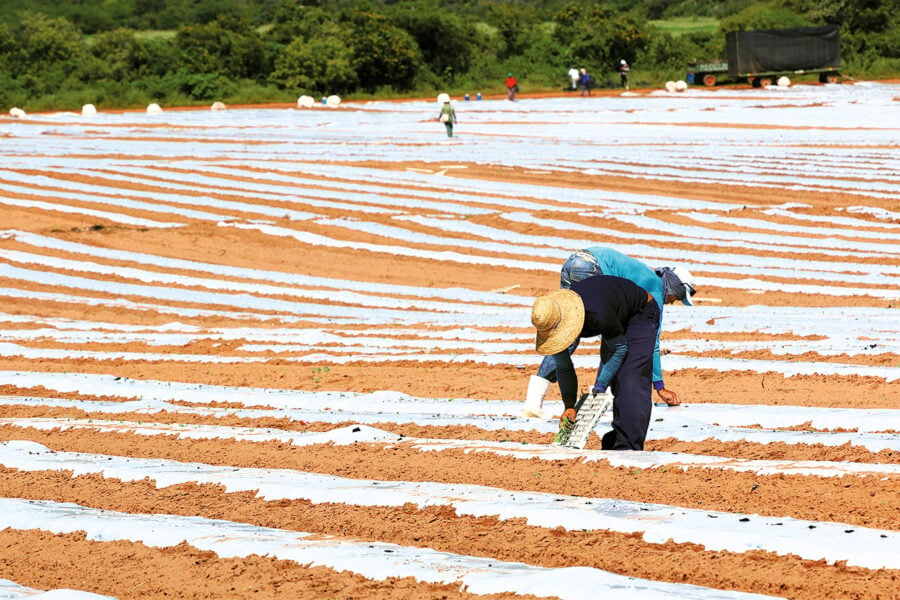
The most recent addition is Dom Melon, a Spanish company that has begun production in Mossoro on 60 hectares, of which 40 hectares are planted with melon and 20 hectares with watermelon. The first harvest is expected in October and should yield 60 containers.
Fabio Queiroga, president of the Rio Grande do Norte fruit-growing executive committee (Coex) and also technical consultant to Dom Melon in the state, said the company set up only a few months ago with a pilot project. "The objective, at this moment, is to get to know local production," he said. The operation employs around 60 workers in Rio Grande do Norte, and the company already runs an equivalent 60-hectare area in the neighbouring state of Pernambuco.
Queiroga stressed that the entry did not involve a large capital injection. "There were no significant new investments here, since the company absorbed a Canadian fund that was already operating in Brazil. There will only be a small investment in crop costing," he said.
A R$1.42 billion season through the Port of Natal
The scale of the local crop explains the interest. The 2026/2027 potiguar melon season should generate R$1.42 billion in business volume, with about 250,000 tonnes shipped to foreign markets through the Port of Natal, according to Companhia Docas do Rio Grande do Norte.
Saldanha attributes the inflow of foreign money to legal certainty and administrative simplification. He cited a set of debureaucratisation measures carried out, in his words, sustainably and with respect for the environment, including water-use permits that can now be issued online. He also pointed to the state's natural advantages for fruit growing, namely water from the Arenito-Acu geological formation and the transfer of the Sao Francisco river, which in his assessment should allow agricultural output in Rio Grande do Norte to double in the coming years without harming human water supply. Proximity to the ports of Natal, Mucuripe and Pecem is another factor drawing investment, he said.
Financing costs reshape ownership
Not all local players read the trend positively. Queiroga linked the advance of foreign capital to what he called Brazil's "disastrous financial policy". "It is a policy that imposes extremely high interest rates on Brazilian companies, which are not able to bear the financial burden and are not managing to stay within their operations. As a result, some national companies are being absorbed by international companies that have rational interest rates within a more solid economy outside the country," he said.
He described the result as "asymmetric competitiveness": while the cost of raising money in Brazil remains very high, capital arriving from abroad at a lower cost "makes life even harder for the domestic producer". The pattern points to a melon industry in Rio Grande do Norte where growing areas, jobs and export volumes remain local, but a majority of the production base is financed and increasingly controlled from outside Brazil.