South Korea opens Qatar to boneless beef as Hanwoo exporters face supply and price constraints
South Korea has completed sanitary arrangements allowing boneless beef exports to Qatar, with the first 100 kg shipment of chilled Hanwoo planned for early next month. Export growth remains constrained by falling domestic production, a 30-month breeding cycle and a large price gap with competing beef.
Qatar grants access for boneless beef
South Korea is extending the international reach of its livestock industry, with premium Hanwoo beef gaining a route into Qatar. Viva100 reported that the Ministry of Agriculture, Food and Rural Affairs and Qatar’s Ministry of Public Health completed negotiations on the sanitary conditions and veterinary certificate format for boneless beef exports on the 20th.
South Korean suppliers may now export beef that complies with the agreed sanitary rules and halal requirements recognized by Qatar. The first shipment, consisting of 100 kg of chilled Hanwoo, is scheduled for early next month. The limited volume makes the delivery primarily an initial commercial test rather than a major addition to Qatar’s beef supply.
Qatar joins a group of markets where South Korean Hanwoo can already be formally exported. The existing list includes Hong Kong, Malaysia, the United Arab Emirates, Cambodia, Macau and Singapore. South Korea is also conducting quarantine negotiations with China and Indonesia as the government seeks to diversify livestock export destinations.
Hong Kong restrictions narrowed
Access conditions are also improving in established markets. Following negotiations with Hong Kong, South Korea reduced the area subject to export restrictions after a foot-and-mouth disease outbreak from the provincial level to the city and county level from the 1st. The change allows Hanwoo shipments from unaffected parts of Gyeonggi and North Gyeongsang to resume.
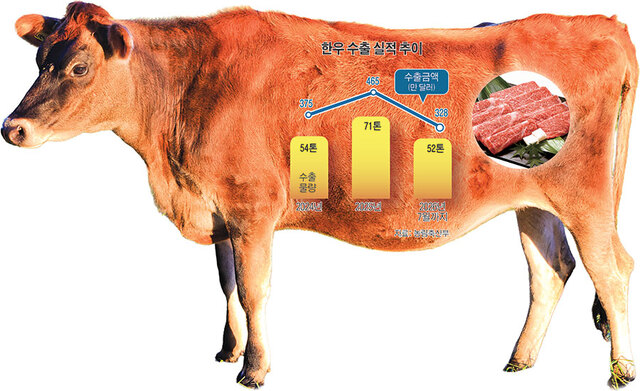
Hanwoo exports increased from 54 tonnes in 2024 to 71 tonnes last year, according to Viva100. Shipments reached 52 tonnes in the first seven months of this year. The direction is positive, but the volumes remain small compared with Japan, which exported 12,628 tonnes of beef last year.
Japan aims to raise beef export revenue to ¥113.2 billion by 2030 through market diversification and broader overseas sales of different cuts. A Hanwoo industry fund representative told Viva100 that Japanese support for farmers’ production costs helps exporters offer wagyu below domestic prices. Hanwoo has no equivalent dedicated support, while slaughtering, processing, certification, logistics, quarantine, customs clearance and local distribution all add to its export cost.
Falling output limits expansion
Price competitiveness has weakened further. South Korean Hanwoo wholesale prices rose by more than 15% in the first nine months of this year, and overseas retail prices increased by a similar rate. At City’super, a premium supermarket in Hong Kong, 1++ grade Hanwoo lower sirloin is selling for about 38,000 won per 100 grams.
Supply is another constraint. Annual Hanwoo production is forecast to fall by about 7.9%, from approximately 313,000 tonnes in 2025 to 288,000 tonnes in 2026, because fewer cattle are expected to receive carcass grades. Hanwoo cattle also require about 30 months to raise, compared with roughly 18 months in major producing countries such as the United States and Australia, limiting the industry’s ability to respond quickly to new demand.
The government plans to pursue further bilateral quarantine negotiations, use international standards to reduce overseas restrictions and strengthen confidence in South Korea’s inspection system. For exporters, however, formal market access is only the first step. Stable growth will depend on finding consumers prepared to pay for Hanwoo’s premium positioning while securing enough product to serve them consistently.