South Korea Uses Malaysia to Expand Halal Food Exports Beyond Noodles and Snacks
South Korea presented 22 promising halal processed-food products at Malaysia’s MAHA 2026 exhibition as it seeks to diversify K-food exports. The campaign combines halal certification, consumer research and buyer outreach, positioning Malaysia as a gateway to a global Muslim market of 2 billion people.
K-food campaign moves beyond established categories
South Korea is using Malaysia as a strategic entry point for a broader push into the global halal food market. The campaign aims to expand exports beyond established K-food categories such as instant noodles and snacks by promoting certified beverages, processed foods and fresh produce to Malaysian consumers and buyers.
According to Dongponews, the Korea Agro-Fisheries & Food Trade Corporation, known as aT, and the South Korean Embassy in Malaysia operated a Korean pavilion at MAHA 2026 for the first time. The agricultural, horticultural and agro-tourism exhibition, described as Malaysia’s largest event of its kind, attracted about 4.3 million visitors.
Twenty-two halal products presented at MAHA 2026
The pavilion’s central initiative was the NEXT K-Food project. Five companies selected as promising exporters in ASEAN’s halal segment presented 22 processed-food products, including fruit and vegetable beverages and croissant-shaped scorched-rice snacks known as crungji. The exhibition also featured established Korean export lines such as noodles, confectionery and drinks, alongside fresh grapes and peaches.
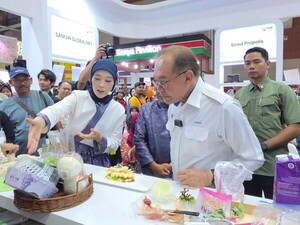
Malaysian Prime Minister Anwar Ibrahim visited the NEXT K-Food section of the pavilion on the final day of the exhibition and reviewed products including halal beverages. His visit gave the campaign additional visibility in Malaysia, where halal compliance is essential for reaching much of the domestic consumer market and can also support access to buyers serving other Muslim-majority countries.
The South Korean government views Malaysia as a strategic base for entering a global Muslim consumer market estimated at 2 billion people. Ambassador Yeo Seung-bae said the embassy would actively support wider local distribution of competitive Korean halal food. aT said it plans to continue identifying promising export products that reflect local consumption trends and to strengthen market-specific promotional activity across ASEAN.
Consumer research to guide localization
The MAHA campaign was also designed as a market-testing exercise rather than solely a product showcase. aT conducted about 3,000 consumer surveys focused mainly on products that have not yet entered Malaysia at scale. The agency intends to use the responses on taste and purchasing interest to guide product localization and future export planning.
That research could help exporters determine which flavors, formats and product categories merit further investment before committing to broader distribution. Halal certification provides market access, but commercial expansion will also depend on whether products meet local preferences, pricing expectations and retail requirements. For Korean manufacturers, Malaysia offers a setting in which certification, consumer demand and buyer interest can be assessed together.
The campaign included consumer-facing promotion by Durian Kimchi, a Korean-Malaysian married influencer duo appointed as ASEAN K-Food honorary ambassadors by South Korea’s agriculture ministry. Their dessert cooking show demonstrated ways to use Korean food products beyond their original formats. The mix of tastings, product demonstrations, surveys and buyer exposure reflects South Korea’s attempt to build demand for a wider export portfolio rather than rely only on the international popularity of noodles and snacks.