South Korea Expands Strawberry Vertical-Farm Support in the Middle East
South Korea’s Rural Development Administration has expanded support for strawberry vertical-farm exporters from five companies in 2025 to seven in 2026. The program combines controlled-environment cultivation with bumblebee pollination research and AI-assisted hive management.
Export support expands to seven companies
South Korea’s Rural Development Administration has increased the number of companies receiving support for strawberry vertical-farm exports to the Middle East from five in 2025 to seven in 2026, a 40% rise. The program is designed to help Korean suppliers establish controlled-environment production systems in a region where high temperatures and dry conditions make conventional cultivation of fresh produce difficult.
The agency is coordinating the initiative through its vertical-farm technology export task force. Its work extends beyond installing growing facilities: participating companies receive support intended to help them produce strawberries consistently after deployment. The assistance covers variety selection, seedling production, pollination, nutrient-solution management, environmental controls and day-to-day crop management.
AI and bumblebees enter the production system
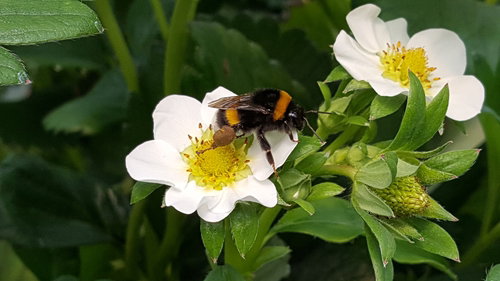
Research from South Korea’s National Institute of Agricultural Sciences is expected to be introduced progressively at overseas projects. Current work includes the use of bumblebees to pollinate strawberries inside enclosed vertical farms, the conditions required for effective pollination and the selection of suitable lighting. Researchers are also developing AI-based technology for automated hive management.
Pollination is a practical constraint for indoor strawberry production because enclosed facilities cannot depend on naturally occurring insect activity. Integrating managed bumblebee colonies with lighting and climate controls could therefore affect fruit formation, crop consistency and labor requirements. The source did not provide commercial yield, investment, capacity or export-value figures for the supported projects, and it did not identify the individual Middle Eastern countries or participating companies.
Focus shifts from equipment to reliable output
The Rural Development Administration plans to assign dedicated specialists to individual exporters and maintain an online response system. These teams will address problems such as introducing new strawberry varieties, applying bumblebee pollination under local conditions and accelerating technical support. This approach reflects the complexity of transferring an agricultural production system rather than exporting standalone hardware.
Choi Kwang-ho, director general of the agency’s Technology Cooperation Bureau, said a vertical-farm export is complete only when the facility can produce agricultural goods reliably at its destination. For Korean suppliers, that makes cultivation protocols, biological inputs and remote operational support part of the commercial offering. For Middle Eastern growers and investors, the program provides access to a production model that precisely manages temperature, humidity, light and nutrients despite an arid external climate. Its commercial significance will ultimately depend on whether the seven supported companies can convert technical deployment into stable output at costs acceptable to local buyers.