South Africa’s strawberry sector produces 33,000 tonnes at high cost
South Africa produces an estimated 33,000 tonnes of strawberries a year on roughly 740 hectares, according to Farmer’s Weekly. Establishment costs can reach R2 million per hectare, while labour may account for as much as 45% of growers’ costs.
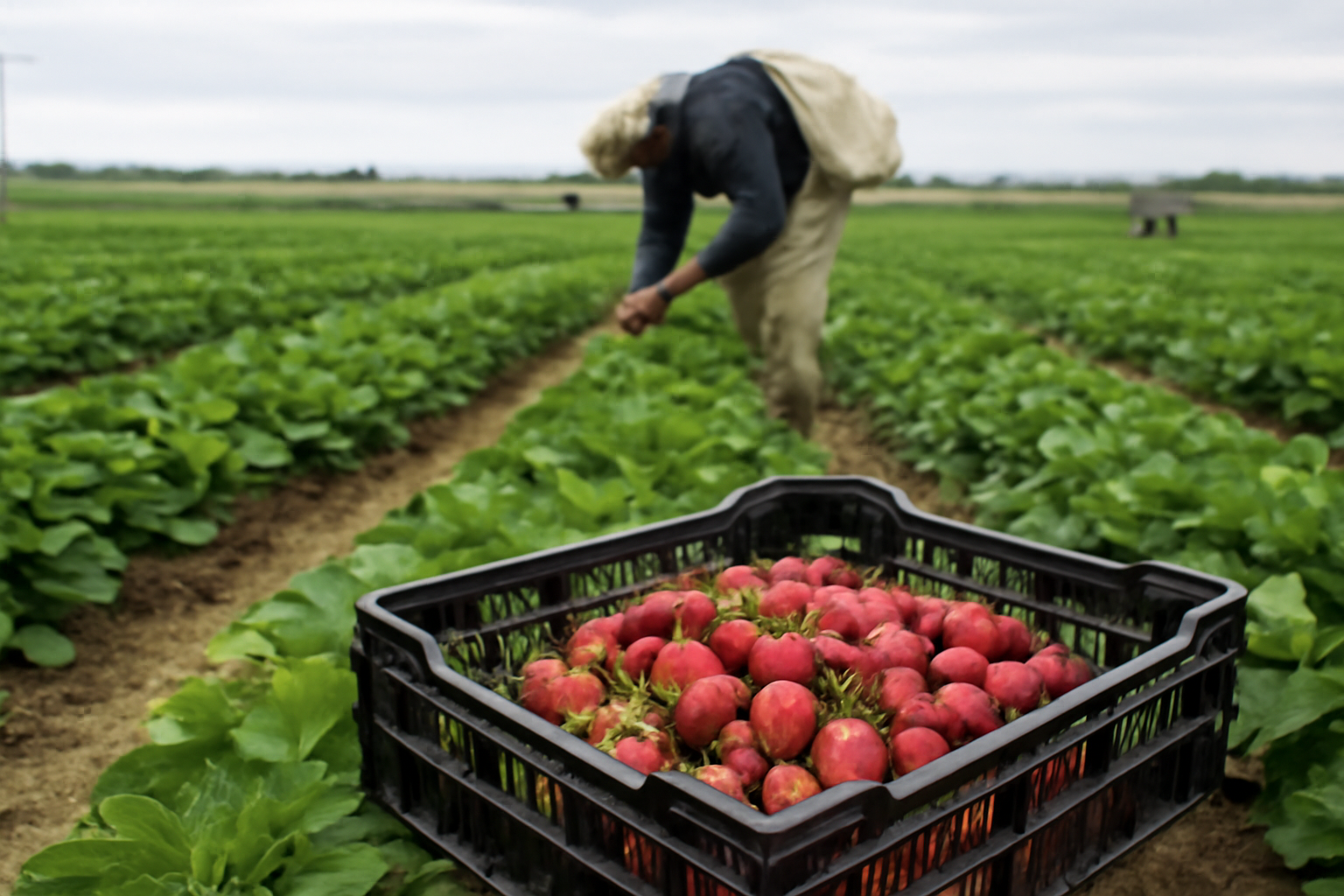
A compact, high-value industry
South Africa’s strawberry industry produces an estimated 33,000 tonnes annually from around 740 hectares, according to Farmer’s Weekly. The figures describe a relatively compact horticultural sector with substantial output concentrated on a limited cultivated area. Dividing the reported production by the reported area gives an indicative average of about 44.6 tonnes per hectare, although actual yields will vary among farms and seasons.
The sector’s economics are shaped by the high value of its crop and the considerable cost of establishing and operating strawberry farms. Farmer’s Weekly reports that establishment expenditure can reach R2 million per hectare. Applied across the reported area only as a measure of scale, that upper-end rate would represent R1.48 billion. It is not an estimate of actual industry investment, because individual farms may have very different establishment costs.
Capital and labour requirements
An establishment cost of up to R2 million per hectare creates a significant entry barrier. Producers must commit substantial capital before earning revenue from the crop, making farm planning, financing and cost control central to commercial viability. The burden is especially relevant for new growers and businesses expanding their planted area, as the investment rises directly with every additional hectare.
Labour is another defining expense. According to Farmer’s Weekly, it can account for as much as 45% of costs. That exposure means changes in wages, worker availability and operational efficiency can materially affect margins. Strawberry production therefore has a different cost profile from less labour-intensive field crops: its value is generated on a small land base, but capturing that value requires substantial spending and close management.
The labour share also affects how producers assess expansion. Adding hectares increases potential output, but it also expands staffing requirements and the capital exposed to the crop. For processors, buyers and other market participants, these economics help explain why supply cannot necessarily respond quickly to stronger demand. Additional production requires more than available land; it depends on financing and the capacity to manage a labour-heavy operation.
What the figures mean for the market
At the reported national scale, every hectare represents roughly 0.14% of the industry’s planted area. That concentration makes individual investment and production decisions relevant to aggregate supply. A grower adding or removing a meaningful block of hectares can have a visible effect in a sector covering only around 740 hectares.
The available figures also show why revenue alone is an incomplete measure of performance. Strawberries may generate high value, but producers must recover establishment spending and absorb a cost structure in which labour can approach half of total expenditure. Profitability therefore depends on the relationship between yield, realised prices and disciplined operating costs rather than crop value in isolation.
For investors and lenders, the central question is whether projected farm income can support the upfront cost and continuing labour bill. For growers, the same numbers place productivity and cost management at the centre of competitiveness. South Africa’s strawberry sector is small by cultivated area, but its estimated 33,000-tonne output and high capital intensity give it considerable economic weight per hectare.