Russian strikes disrupt Ukrainian retail logistics but nationwide food shortage is unlikely
Russian strikes on major distribution facilities have caused temporary gaps on supermarket shelves, particularly in Kyiv. Retailers are rerouting supplies, while industry representatives expect disruptions to ease within two to four weeks.
Distribution centers hit in coordinated attack
Russian strikes on August 5 damaged infrastructure used by several of Ukraine’s largest retailers and logistics companies, interrupting deliveries and leaving visible gaps on some supermarket shelves. RFI Ukrainian reported that a Novus logistics center stopped operating and two Silpo distribution centers caught fire. Production and logistics facilities belonging to Epicentr, a ROZETKA warehouse complex and a Nova Poshta sorting center were also targeted that day.
The disruption has been most apparent in Kyiv, where the damaged warehouses and distribution centers primarily served the capital region. Mykhailo Nepran, first vice-president of the Ukrainian Chamber of Commerce and Industry, told RFI Ukrainian that shortages within Kyiv were concentrated at businesses belonging to Fozzy Group—including Silpo, Fora, Thrash! and Fozzy Cash & Carry—and at Novus. Other chains were generally operating normally.
Cold-chain products have been particularly affected because dairy, meat, fruit and other perishable goods depend on temperature-controlled storage and frequent deliveries. A Kyiv resident interviewed by RFI Ukrainian said that on August 14 her local ATB had no flour and almost no cereals, although pasta remained plentiful. Canned meat was also difficult to find, while smaller dairy and meat shops and a neighborhood market maintained an adequate range.
Impact varies across cities and retail formats
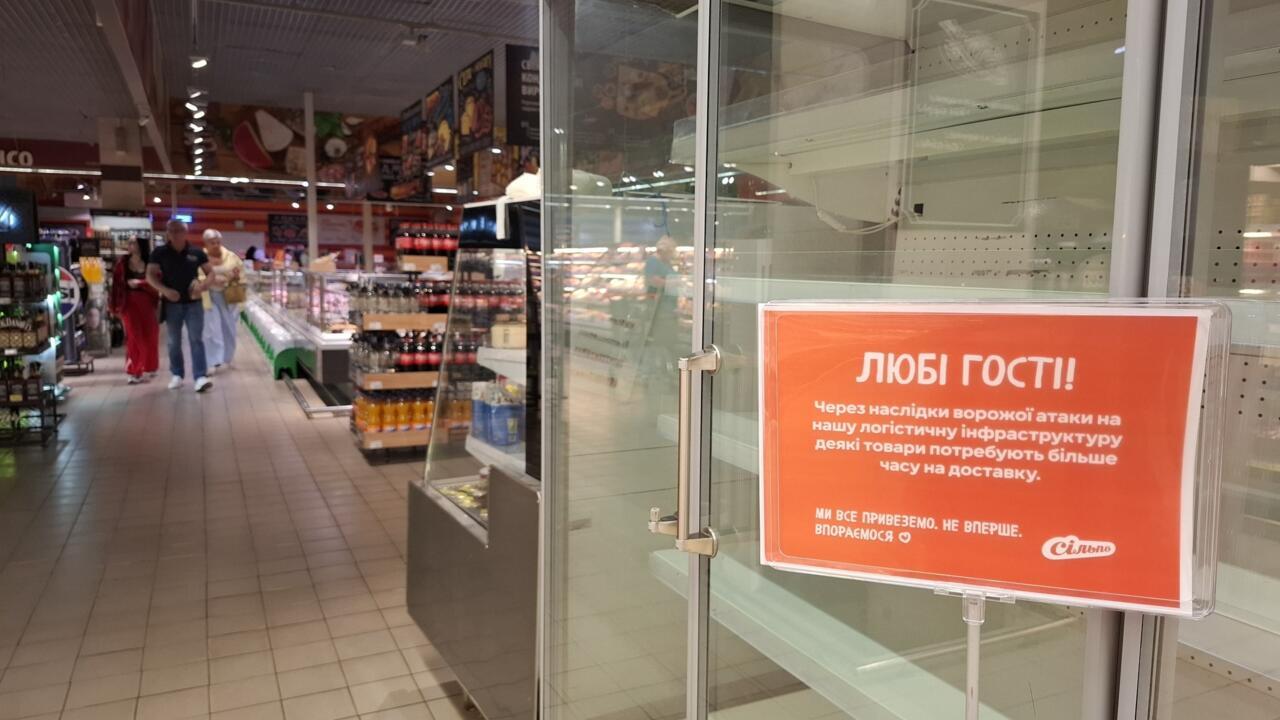
Conditions outside Kyiv are uneven but do not indicate a nationwide breakdown. In Kharkiv, national retailers compete with local grocery chains, helping to preserve the overall assortment. An RFI Ukrainian journalist nevertheless saw empty refrigerators in one Silpo store on August 13, where a notice warned that some products would take longer to arrive because of damage to the company’s logistics infrastructure. Fruit, vegetables and dry staples remained broadly available.
Residents of Sumy reported empty shelves in some supermarkets and purchases of several packs of flour, oil and sugar. Food gaps were also observed in Zaporizhzhia, although residents later reported that normal volumes were returning. In Odesa, availability remained broadly normal, but consumers complained about higher prices. One resident cited grapes at 120 hryvnias per kilogram and tomato paste at more than 30 hryvnias, compared with up to 20 hryvnias previously; these observations were not presented as national price data.
Retailers have reserve routes, alternative suppliers and contingency logistics developed since 2022, according to Andrii Zhuk, head of the Ukrainian Retailers Association. Companies are already arranging direct deliveries from producers where possible. Nepran expects chains to resolve the main interruptions within two to three weeks or, at most, one month.
Domestic supply limits shortage risk, but costs may rise
Nepran said 80% of food sold in Ukraine, particularly essential products such as cereals, canned food, sugar, salt, vegetables and fruit, is produced domestically. This production base, combined with alternative retailers and smaller stores, reduces the likelihood that damage to several centralized warehouses will become a national food shortage. If individual products become unavailable, supplies could also arrive from Poland, the Czech Republic, Slovakia, Romania and Hungary.
Prices remain the larger risk. Logistics represents 10% to 12% of food costs depending on the product, although Nepran stressed that this does not imply an automatic price increase of the same size. Falling seasonal prices for vegetables, fruit and berries could offset part of the additional distribution expense. Imported wine, cognac, premium cheese, caviar, citrus fruit and sea fish face greater upward pressure.
The attacks may also change retail investment and warehouse planning. Repeated strikes favor additional routes, dispersed inventories and smaller outlets that are less dependent on a single large distribution hub. Major chains are expected to remain central to Ukrainian retail, but the latest damage shows that logistics redundancy—not aggregate food production—is now the immediate constraint on shelf availability.