Russian Poultry Prices Up More Than 15% as Producers Pass On Higher Costs
Chicken prices in Russia rose 15.8% year on year in August 2026 and turkey 15.1%, according to Rosstat data cited by Kommersant. The Agriculture Ministry said on 22 September that prices are correcting after a long period at relatively low levels, reflecting accumulated production costs. Output in agricultural organisations reached 4.4 million tonnes in live weight over January-August.
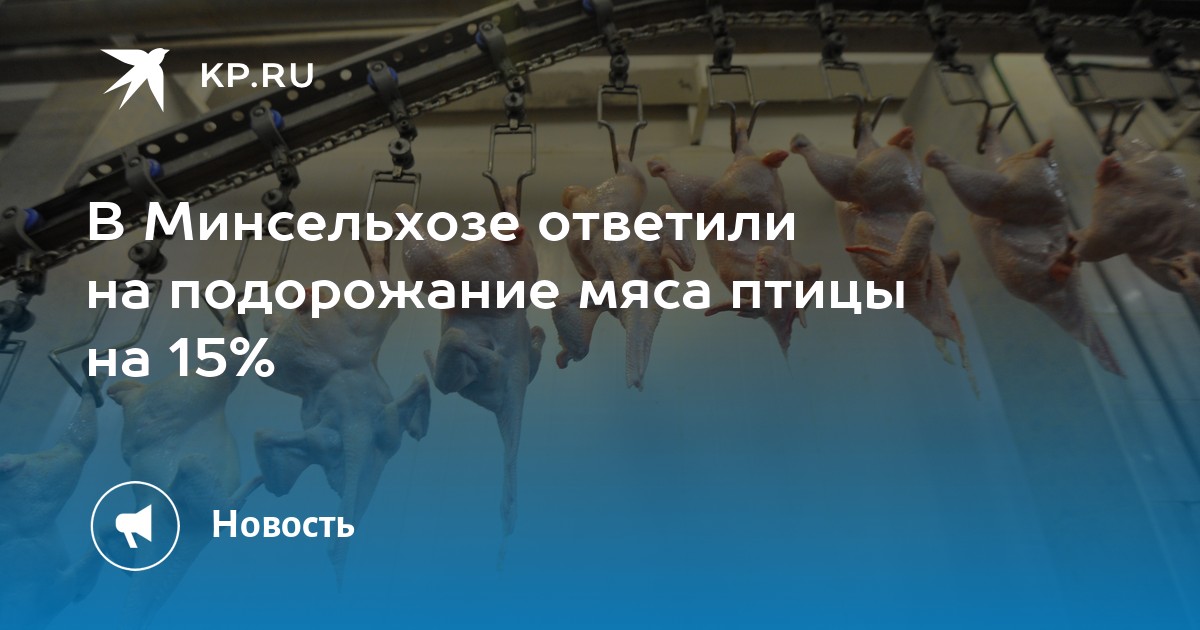
Price growth for poultry meat in Russia accelerated in August 2026, with chilled and frozen chicken rising 15.8% year on year and turkey 15.1%, according to Rosstat data cited by Kommersant and Rosbalt. Russia's Ministry of Agriculture responded on 22 September, describing the move as a correction after a prolonged period of relatively low prices rather than a supply problem.
Ministry points to accumulated production costs
“Wholesale price dynamics largely depend on changes in production costs and market conditions. At the same time, poultry meat prices remained at a relatively low level for an extended period. They are currently being corrected in view of the accumulated increase in production costs,” the ministry said in a statement carried by TASS, Interfax, Kommersant and KP.RU.
The ministry added that high competition and significant installed production capacity are keeping supply on the domestic market stable. Poultry enterprises are working steadily, raising operating efficiency and containing cost growth, and fully cover domestic demand with the volumes required, according to the statement reported by MK.RU. The ministry framed the price move as a response to costs already absorbed by producers over previous periods, not a signal of tightening availability.
Rosbalt attributed the acceleration to higher producer spending on feed, logistics and other production costs. Neither the ministry nor the publications quantified the individual cost components.
The numbers behind the move
Kommersant reported that the average retail price of chilled and frozen chicken reached 263.6 roubles per kilogram in August 2026, up 15.8% from a year earlier. Turkey, a smaller but faster-growing segment of the Russian poultry market, rose 15.1% over the same period, Rosbalt reported. The key figures on the record:
- Chicken, chilled and frozen: 263.6 roubles per kilogram in August 2026, up 15.8% year on year (Kommersant, citing Rosstat)
- Turkey: up 15.1% year on year in August 2026 (Rosbalt, citing Rosstat)
- Poultry output in agricultural organisations: 4.4 million tonnes in live weight for January-August 2026 (Rosstat)
Output holds while margins reset
The 4.4 million tonnes produced by agricultural organisations between January and August underpins the ministry's argument that the price move is cost-driven rather than volume-driven. Poultry is one of the core branches of Russian agriculture and the country's most affordable mass-market source of animal protein, MK.RU noted, with the state supporting producers through various subsidy mechanisms intended to keep supply stable and constrain domestic price formation.
Russian output is also large enough to serve export markets alongside domestic demand. KP.RU reported that producers are able both to fill the domestic market with poultry and to ship it abroad, and referred to recent deliveries of poultry meat to Qatar; the volume of those shipments was not disclosed in the material reviewed.
Poultry inside a broader price picture
The increase is not isolated. Rosbalt reported that prices for eggs, cereals, meat, margarine and petrol continued to rise in September. For consumers, poultry remains the cheaper protein: MK.RU noted that Russians have been eating more poultry in place of beef and pork, a substitution pattern that gives processors and retailers more room to pass costs through before demand reacts.
That combination — steady volumes, sustained substitution demand and a cost base that producers say has been accumulating for several periods — is the central tension in the market now. The ministry's position is that the correction realigns prices with production economics after years in which poultry lagged. Whether the pass-through continues into the autumn will depend on feed costs and on how far competition among producers, which the ministry cites as a stabilising factor, limits further increases.