Russian confectionery export revenue rises 12% to $1.1 billion
Russia exported more than 315,000 tonnes of confectionery worth $1.1 billion in the first seven months of 2026. Revenue increased by 12%, led by chocolate products and stronger sales to Kazakhstan, Belarus and Uzbekistan.
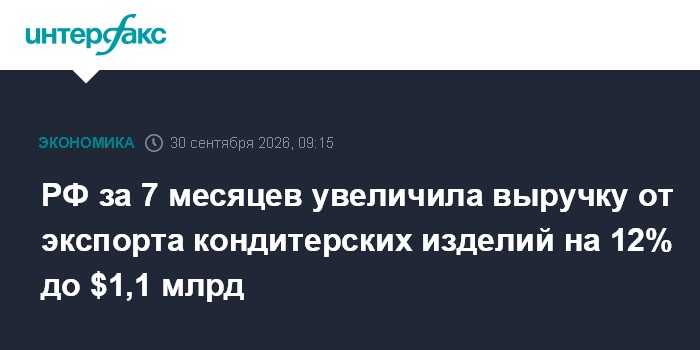
Export revenue reaches $1.1 billion
Russia exported more than 315,000 tonnes of confectionery products in the first seven months of 2026, generating $1.1 billion in revenue. The value of shipments increased by 12% from the same period of 2025, Interfax reported, citing expert estimates provided by the federal Agroexport center. Agroexport did not disclose a year-on-year comparison for export volume, making it unclear how much of the revenue growth came from higher physical shipments and how much reflected changes in prices or the product mix.
The result continues a longer expansion of Russia’s confectionery business abroad. According to Agroexport, the country’s confectionery exports increased 1.5-fold over the past five years and exceeded $2 billion in 2025. The center estimates that annual exports could grow by another third to $2.8 billion by 2030, provided global demand remains supportive and Russia’s domestic confectionery industry continues to develop.
Chocolate remains the largest export category
Chocolate confectionery accounted for the largest share of revenue, with shipments worth $510 million, up 13% year on year. Exports of flour-based confectionery and bakery products increased by 10% to $465 million. Sugar confectionery generated $149 million, representing the fastest growth among the three main categories at 15%.
The figures show a relatively balanced export portfolio, although chocolate alone generated close to half of total confectionery revenue. Flour-based goods and bakery products were only slightly behind. Sugar confectionery remained the smallest category by value, but its higher growth rate indicates that it is gaining ground within the export mix.
Kazakhstan and Belarus dominate purchases
Kazakhstan was the largest buyer, receiving Russian confectionery worth $372 million, 20% more than a year earlier. Belarus ranked second with purchases of $271 million, up 18%. Together, the two markets represented well over half of the reported $1.1 billion in export revenue, underlining the importance of neighboring markets and established regional distribution networks for Russian producers.
Agroexport said Kazakhstan remained the leading importer of Russian flour-based confectionery and chocolate, while Belarus was the largest buyer of Russian sugar confectionery. Uzbekistan completed the top three: shipments to the country reached $87 million, an increase of 17% compared with the same period of 2025.
Russian producers supplied confectionery to more than 90 countries during the period. The fastest-growing destinations included Kuwait, where sales tripled; Afghanistan, where they increased by more than 1.5 times; Armenia, with growth of 23%; and Vietnam, with 22%. The source did not provide the absolute value of exports to these four markets, so their contribution to the overall increase cannot be quantified.
Producers seek expansion in Asia and the Middle East
United Confectioners, a holding company comprising 16 enterprises and ranked among the world’s top 20 confectionery companies, is one of Russia’s major exporters. About 12% of its sales volume is shipped abroad. Its export network covers more than 50 countries across the Commonwealth of Independent States, Asia, the Middle East, Africa and Latin America.
The company adapts its assortment for overseas markets and has obtained international halal and kosher certification for products popular in relevant destinations. Alexey Nosenko, a department head at the holding, identified Asian markets, China and the United Arab Emirates among the priority areas for further growth. The company is also considering cooperation with Russian marketplaces and the possible opening of a pilot Alenka-branded confectionery store in neighboring countries.
For manufacturers, the latest figures show that nearby markets still provide the scale, while destinations in Asia and the Middle East offer additional growth. Reaching Agroexport’s $2.8 billion target will depend on converting rapid percentage gains in newer markets into substantial sales without losing momentum in Kazakhstan, Belarus and Uzbekistan.