Russia’s record pea harvest pushes prices down 40% as stocks overwhelm demand
Russia’s 5.7 million-tonne pea harvest exceeded domestic and export demand, sending producer prices down 37–40% and leaving stocks in storage. Rising shipments to China and a weaker global crop outlook could help clear the surplus, but carryover stocks, port constraints and the strong ruble will continue to pressure margins.
Record crop creates a domestic surplus
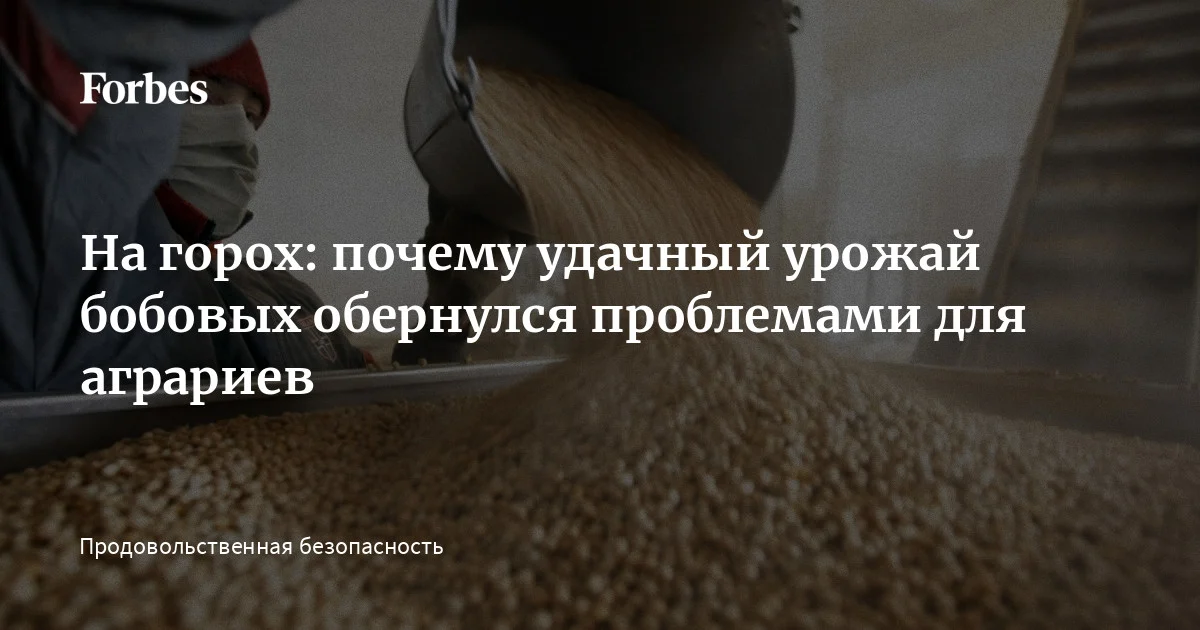
Russia’s unexpectedly large pea harvest has turned a profitable crop into a storage and marketing problem for farmers. According to Forbes Russia, the country harvested 5.7 million tonnes last year, 50% more than the 3.8 million tonnes collected in 2024. Producers could not sell the entire crop, while domestic buyers delayed purchases in anticipation of abundant supplies.
The surplus drove producer prices down by 37–40%, according to Vladimir Poklad of Delovoy Profil. Peas that traded at 22,000–26,000 rubles per tonne at the beginning of the season fell to 15,000–16,000 rubles by its end. Farmers also incurred storage costs because part of the previous crop remains in warehouses. Peas are now trading below wheat prices, according to Zemlitsa chief executive Natalia Zgurskaya.
Exports rise but logistics and currency limit returns
Russia exported more than 1.3 million tonnes of pulses in the first half of 2026, excluding June data for Eurasian Economic Union countries, according to the Federal Agroexport Center. Volume increased 8% year on year. China accounted for 56% of shipments, Turkey for 15% and Pakistan for 10%.
Pea deliveries to China rose 85% in the first half of 2026. However, Oleg Nikolaev of the Stolypin Institute for Growth Economics said Russia shipped 2.3 times as much pea to China while revenue increased by less than 100%, indicating a lower unit price. Sales are also constrained by restrictions at the ports of Rostov and Azov, the concentration of flows through Novorossiysk, and a strong ruble. A 5% export duty, in effect since January 1, 2025, further reduces margins when prices are weak.
Smaller global crop may help absorb stocks
The International Grains Council expects global pea production to fall by almost 14% this season to 15.7 million tonnes. Canada, one of Russia’s main competitors, harvested about 4 million tonnes last year but may produce less than 3 million tonnes this year because of adverse weather, according to early forecasts cited by Forbes Russia. The European Union is also expected to prioritize its own requirements, although Canada retains substantial carryover stocks.
Russia’s share of global pea production rose from 6% to 10% last year. The country’s export opportunity is therefore expanding just as its warehouses need relief. Exports of all pulses in the new season could exceed last year’s 3 million tonnes, but large carryover stocks are expected to restrain prices for at least the first half of the agricultural year.
Planting decisions reflect weaker profitability
The Agriculture Ministry’s forecast balance places Russia’s total pulse area in 2026 at about 4 million hectares or less, compared with 4.1 million hectares a year earlier. Poklad expects peas to occupy 2.2 million hectares, unchanged from last year, while Ruseed estimates about 1.85 million hectares. Peas’ share of pulse planting declined from 67% in 2020 to 54.9% in 2025.
If weather is close to long-term averages, Russia could harvest 4.1–4.2 million tonnes of peas in 2026, according to Ruseed analyst Margarita Svishcheva. That would be below last year’s record but remain historically high. With the Agriculture Ministry forecasting a total pulse crop of 7.5 million tonnes or more, export growth will be essential to prevent another accumulation of stocks.