Russian Fish Exports Up 71% in a Decade as Global Seafood Trade Nears $186 Billion
Exports of frozen and chilled fish from Russia rose 71% in value over ten years against 50% growth worldwide, the Fish Union said at the International Fishery Forum in St Petersburg. Russia remains fourth in the world by export volume but only 14th by export value. Global fish and seafood output has reached a record 235 million tonnes, with international trade approaching $186 billion.
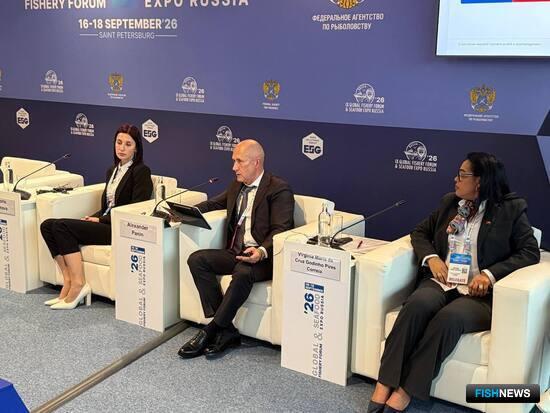
Exports of frozen and chilled fish from Russia increased by 71% over the past ten years, while the comparable global figure grew by 50%, said Alexander Panin, chairman of the Fish Union, at the International Fishery Forum and Seafood Expo in St Petersburg. TASS reported his remarks from the forum on September 16. Fishnews, which covered the same round table, specified that the comparison is made in value terms.
The session was built around data from the FAO report on the state of world fisheries and aquaculture. Global fish and seafood production has reached a record 235 million tonnes, and the value of international trade has approached $186 billion, Rossiyskaya Gazeta reported. Trade in fish and seafood is now comparable in value with trade in meat, a market conventionally regarded as the larger of the two.
Russia outgrows the global market in every category
The Fish Union compared ten-year growth in export value by product group. In each of the three groups cited, Russian shipments expanded faster than the world average:
- frozen and chilled fish — 71% in Russia against 50% worldwide;
- canned products — 83% against 51%;
- products from crustaceans and molluscs — 66% against 29%.
In aggregate, Russian fish and seafood exports in value terms added 74% over the decade, against 47% on average for the world, according to Fishnews. The structural backdrop is a steady rise in the share of output that crosses borders: about 36% of all fish caught and farmed is now exported, compared with 25% in the mid-1970s. Export value has grown 23-fold since 1976.
Fourth by volume, fourteenth by value
Russia ranks fourth in the world by the weight of fish exported, but only 14th by the value of those exports. “And this is a real reserve for growth,” Panin said.
The gap is explained by the product mix. The leading items in Russian exports are crab, frozen pollock, cod, pollock fillet, roe and milt. The categories that dominate world trade are shrimp, salmon and salmon fillet, with salmon emerging as the most valuable species on the market by trade value. “It means we play in our own niches, and we play strongly,” Panin said.
Prices rise faster than volumes
The price per kilogram of Russian export products rose 54% over the ten-year period, while the global average increased by 20% — a figure that is below accumulated dollar inflation, according to Fishnews. That divergence means Russian suppliers captured real price gains over the decade, while the average exporter worldwide did not keep pace with the depreciation of the currency in which the trade is settled.
Panin also addressed the importance of diversifying the geography of shipments and the role of aquaculture in global growth in fish and seafood production. Aquaculture accounts for the bulk of the increase in world output reflected in the record 235 million tonnes cited at the forum.
“The world fish market is rising in price faster than it is growing in volume. Competition for quality fish and seafood will only intensify, and in this race Russia is not catching up — it is running in the leading group,” Panin concluded. Rossiyskaya Gazeta, reporting on the same discussion, noted that Russia remains a major player in world trade.