Rungis market and Dunkirk port plan rail link for fruit and vegetable freight
Paris’s Rungis wholesale market has signed an agreement with Dunkirk, France’s leading agrifood port, to develop a rail freight link for fruit and vegetables. The project is intended to reduce reliance on trucks by creating a new logistics hub between the port and the fresh produce market.
Agreement targets a new produce corridor
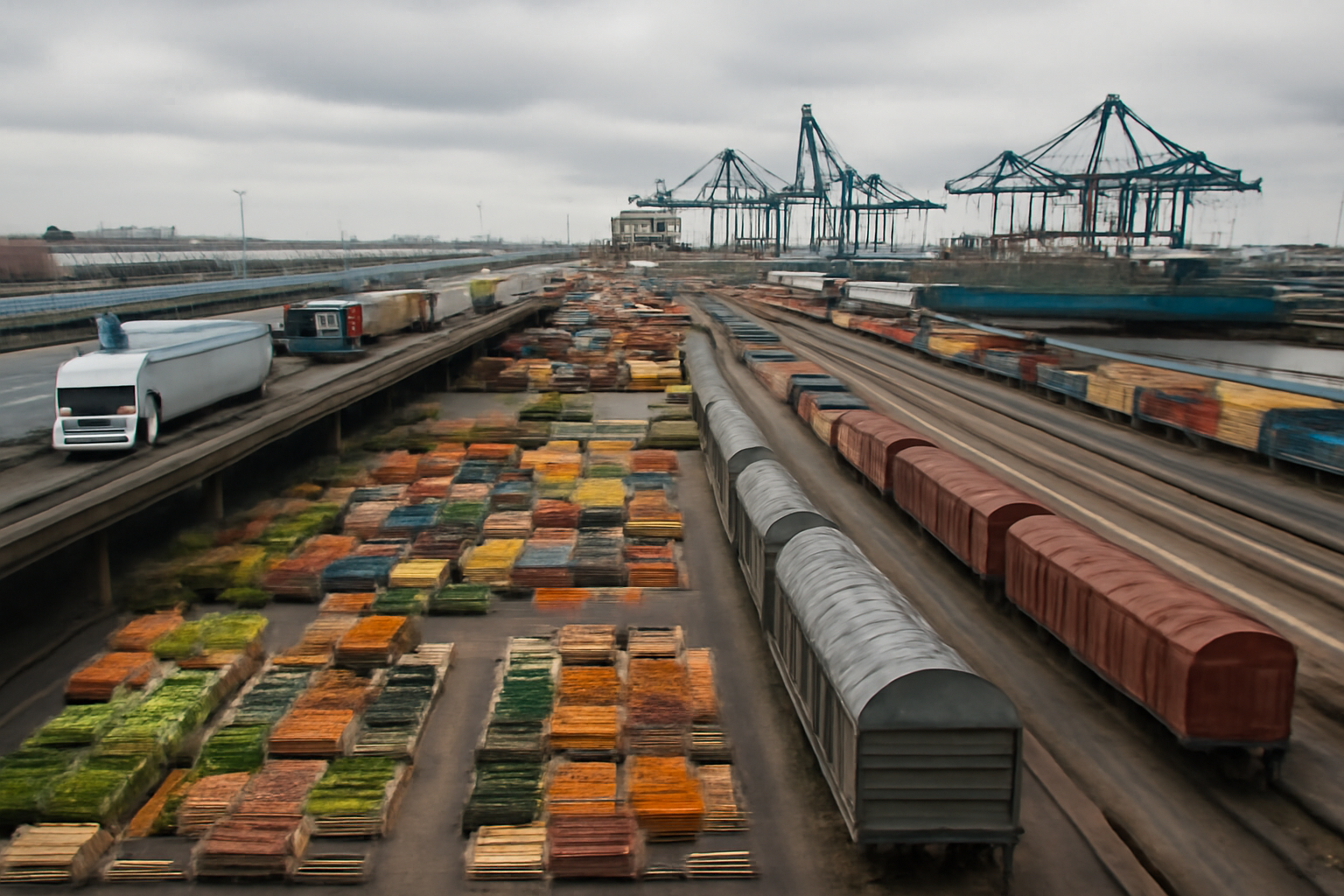
Paris’s Rungis wholesale market is working with the port of Dunkirk to establish a rail freight connection for fruit and vegetables, according to Le Parisien. The two organizations have signed an agreement covering the creation of a logistics hub linking Europe’s largest fresh produce market with France’s leading agrifood port.
The planned service would give companies handling produce through Dunkirk an alternative route to the Rungis market, which serves as a major distribution point for fresh food. The central objective is to reduce the logistics chain’s dependence on road transport. The available announcement does not specify a launch date, planned train frequency, cargo capacity, investment amount or the companies expected to operate the service.
Dunkirk gains a route to a major consumption center
For Dunkirk, the agreement could strengthen the port’s role beyond the handling of agrifood cargo by adding an inland distribution connection to the Paris region. A functioning rail corridor would allow fruit and vegetable shipments arriving at the port to move toward Rungis in consolidated loads instead of relying exclusively on individual truck movements.
Rungis, meanwhile, would gain another logistics option for supplying wholesalers and other market operators. Fresh produce requires tight control of transit times, handling and temperature, so the commercial value of the project will depend on whether the partners can offer a reliable schedule and suitable facilities at both ends. Those operational details were not included in the information reported by Le Parisien.
Rail must compete on reliability and handling
The agreement marks the start of a logistics development process rather than the opening of an operating service. The next practical questions concern cargo consolidation, terminal handling and the transfer of produce between port facilities, trains and the market. Rail economics generally depend on grouping sufficient volumes, while fruit and vegetable buyers require predictable delivery windows because product quality can deteriorate during delays.
If implemented, the link would not necessarily eliminate trucks. Road transport would still be required for collection, final distribution or shipments that do not fit the rail schedule. Its main effect would be to shift the long-distance segment between Dunkirk and the Paris market onto trains, while trucks could concentrate on shorter journeys at either end.
Key commercial terms remain open
The convention gives the partners a framework for developing the hub, but the reported material provides no volume targets or timetable. It also does not identify which fruit and vegetable categories would use the route, where the rail terminal would be located or how refrigerated cargo would be handled. These points will determine which importers, wholesalers, logistics providers and producers can use the service.
For market participants, the project’s significance will therefore depend on execution. Regular departures, competitive costs and dependable cold-chain handling would make the corridor relevant to produce companies using Dunkirk. Without disclosed capacity and service commitments, however, the agreement should currently be viewed as a plan to diversify access to Rungis rather than a confirmed change in existing freight flows.