Qasr-e Shirin emerges as Iran's new date export hub with 950 hectares planted
Date palm plantings in Iran's Kermanshah province have reached 950 hectares, almost all of them in the border county of Qasr-e Shirin, with this season's harvest forecast at about 4,500 tonnes. Provincial officials plan to add 600 hectares this year and 3,000 hectares within two years, shifting the variety mix toward Medjool for export. The absence of local sorting and packing capacity remains the main constraint.
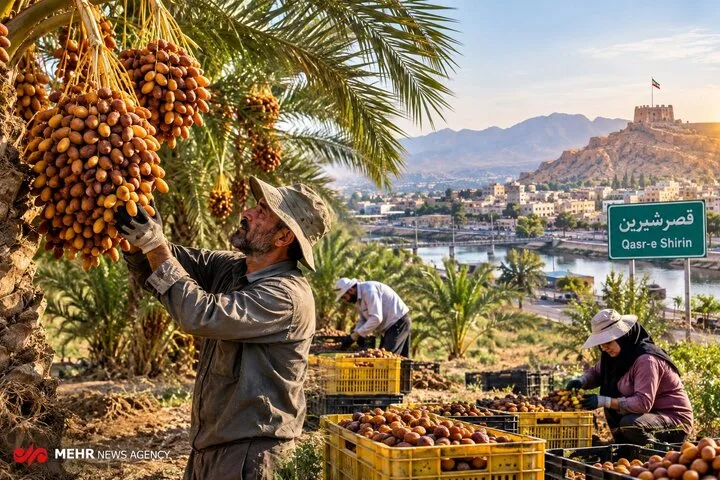
Date palm plantings in Iran's Kermanshah province have reached 950 hectares, with this season's harvest forecast at about 4,500 tonnes, Mehr News Agency reported, citing the provincial Agricultural Jihad Organization. Almost the entire area is concentrated in the border county of Qasr-e Shirin, which the agency described as the main date-producing centre in the west of the country.
Water transfer turns a border district into palm country
Qasr-e Shirin and the neighbouring areas of Sumar and Naft-Shahr lie in a hot lowland pocket on the western edge of the Zagros. According to Mehr, the rollout of the Garmsiri warm-zone water scheme has brought a stable supply to these districts and has made date palm development one of the main drivers of orchard expansion across Kermanshah province.
The agency said the potential of the area had previously been overlooked because of water scarcity, and that new irrigation technology combined with large-scale investment has turned the local climate into a competitive advantage. Farhad Sharifi, deputy for crop production at the Kermanshah Agricultural Jihad Organization, told Mehr that the highest development potential for the crop has been identified along the border strip covering Qasr-e Shirin, Sumar and Naft-Shahr.
Variety mix moves from Zahedi toward Medjool
Sharifi said the planting pattern has changed significantly. Zahedi and Ashrasi historically accounted for most of the province's date area, while Piarom and Rabbi have been established successfully over the past several years. The current programme of the Agricultural Jihad Organization is focused specifically on the commercial Medjool variety, which officials want to use to win a share of global markets.
Rahman Feyz-Qorbani, horticulture director at the same organization, said Medjool is the principal variety being planted in the new modern groves, describing it as meeting the highest export standards and ranking among the best and most productive varieties worldwide. Mehr reported that the Medjool push is aimed at European markets and the Persian Gulf states.
Investors move in behind a fourfold expansion target
Mehr identified Mahan Company, the Isargaran group and the Awqaf endowments organization among the investors establishing modern date groves in the area. Both officials cited the same expansion schedule:
- 950 hectares currently under date palms in Kermanshah province, almost all of it in Qasr-e Shirin
- 600 hectares of additional planting during the current year
- 3,000 hectares of additional planting targeted over the next two years
Feyz-Qorbani said date palm development is one of the central components of the province's orchard programme and that the pace of the rollout reflects a serious push to change the region's agricultural profile. He added that, given the crop's suitability to the local climate and the stable water supply from the Garmsiri scheme, there is no constraint on further expansion in the province's warm-zone districts. Officials also framed the programme as a tool for retaining the border population, creating employment and generating foreign-currency earnings.
Processing gap keeps value outside the county
Sharifi named high orchard establishment costs, the absence of suitable processing industries and insufficient access to finance for growers as the main obstacles. He said most of the current crop is consumed within the province, with only the surplus shipped to other provinces. The stated objective is to export Medjool once the variety is widely established, with officials projecting that Kermanshah will become the country's main date production and export centre within a few years.
The Mehr report argued that quantitative expansion of the groves needs to be matched by downstream capacity, calling on the Agricultural Jihad Organization, the provincial industry and trade directorate and other economic bodies to enable a specialised date processing, sorting and modern packaging complex in Qasr-e Shirin through dedicated credit facilities, tax exemptions and land allocation. Without it, the report said, the margin from the crop will continue to accrue to intermediaries rather than to local growers, and the Qasr-e Shirin date brand will struggle to reach global markets with standardised packaging.