Preservation technology extends the reach of Vietnamese fruit exports
Vietnamese exporters are combining heat treatment, cold storage, irradiation and ethylene removal to extend fruit shelf life and meet import standards in distant markets. The opportunity remains constrained by post-harvest losses of 20–25% and uneven technology adoption across the supply chain.
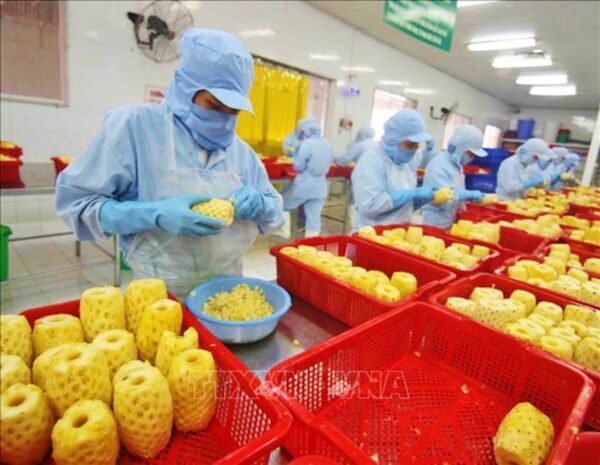
Technology opens more distant markets
Vietnamese fruit exporters are investing in integrated post-harvest systems to preserve quality during longer journeys and meet the technical requirements of high-value markets. According to Vietnam News Agency's Happy Vietnam, these systems combine cleaning, heat treatment, cold storage, irradiation and control of the gases that accelerate ripening. The objective is to reduce losses while giving exporters more time to reach buyers in Asia, North America, Europe and Oceania.
Goodlife has used hot-vapour heat treatment since 2012. The company now exports more than 5,000 tonnes of fruit annually, including dragon fruit, mango, coconut and pineapple. Dragon fruit represents more than 80% of its volume, with destinations including Japan, South Korea, the United States, Australia, New Zealand, Canada and Europe. Its facilities use nanoplasma cleaning, Japanese hot-vapour technology for insect control, cold rooms that regulate temperature, humidity and ventilation, and an ethylene-removal system that slows ripening.
Export growth and lower logistics risk
Goodlife Deputy General Director Trần Nguyễn Khánh Vy said the combined technologies stabilize product quality, extend shelf life and create room to develop new markets. The company's export volume is growing by more than 30% a year. It also plans to expand processed products, increasing value added rather than relying only on fresh-fruit sales.
Other supply-chain companies are integrating storage and treatment. Toàn Phát Irradiation said locating cold storage near production areas and combining irradiation and storage at one site reduces transfers, transport time, costs and logistics risks. The model can also support lower-emission logistics. Đặng Phúc Nguyên, secretary-general of the Vietnam Fruit and Vegetable Association, said pomelo can now be stored for as long as 70 days, improving its commercial viability in large, distant markets.
Losses remain a costly constraint
Vietnam's fruit and vegetable exports exceeded $6 billion in the first eight months of 2026, up 24.9% from the same period of 2025, according to Đặng Phúc Nguyên. He linked part of the sector's recent export expansion to improvements in preservation technology. Hoàng Phát Fruit expects monthly exports in the final months of 2026 to reach about 400–500 tonnes to South Korea and Japan, plus 100–200 tonnes to the United States and markets in Oceania.
Technology inside packing and treatment facilities cannot compensate for fruit that has already deteriorated. Hoàng Phát Fruit Commercial Director Nguyễn Nam Phương Thảo said quality must be controlled from the production area because importing markets are tightening pesticide-residue and technical requirements. Coordination with farmers, faster handling and traceability are therefore as important as the equipment used after delivery to a packing house.
The Ministry of Agriculture and Environment estimates Vietnam's post-harvest losses at 20–25% of output, equivalent to $3.5–4.1 billion annually and 12% of agricultural GDP. Lê Minh Hùng, director of the Sub-Institute of Agricultural Engineering and Post-Harvest Technology, said investment has increased and losses have gradually declined, but harvesting still lacks suitable equipment. Varied terrain and climate, fragmented production areas and small farm sizes complicate mechanization.
Vietnam has produced substantial research on post-harvest equipment, but many results remain at small scale. Large export orders require industrial systems that deliver stable performance and acceptable economics. Lê Minh Hùng called for equipment suited to cooperatives and households, capable of operating in orchards or fields, alongside more initial processing near production areas. Closer cooperation among exporters, research institutes, universities and technology centers will determine whether preservation gains can spread beyond leading companies and strengthen the wider agricultural supply chain.