Polish Farmers Withhold Grain as Port Wheat Tops 1,000 zł per Tonne
Wheat at Polish buying points near the Baltic ports has reached and in places exceeded 1,000 zł per tonne, but southern quotations remain far lower and fuel and gas costs are absorbing much of the premium. farmer.pl reports that supply into buying points is minimal as growers delay sales, while Credit Agricole forecasts wheat at about 90 zł/dt by the end of 2026 and 95 zł/dt by the end of 2027.
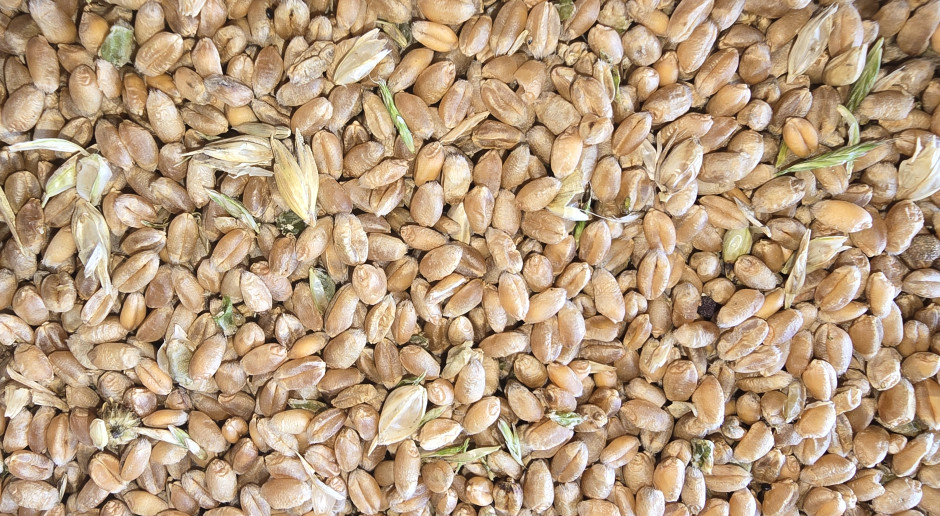
Grain deliveries into Polish buying points have thinned out as farmers delay sales in the expectation of higher prices, farmer.pl reported in its price survey dated 22 September 2026. Wheat in northern regions close to the ports is approaching and in places exceeding 1,000 zł per tonne, while quotations in the south of the country are considerably lower. Growers are asking about prices, the publication notes, but holding back the crop.
Fuel costs split the market by region
farmer.pl attributes the regional gap primarily to fuel prices, which continue to rise and feed directly into the cost of hauling grain to the Baltic terminals. The further a farm sits from a port, the larger the share of the headline price that logistics absorbs.
Timing is the second consideration. Levels quoted this week frequently refer to collection in November, which means payment is deferred as well. Against the previous week the survey shows slight declines of up to 10 zł per tonne. The figures are net prices gathered by telephone from individual buying points and refer mostly to new-crop grain.
Drying bills track gas prices
Oilseeds remain the firmest part of the complex. Sunflower harvesting is being interrupted by rain, and the crop is coming off the field at 11-12% moisture against the 9% required for storage. At current gas prices, removing each percentage point of moisture costs about 30 zł per tonne, a charge that falls directly on the grower and explains the gap between dry and wet maize quotations.
- Wheat: above 1,000 zł per tonne at northern points near the ports, materially lower in the south
- Rapeseed: up to 2,400 zł per tonne
- Soybeans: 1,960 zł per tonne, currently being harvested
- Sunflower seed: 1,920 zł per tonne
- Maize: about 900 zł per tonne dry, about 640 zł per tonne wet
Credit Agricole sees an upward trend into 2027
The autumn 2026 edition of the Agromapa quarterly, prepared by analysts at Bank Credit Agricole, argues that with world stocks declining, prices over the coming quarters will follow an upward trend and remain more sensitive to news on harvest and trade prospects. The bank forecasts Polish wheat at about 90 zł per decitonne (100 kg) and maize at about 80 zł/dt at the end of 2026, equivalent to roughly 900 zł and 800 zł per tonne, rising to about 95 zł/dt and 90 zł/dt at the end of 2027.
For rapeseed, Agromapa puts the purchase price at about 2,350 zł per tonne at the end of 2026 and about 2,450 zł per tonne at the end of 2027. Credit Agricole lists agrometeorological conditions at key producing and exporting countries, further estimates of world oilseed output in 2026/2027, and developments in the Black Sea region and the Middle East as the main risks to both forecasts.
Black Sea disruption points buyers toward EU origins
The trading session of 21 September 2026 brought a clear turn on world agricultural markets, with grain and oilseed futures in Chicago and Paris closing firmly higher after earlier declines, supported by recovering export demand for US grain and uncertainty around the Black Sea. The move came despite pressure from energy: WTI fell 4.51% and Brent 3.40% the same day. Analysts quoted by farmer.pl explain that physical availability, export flows and world demand currently matter more for agricultural quotations than the direction of crude.
Russia and Ukraine are recording high harvests in 2026, but that does not automatically translate into supply reaching the world market, as attacks on port and energy infrastructure and uncertain grain logistics continue to hamper exports. Some importers are consequently turning to the European Union, including Egypt, which is directing wheat inquiries to suppliers such as France, Romania and Bulgaria. The maize balance is a further support: the EU is running a deficit of the grain, while USDA projections point to a global maize shortfall of around 30 mln tonnes, a backdrop that farmer.pl describes as favourable for Polish growers given prospects for the domestic crop.