Philippines targets 150 million kg durian crop as China takes 90% of its exports
The Philippines has about 15,000 hectares under durian and expects roughly 150 million kg in the 2026-2027 season, with 40-50% seen as export grade. China takes around 90% of Philippine durian exports while Philippine fruit holds less than 1% of China's import market.
The Philippines is expanding its durian industry with a push to raise output and widen its export base beyond China, Vietnamese business outlet cafebiz.vn reported. The country has about 15,000 hectares planted to durian and expects production of roughly 150 million kg in the 2026-2027 season — a build-out the publication framed as a new competitor for Vietnamese durian in Southeast Asia.
Output target and a single dominant market
Candelario Banton Miculob, president of the Philippine Durian Exporters Association, said about 40-50% of that volume has export potential, equivalent to some 60 million to 75 million kg on the projected harvest. The remainder would stay in the domestic market.
China is by far the most important destination, taking around 90% of Philippine durian exports. At the same time, Philippine fruit accounts for less than 1% of China's total durian import market. That gap is read in the Philippines as room to grow rather than as a ceiling, but it also underlines how narrow the country's export base currently is.
Varietal branding against Monthong and Musang King
Rather than compete on volume alone, Philippine growers are trying to build recognition for their own varieties. Thailand has established Monthong and Malaysia has built its image around Musang King; the Philippines is promoting Golden Puyat as an export flagship. According to cafebiz.vn, the variety has golden-yellow flesh and a smooth, soft texture, and is rated as high-yielding with resistance to disease and to shifting climate conditions.
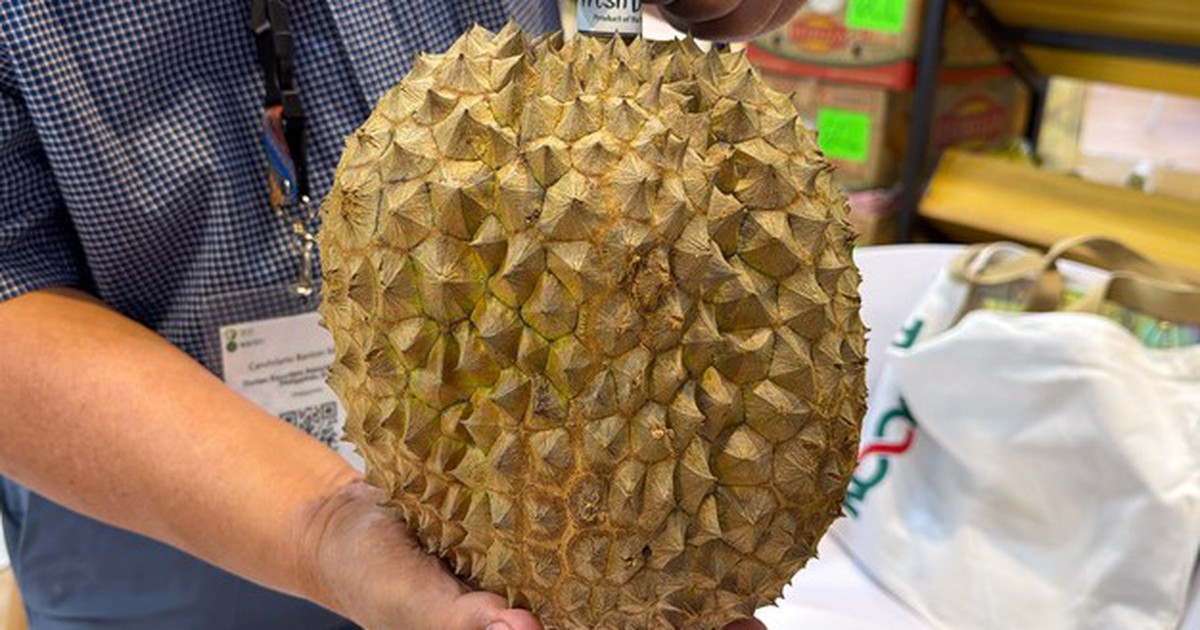
One obstacle in China is appearance. Some buyers there prefer durian with a green or yellow husk, while Philippine fruit can be brown. That has pushed exporters to market the eating quality and characteristics of the fruit rather than rely on its looks.
New destinations after the Asia Fruit Logistica debut
Alongside China, Singapore and Japan are among the markets Philippine exporters are targeting, and the industry is also exploring Canada, Europe, the Middle East and the United States. At its first appearance at the Asia Fruit Logistica trade fair, Philippine durian drew inquiries from companies in Germany, Canada, Australia, New Zealand, the Middle East and the United States, opening the possibility of destinations beyond the traditional ones.
Certification, traceability and Mindanao logistics
Market expansion brings a logistics problem. Most Philippine durian is grown on Mindanao, whose location makes moving produce from the growing areas to international markets more complicated. For a highly perishable fruit, transit time and consistency feed directly into cost and into handling before the product reaches the buyer, so reliable shipping routes are a condition for holding any new market.
Compliance is the other constraint:
- about 40% of durian farms are certified and eligible to supply exports;
- the remaining 60% still need farm codes to meet food safety and traceability requirements;
- smallholders face the most difficulty, as certification costs can deter them from taking part.
The Philippine durian exporters' association is helping growers complete certification while promoting the product in international markets. The sector now has to solve two problems at once — raising the profile of its signature varieties and building supply stable enough to meet international buyers' requirements. Whether exports expand will depend on output, certification, traceability and logistics improving together.