Non-EU suppliers reach 34.2% of Europe's orange imports as regional volumes shrink
Suppliers from low- and middle-income countries lifted their share of European orange imports from 32.5% in 2021 to 34.2% in 2025, according to freshplaza.it. Volumes from European origins fell from 2.17 million to 2.07 million tonnes over the same period. Overseas shipments remain concentrated in the July-October window, when regional supply thins out.
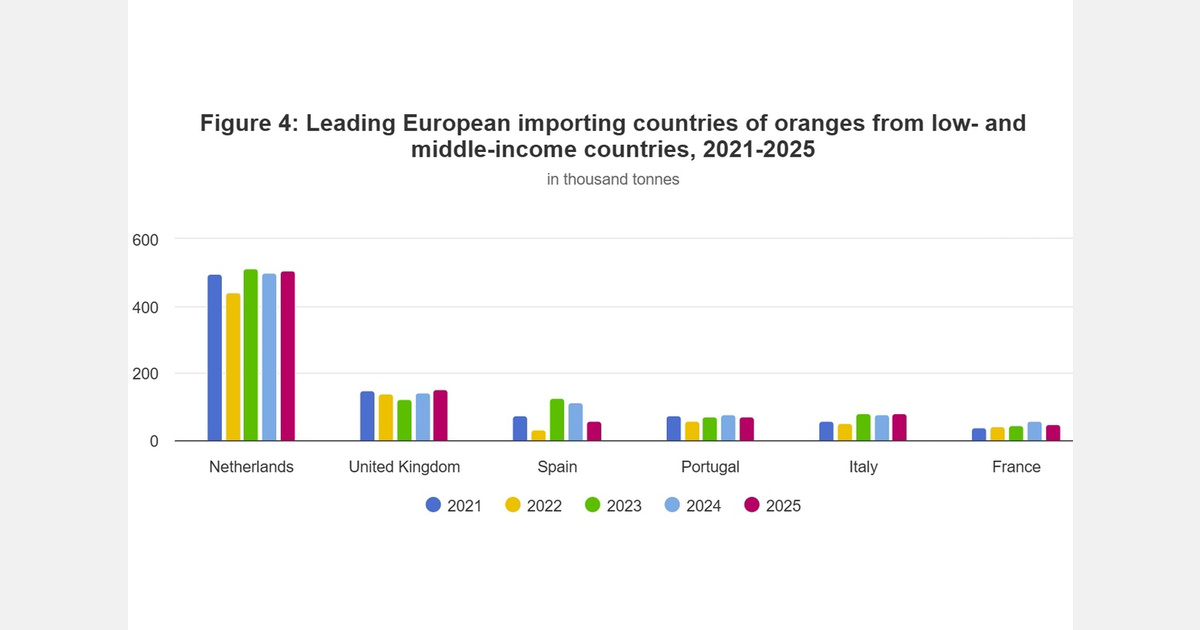
Suppliers from low- and middle-income countries accounted for 34.2 percent of European orange imports in 2025, up from 32.5 percent in 2021, according to freshplaza.it. Regional European origins still cover about 65 percent of the total, but their volumes have been contracting while extra-regional shipments edge higher.
European origins shrink, overseas volumes grow
Orange imports sourced from European suppliers fell from 2.17 million tonnes in 2021 to 2.07 million tonnes in 2025, an average annual decline of 1.1 percent. Volumes from low- and middle-income countries moved the other way, rising from 1.05 million tonnes to 1.08 million tonnes over the same period, an average annual gain of 0.7 percent.
Taken together, the two figures imply a combined import total of roughly 3.15 million tonnes in 2025 against about 3.22 million tonnes in 2021. The shift in shares is therefore driven more by European contraction than by overseas expansion: some 100,000 tonnes were lost on the regional side, against roughly 30,000 tonnes added from outside the region. Even so, European origins remain the dominant source at close to two-thirds of the market.
Trade follows the citrus calendar
Flows are tightly seasonal. Regional supply peaks during the Spanish campaign and falls away from June onwards. Imports from low- and middle-income countries peak in July, August, September and October, creating a seasonal window for fruit arriving from outside the region. That four-month period is the practical entry point for overseas exporters, and it is where their rising share is concentrated.
Six target markets, two demand drivers
freshplaza.it identifies the Netherlands, the United Kingdom, Spain, Portugal, Italy and France as markets with potential for fresh orange exports. The Netherlands functions mainly as a logistics and re-export hub rather than a final destination. The United Kingdom and France are consumption-driven markets. Imports into Spain, Portugal and Italy are more closely tied to supply shortfalls, end-of-season requirements and price.
Apparent per capita consumption varies widely across the region:
- Greece: 54.0 kg per person
- Spain: 39.4 kg
- Portugal: 32.3 kg
- Italy: 31.2 kg
- Netherlands: 9.6 kg
- Belgium: 6.9 kg
- France: 5.9 kg
- Germany: 4.9 kg
- United Kingdom: 3.3 kg
The high-consumption markets of Greece, Spain, Portugal and Italy also host domestic citrus growing and processing industries, which shapes when and why they buy abroad. North-western and central Europe consume far less per head, have little or no domestic orange production, and are correspondingly more dependent on imports throughout the year.
Organic remains a thin segment
Organic oranges are still marginal in volume terms and show no clear trend. Europe imported 7,100 tonnes of organic oranges from outside the region in 2024, against 6,600 tonnes in 2023, 12,000 tonnes in 2022, 7,700 tonnes in 2021 and 10,900 tonnes in 2020. Swings of that size on such a small base point to availability and certification constraints rather than demand shifts. Opportunities for organic suppliers sit mainly outside the European season and depend on certification, traceability, availability and price.