Kazakhstan extends seasonal apple import ban to EAEU partners
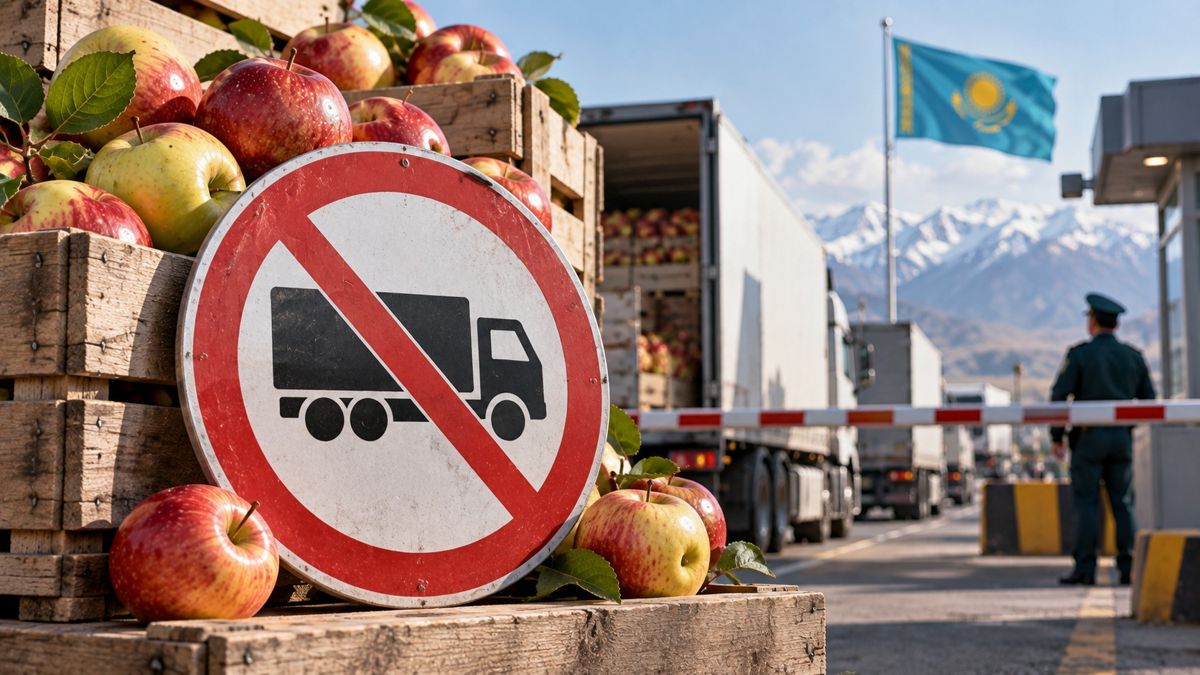
Kazakhstan has banned apple imports from both third countries and fellow EAEU members from September 3 through December 31, 2026. The measure may support orchard growers during the harvest, but limited commercial output and storage capacity create risks for winter availability and prices.
Kazakhstan widens a seasonal trade barrier
Kazakhstan has prohibited apple imports from September 3 through December 31, 2026, extending a seasonal restriction to fellow members of the Eurasian Economic Union for the first time. An order signed by the acting agriculture minister on September 1 covers shipments by every mode of transport from both third countries and EAEU states. The product is classified under EAEU tariff subheading 0808 10.
National Business Kazakhstan reports that the government presented the measure as support for domestic orchard growers during the harvest. A similar four-month ban introduced in August 2024 was narrower: it applied only to third countries, excluded EAEU supplies and covered road transport alone. The 2026 order removes both exemptions, disrupting a regional channel that previously remained open when other foreign supplies were restricted.
The order relies on Kazakhstan’s national security and trade regulation laws, as well as Article 29 of the EAEU Treaty. That article permits restrictions on trade between member states for specified public-interest and security reasons, provided they do not constitute arbitrary discrimination or a disguised trade restriction. An EAEU Court clarification issued on October 30, 2017 established that a separate international agreement is not required for a member to impose such a measure unilaterally. National Business Kazakhstan notes, however, that whether this particular ban discriminates against union partners remains unresolved.
Official supply figures mask a commercial-apple gap
The Agriculture Ministry says domestic production covered about 73% of Kazakhstan’s apple demand in 2025. Consumption totaled 279,200 tonnes and imports reached 94,400 tonnes. The 2026 harvest is forecast at 210,000–215,000 tonnes, led by the Turkestan, Almaty, Zhetysu and Zhambyl regions.
Industry participants question how much of that harvest can satisfy supermarket and export specifications. Apple Bee director Olzhas Svanbayev told National Business Kazakhstan that official statistics include old orchards and processing-grade fruit. He estimates that intensive orchards produce only about 30,000 tonnes of marketable apples nationwide, while stressing that no precise count exists for this segment.
Plant survival is another constraint. According to Svanbayev, as many as 40% of imported seedlings die within four to seven years because their genetics are poorly adapted to Kazakhstan’s climate. Some orchards therefore fail to reach designed capacity or are lost before recovering their investment. Local nurseries are trying to address the problem by cultivating and adapting virus-free material from European breeders inside Kazakhstan.
Storage shortage could outweigh the ban’s price effect
Apple prices were already declining before the restriction took effect. Weekly monitoring by the Bureau of National Statistics recorded falls of 1.9% by July 29, 2.7% by August 19 and 1% by September 2. The average price stood at 776 tenge per kilogram in the week ending August 19. The movement coincided with the seasonal arrival of the domestic harvest, and National Business Kazakhstan said there was not yet enough post-September 3 data to isolate the ban’s effect.
Kazakhstan has 72 operating fruit-storage facilities with combined capacity of 175,200 tonnes, compared with annual apple consumption of almost 280,000 tonnes. Svanbayev said prices normally begin rising after November, when freshly harvested supplies recede and sellers draw from storage. Domestic apples are generally exhausted by February and imports then take their place. Retail prices reached almost 2,000 tenge per kilogram around May 2026, according to his account.
The ban may improve growers’ ability to sell during the harvest window, but it does not expand the volume of retail-grade fruit or the capacity to preserve it. Once the restriction expires, importers may face pressure to replenish the market as stored domestic supplies diminish. For producers, traders and retailers, the winter 2026–2027 balance will depend less on the border measure itself than on how much suitable fruit enters storage and remains available after the harvest season.