Japan reopens its market to Argentine beef after a 20-year halt
Japan has granted market access to Argentine beef, allowing exports to resume after 20 years, according to Japanese media reports. The available reporting does not specify the start date, the list of approved Argentine plants, or whether access covers chilled or frozen product. Argentine exporters return to a market where Japanese buyers have spent two decades sourcing from a narrow set of origins.
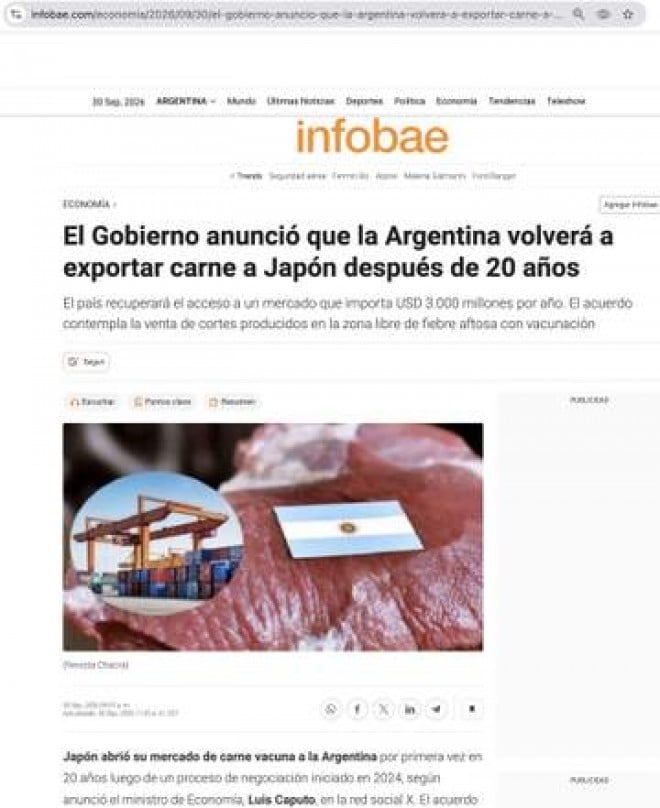
Japan has opened its market to Argentine beef, clearing the way for exports to resume after a halt of 20 years, Japanese media reported. For Argentina, the decision adds a high-value Asian destination to an export book long dominated by lower-priced bulk trade. For Japanese importers and processors, it introduces a new origin into a supply base that has been narrow for years.
The reporting confirms the substance of the decision — market access granted, shipments possible after two decades — but does not set out the operational detail trade participants need in order to plan. The date of the first shipments, the list of Argentine establishments approved to export, whether access covers chilled product, frozen product or both, and which cuts and bone-in categories qualify are all unspecified in the material available. The reason for the original suspension is likewise not stated.
What a 20-year closure means in practice
Two decades is long enough that formal access and commercial presence stop being the same thing. Trading relationships, importer contacts and shelf positions built before the closure no longer exist in any usable form. Japanese buyers have spent that period sourcing from a stable set of origins and have written their specifications, grading expectations and cold-chain procedures around them. Argentine exporters re-entering the market will be selling against incumbents with established service records rather than filling an empty shelf.
The approval process itself is also staged. Country-level access is the first step; plant-by-plant registration, agreement on health certificate wording and inspection arrangements follow, and each adds time before containers move. Until the list of eligible establishments is published, the realistic volume ceiling for the first year cannot be estimated.
Where Argentine beef could fit
Japanese beef demand splits between the premium domestic wagyu segment and imported product used in foodservice, retail and processing. Imported beef competes mainly on consistency, cut specification and price rather than on brand. Argentine supply is predominantly grass-fed, which gives it a different flavour and fat profile from the grain-fed product that dominates Japan's import mix — an advantage in some channels and a constraint in others.
Several variables will determine the commercial outcome:
- Tariff treatment — whether Argentine product enters at Japan's standard most-favoured-nation rate or under a preferential arrangement, which sets the landed-cost gap against suppliers covered by Japan's trade agreements.
- Product form — chilled access supports higher-value cuts and better margins, while frozen-only access pushes the product towards processing and foodservice.
- Plant coverage — how many Argentine abattoirs are cleared, and whether the larger export-oriented operations are among them.
- Logistics — transit times from the River Plate to Japanese ports favour frozen over chilled, unless air freight or fast services are used for premium cuts.
Supply-side constraints at home
Argentina's ability to respond depends on cattle availability and on domestic consumption, which absorbs a large share of national production. Export growth has historically been limited by herd size and by policy that has alternated between export restrictions and liberalisation. A new destination does not create additional cattle; in the short term, product shipped to Japan will be diverted from other markets or from domestic sale unless slaughter rises.
For importers in Japan, the practical effect is optionality rather than immediate volume. Adding an origin reduces exposure to disruption from any single supplier — whether from disease, drought or currency moves — and strengthens the buyer's hand in annual negotiations. Those benefits accrue gradually, through trial shipments and agreed specifications, not on the day access is granted.