Japan’s ¥1 Trillion New Foods Plan Opens Higher-Value Protein Path for Thailand
Japan plans to invest about ¥1 trillion in alternative proteins and functional and nutritional foods, targeting a ¥3 trillion New Foods market by 2040. Thailand sees an opportunity to combine its agricultural ingredients and processing capacity with Japanese fermentation, formulation and food-safety technology.
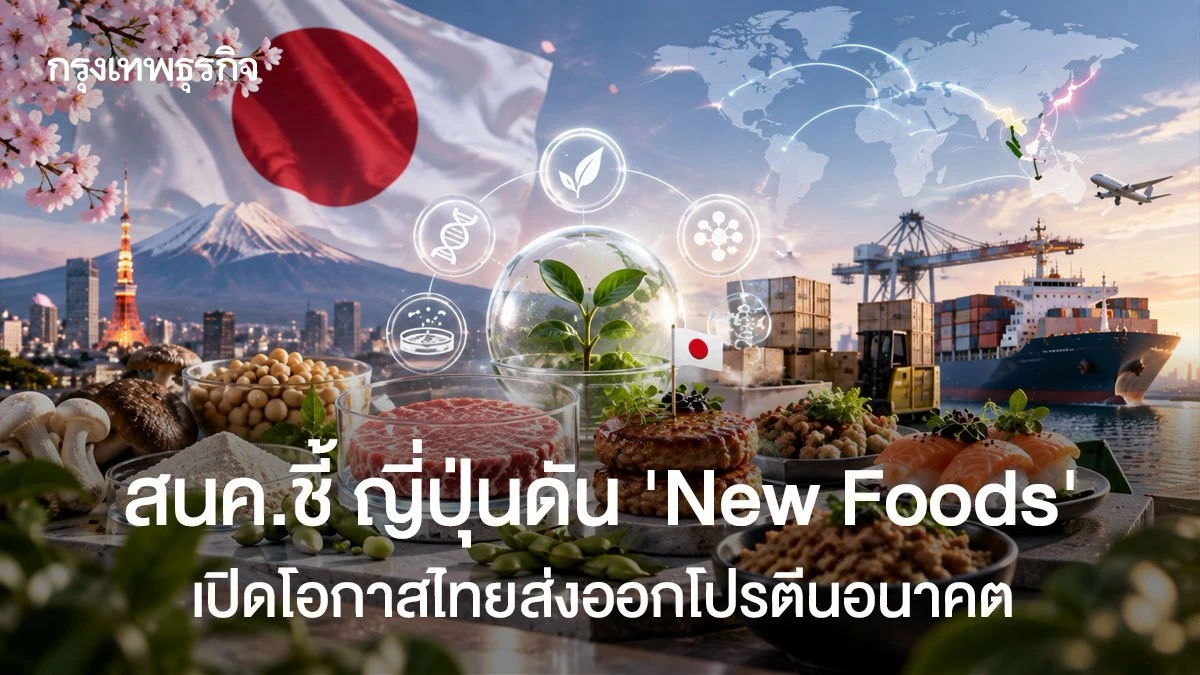
Japan puts New Foods on its investment agenda
Japan has designated New Foods as a strategic industry alongside fields including artificial intelligence, semiconductors, biotechnology and clean energy. According to Bangkok Biz News, the country’s Public-Private Investment Roadmap seeks to attract more than ¥370 trillion, or about $2.29 trillion, across 17 strategic sectors and 62 priority products and technologies by 2040.
Food technology accounts for about ¥9.7 trillion of the roadmap, covering plant factories, land-based aquaculture, food machinery and New Foods. Around ¥1 trillion is earmarked for New Foods, with emphasis on alternative proteins and functional and nutritional products. Japan aims to expand this market to ¥3 trillion by 2040 from what the report describes as a currently low base.
The strategy builds on areas where Japanese companies already possess technical expertise, including fermentation, food formulation, functional foods, rice-flour products and high-quality agricultural and fishery ingredients. It gives less immediate priority to cultivated meat, where costs and commercial viability remain constraints. Japan initially plans to target the United States and Europe, where demand for health-oriented and sustainable products is strong, before expanding further in Asia.
Thai suppliers face a shift toward higher-value ingredients
Thailand’s Trade Policy and Strategy Office said the policy creates both an opportunity and a challenge for Thai businesses. Japan was Thailand’s third-largest market for agricultural and agro-industrial exports in 2025, with shipments valued at $5.08 billion, or about 166.78 billion baht. That total was 2.1% lower than a year earlier because of Japan’s economic slowdown, the weak yen, stronger competition and strict food standards.
Thailand’s main products sold to Japan still include processed chicken, fresh chilled and frozen chicken, canned seafood, natural rubber and rubber products. Overall Thai food exports to Japan contracted by about 8.9% in 2025. China, meanwhile, was Thailand’s largest food export market with a 22.3% share, followed by ASEAN, the United States and the CLMV group.
Those figures underline the commercial case for moving beyond established raw materials and conventional processed foods. Thai companies could instead supply functional ingredients, alternative proteins and other higher-value products aligned with Japan’s focus on health, ageing consumers and sustainability. Access will still depend on consistent quality, traceability and compliance with Japanese safety requirements.
Wolffia and tempeh offer initial platforms
The Trade Policy and Strategy Office has promoted Wolffia, locally known as pham or watermeal, as a Thai alternative-protein “Product Champion.” Thai researchers have developed three high-quality strains containing 46–48.6% protein. The plant can be processed into dried protein powder priced at about 3,000–5,000 baht per kilogram, and it is already being marketed in the United States, Europe, the Middle East and Japan.
Tempeh is another product being developed from local Thai beans to meet international standards for plant-based protein. Japanese capabilities in fermentation and formulation could help Thai processors improve product consistency, functionality and suitability for overseas consumers.
Nanthapong Jiralertpong, director of the Trade Policy and Strategy Office, said Thailand should become a developer of food technology and higher-value products rather than remain primarily an exporter of raw materials. Cooperation with Japan could cover investment and technology transfer in fermentation, formulation, functional foods and safety standards, potentially giving Thai suppliers a route into Japanese production networks as well as markets in the United States, Europe and the rest of Asia.