İzmir expands industrial tomato and dried-tomato output to pursue market leadership
İzmir produced about 870,000 tonnes of industrial tomatoes on 110,000 decares in 2025, ranking third in Turkey. The province is seeking to expand value-added dried-tomato production, which requires 13-14 kilograms of fresh tomatoes for each kilogram of finished product.
İzmir ranks third in Turkey
İzmir is seeking to strengthen its position in Turkey’s industrial tomato sector by expanding production and raising the share processed into dried tomatoes for domestic and overseas markets. According to Yeni Asır, the province produced about 870,000 tonnes of industrial tomatoes across approximately 110,000 decares in 2025, placing it third nationally behind Bursa and Manisa.
The provincial target is to move into first place. Kahraman Akdoğan, İzmir’s provincial director of agriculture and forestry, said rainfall had supported a productive tomato season this year. Planting takes place in April, while harvesting begins in July. The dried-tomato campaign, which started in July, is expected to continue until the middle of August.
Production is spread across several districts, particularly Torbalı, Tire, Kınık, Bergama and Menemen. Torbalı is the largest production center, yielding more than 300,000 tonnes from about 38,000 decares. Akdoğan said the district represents 38% of İzmir’s total tomato production.
Dried tomatoes add value to the crop
About 15% of Torbalı’s tomato crop is allocated to drying. The district’s tomatoes also carry a geographical indication based on their quality, standards and drying method, giving processors and growers a tool to distinguish the product in domestic and export markets.
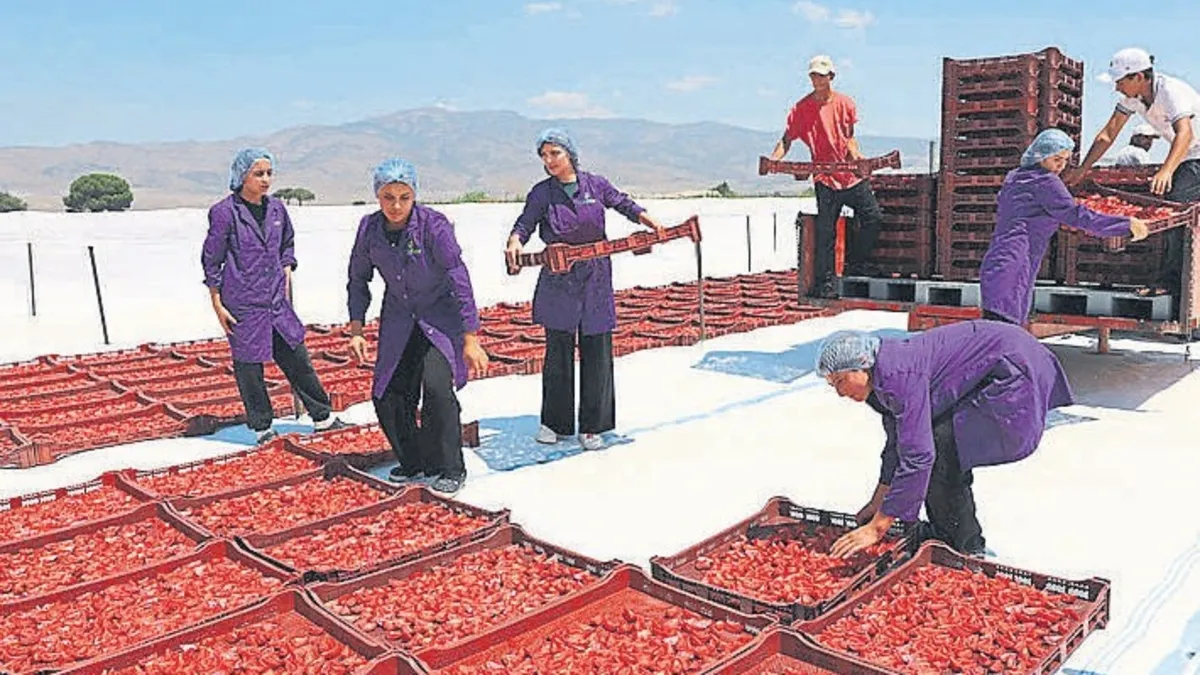
After harvesting, tomatoes are sorted, washed, calibrated and cut according to size and diameter. They are then laid out to dry, washed again and subjected to a second drying stage before being transferred to cold storage. The finished product is packaged according to demand and supplied to buyers in Turkey and abroad.
The conversion ratio illustrates both the processing intensity and the potential added value: approximately 13-14 kilograms of fresh tomatoes are needed to produce 1 kilogram of dried tomatoes. For growers and processors, drying offers an alternative to tomato paste, the other main outlet for industrial varieties, while producing a higher-value and more easily stored product.
A processing cluster centered in the Aegean region
Producer Onur Yılmaz, who has worked in agriculture for 36 years and is also involved in seedling production and packaging, said almost all Turkish dried-tomato companies are concentrated in İzmir and the wider Aegean region. Turkey produces approximately 40,000 tonnes of dried tomatoes annually, with half of that volume made in the Aegean region, according to Yılmaz.
The seasonal operation depends on tight harvesting and processing schedules. Farm workers enter the fields at 05:00 and complete harvesting by 11:00, after which the tomatoes are immediately sorted and prepared for drying. This concentration of farms, drying sites, packaging operations and cold-storage facilities gives İzmir an established processing base as it seeks to increase output.
Growth depends on quality and processing capacity
İzmir’s 870,000-tonne industrial tomato crop provides a substantial raw-material base, but its move toward national leadership will depend on how much additional production can be processed and marketed profitably. Expanding dried-tomato output could increase returns without relying only on higher fresh-crop volumes.
The geographical indication for Torbalı tomatoes may support that strategy by connecting production standards with a recognizable regional origin. For growers, processors and exporters, the central challenge is to maintain consistent quality through harvesting, two-stage drying, storage and packaging while developing demand for the finished product in Turkey and international markets.