Italian food and beverage export growth slows to 0.5% in first half of 2026
Italian food and beverage exports rose just 0.5% in the first half of 2026, down from 5.1% growth in 2025, according to Nomisma Observatory data compiled for Italia del Gusto. Shipments to the United States fell 10.8%, while Turkey, India and Mercosur posted double- and high-single-digit gains. Olive oil, chocolate and wine were the weakest categories.
Italian food and beverage exports rose by 0.5% in the first half of 2026, a sharp slowdown from the 5.1% growth recorded across 2025, according to previously unpublished figures from the Nomisma Observatory on international food and beverage markets, produced for the producer association Italia del Gusto and reported by agricolae.eu.
Italy exported 59.3 billion euros of food and beverage products in 2025, confirming its position as the world's sixth-largest exporter in the sector, behind the Netherlands, Germany, the United States, Brazil and France. Despite the deceleration, the Observatory describes Italy as one of the few major exporters still in positive territory, in a scenario marked by widening gaps between destination markets and product categories.
A shifting map of destinations
The headline stability conceals a redrawing of Italy's export geography. Shipments to the European Union rose 1.9% in the first six months of 2026, with positive results in Germany (+2.5%), France (+1.9%), Spain (+2.7%) and Poland (+2.5%).
The United States is the clearest point of weakness: Italian food and beverage exports to the American market fell 10.8%. The strongest growth came from markets outside Italy's traditional core — Turkey (+19.3%), India (+15%), Mercosur (+8%) and South Korea (+6.4%).
Coffee leads, olive oil retreats
Category performance was equally uneven, with a spread of more than 30 percentage points between the best and worst performing product groups in value terms:
- Coffee: +11.1%, still supported by high prices
- Bakery products: +2.2%
- Cheese: +2%
- Pasta: -1.1%
- Wine: -6%
- Chocolate: -8.3%
- Olive oil: -21.9%
Taken together, the figures describe what the Observatory calls a multi-speed market, in which the resilience of Italian exports coexists with an overall slowdown and growing polarisation between markets, products and development opportunities.
Industry debate at IDG Days 2026
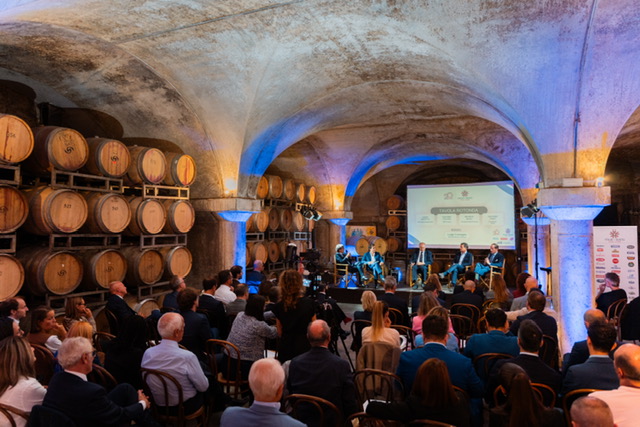
The data was presented at IDG Days 2026, the annual meeting of Italia del Gusto, held on 17 and 18 September between Gavi and Novi Ligure. This year's edition was hosted by Gruppo Elah Dufour Novi, a long-established Italian confectionery company, and was dedicated to the theme “The value of history and territory in building brand image”.
Discussion centred on whether heritage and origin alone can still sustain competitiveness. Participants argued that history and territory remain a core asset for Italian food brands but are no longer sufficient in themselves. In increasingly differentiated markets, large Italian brands need to convert heritage and origin into concrete, contemporary value for consumers who weigh quality, convenience, transparency and new consumption occasions. Price remains central, but convenience is understood more broadly, covering the time needed to buy and prepare a product, ease of use, waste avoidance and the overall quality of the experience.
“The strength of our companies comes from histories, territories and skills built over time, but this heritage must continue to speak to today's consumers,” said Giacomo Ponti, President of Italia del Gusto. “In a phase characterised by markets and product categories moving at different speeds, the ability to innovate without losing identity can strengthen the competitiveness of Italian food on international markets.”
Guido Repetto, President of Gruppo Elah Dufour Novi, said that for a company with a long history heritage “cannot be only something to celebrate: it must be a basis on which to keep building the future”, adding that ties to territory and accumulated expertise acquire value when they are made current through products, innovation and dialogue with consumers who keep changing.
The sessions brought together Guido Repetto, Giacomo Colussi, Michele Bauli and Giacomo Ponti with Daniela Corsaro, full professor of marketing at IULM, and Marco De Carli, co-founder and chief executive of Dinn!. The shared conclusion reported by agricolae.eu was that origin is a promise rather than a privilege: on international markets consumers do not choose a product automatically because it is Italian, but because its history, territory and know-how offer something distinctive and relevant.