Iran reports 4.2 million tonnes of apple output and fourth place among world producers
Iran's Ministry of Agriculture Jihad says national apple output reached 4.2 million tonnes, placing the country fourth among world producers, with fruit shipped to 57 destination markets. The statement, carried by the news agency ISNA, gave no export tonnage, value or breakdown by country.
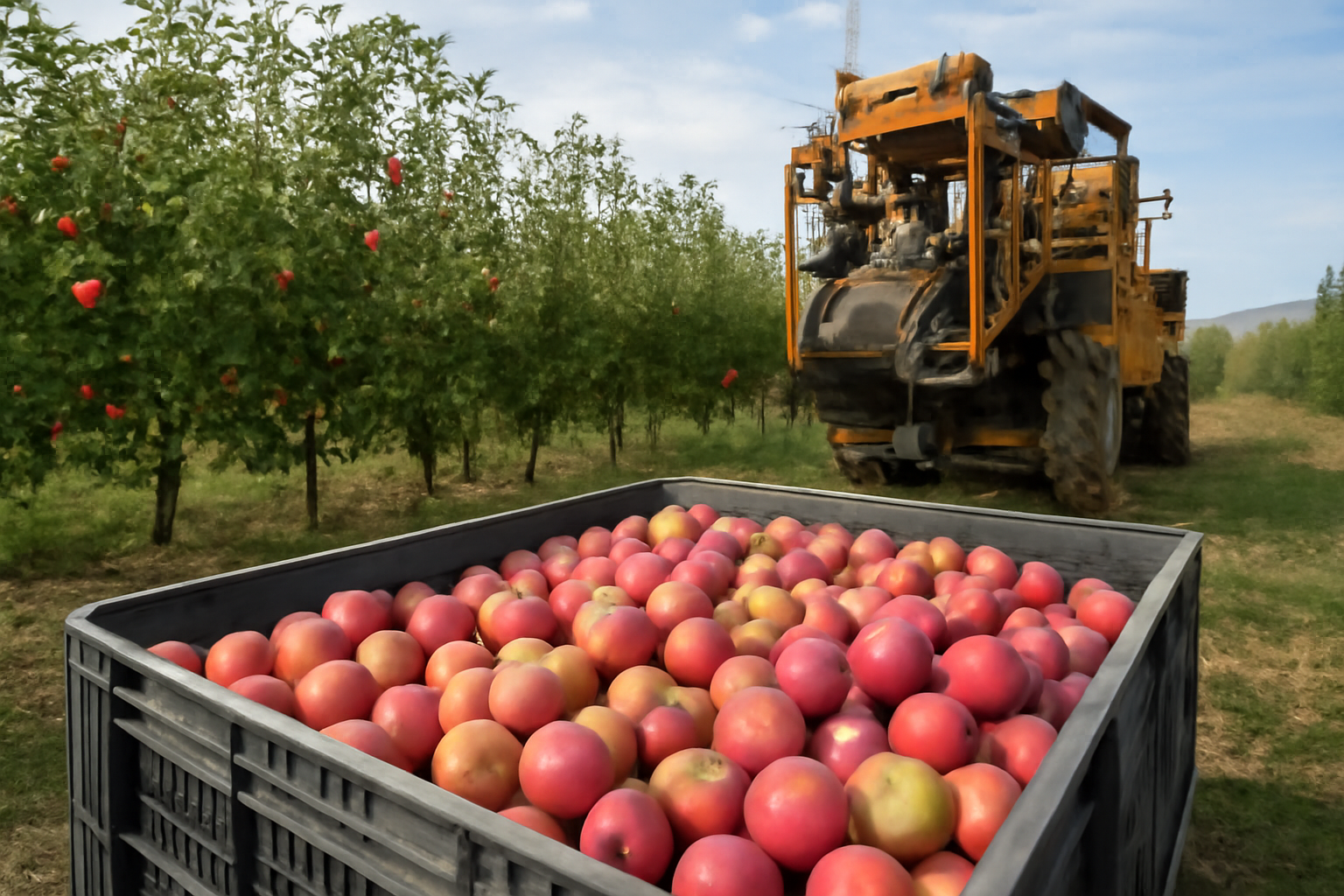
Iran produced 4.2 million tonnes of apples and ranks fourth in the world among apple-producing countries, the deputy for horticultural affairs at the Ministry of Agriculture Jihad said in remarks carried by the Iranian news agency ISNA. According to the same statement, Iranian apples are sold to 57 countries.
A crop of 4.2 million tonnes
The official put national output at four million and 200,000 tonnes and said that this volume places Iran in fourth position globally. ISNA did not name the three larger producers, and the report did not specify the crop year to which the figure refers or whether it covers only commercial orchards.
Output on that scale makes apples a bulk commodity rather than a niche horticultural line. A harvest of 4.2 million tonnes has to be picked, graded, packed and stored within a short seasonal window, which requires controlled-atmosphere storage, packing houses and refrigerated transport in proportion to the crop. Storage capacity, rather than orchard area, is usually what determines how much of a crop can be sold at stable prices through the year instead of being pushed onto the market immediately after harvest.
Exports to 57 countries
The number of destination markets is the only export indicator in the announcement. The deputy did not give an export tonnage, an export value, or the share of the crop that is shipped abroad, and the individual destination countries were not named.
Breadth of market access and export volume are not the same thing. A long list of destinations shows that Iranian fruit has cleared phytosanitary and commercial requirements in a wide range of markets, but it is compatible both with a broadly spread trade and with one concentrated in a handful of neighbouring countries that take most of the volume. The ISNA report does not indicate which pattern applies.
Apples are also traded in several distinct forms — fresh dessert fruit sold by variety, size and grade; industrial-grade fruit destined for juice concentrate; and dried product — and each moves under different pricing, packaging and transport requirements. The statement reported by ISNA refers to apple production as a single figure, without distinguishing between these streams.
What the figures leave open
For buyers, processors and freight operators, several data points that would normally frame an apple crop of this size were absent from the statement:
- the crop year covered by the 4.2 million tonne figure;
- exported volume and value, and the share of output sold abroad;
- the identity and ranking of the 57 destination markets;
- the split between fresh fruit and processed products such as juice concentrate and dried apple;
- orchard area, average yields and the regional distribution of production.
Why the scale matters for the trade
Apples are a low-value-per-tonne, high-volume product, and transport and cold-chain costs account for a large part of the delivered price. That economics tends to favour overland trucking to nearby markets over long-haul refrigerated container shipping, and it means freight rates, border-crossing times and cold storage availability weigh on export competitiveness as heavily as production volume does.
Production rankings also say little about a country's position in world trade in the fruit: a top-four producer can remain a marginal exporter if most of the crop is absorbed domestically. Until export tonnage and destination data are published alongside the production figure, the fourth-place ranking reported by ISNA describes the size of Iran's orchard sector rather than its weight in international apple trade.