Iran's Estahban Fig Harvest Under Way: 17,000-18,000 Tonnes, Three-Quarters for Export
Harvesting has started in Estahban, Fars province, a district holding roughly 26,000 hectares of rain-fed fig orchards. Annual dried fig output is estimated at 17,000-18,000 tonnes, of which about 75% goes to export markets including China, India, Vietnam, Malaysia, the Gulf states and parts of Europe. Iranian media report the district accounts for around 90% of the country's dried fig exports.
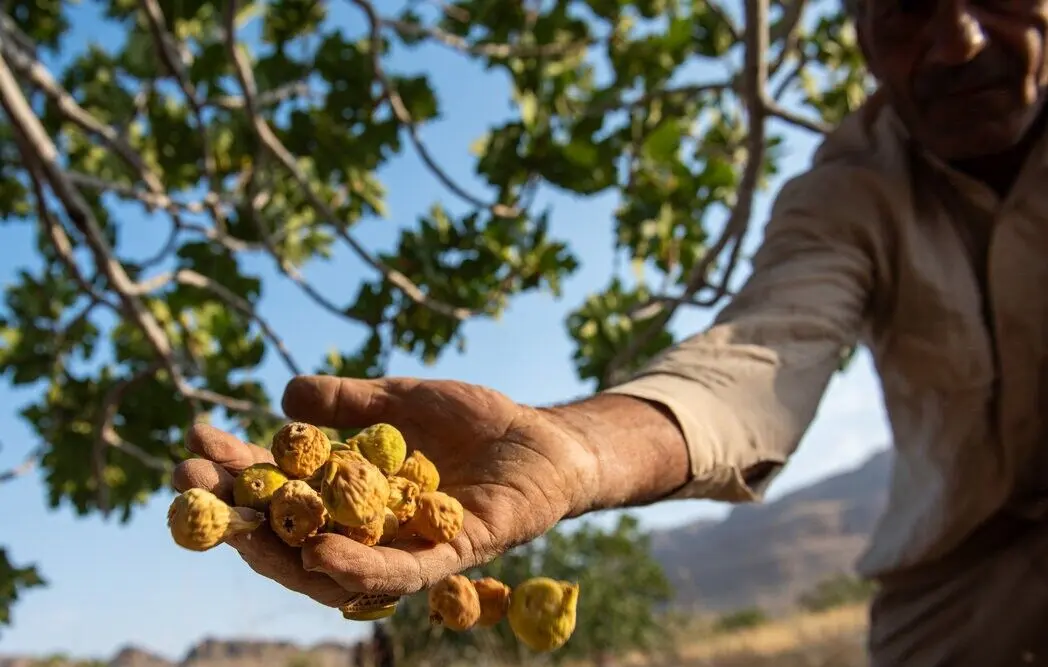
The dried fig harvest has begun in Estahban, a district of Iran's Fars province that Iranian media describe as one of the country's most important production centres for the crop. According to Mashregh News, the district holds roughly 26,000 hectares of rain-fed fig orchards, and picking usually starts from the middle of the Iranian month of Mordad, which corresponds to the first half of August.
Rain-fed orchards, no irrigation buffer
The Estahban orchards are rain-fed, meaning the trees depend on seasonal precipitation rather than irrigation. That makes the district's volumes directly exposed to rainfall in the preceding winter and spring, with no water-management cushion between a dry year and a smaller crop.
Annual dried fig production in the district has been estimated at 17,000 to 18,000 tonnes in recent years, according to Fararu and Mashregh News. Set against the reported 26,000 hectares, that implies an average yield of roughly 0.65 to 0.69 tonnes of dried product per hectare across the orchard belt.
Drying on the tree, then on the rooftops
A significant share of the crop is produced by the traditional method, drying naturally on the tree before it is picked. The figs are then moved to house rooftops, to structures known locally as eshband, where they are aerated and finished. Alongside this household-level process, industrial capacity in the district is limited: official statistics cited by both publications put it at about three fig processing units and ten packaging units.
That combination - a large orchard area, low mechanisation and a small number of registered processing and packing facilities - shapes how the crop reaches buyers. Value is added mainly at the sorting and packaging stage rather than through deeper processing.
Export destinations and share of national trade
About 75% of the district's dried fig output is directed to export markets and about 25% to domestic consumption, according to Fararu. On the reported production range, that places roughly 12,750 to 13,500 tonnes a year in the export channel from a single district.
Reported destinations are spread across several regions:
- East and South Asia: China, India, Vietnam and Malaysia;
- The Persian Gulf states;
- Selected European markets.
Fararu reports that around 90% of Iran's dried fig exports are accounted for by this product, concentrating a national non-oil export line in one district's output. For importers and traders, that concentration means supply continuity for Iranian dried figs is tied to conditions in a single rain-fed growing area rather than spread across multiple regions.
Local economic weight
Beyond the traded volume, the crop supports employment for orchard owners and seasonal labour during the picking and drying season, and underpins the district's processing industries. Both publications describe dried figs as a significant contributor to Estahban's economy and to its non-oil export earnings.
The sources do not give current price levels, export values or year-on-year volume comparisons, and no figures for the 2025 crop size have been published in the reports. What they establish is the structural profile of the supply base: a fixed orchard area of about 26,000 hectares, output in the 17,000-18,000 tonne range, a three-quarters export orientation, and a processing footprint of three plants and ten packing houses serving that volume.