Inpasa Ethanol Contract Drives Threefold Expansion of Sorghum Area in Western Bahia
Producer Augusto José Montani expanded his sorghum area from 1,500 to 4,500 hectares in 2026 after securing an offtake contract with Inpasa Brasil. Grain ethanol demand is giving Western Bahia growers a more predictable market for a drought-tolerant second crop.
Industrial demand changes the market for sorghum
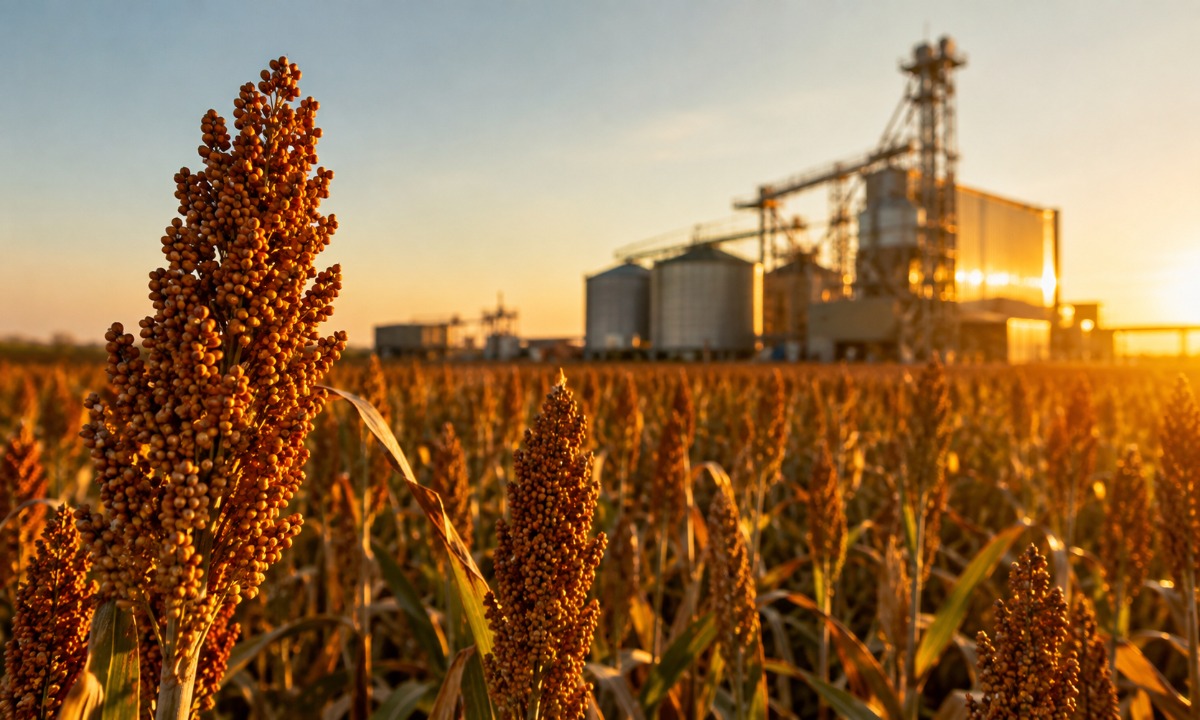
Grain ethanol demand is reshaping the market for grain sorghum in Western Bahia, giving producers a defined buyer for a crop that was previously difficult to sell locally. According to Brasil 247, farmer Augusto José Montani cultivated sorghum for eight consecutive years while facing uncertainty over whether he could market his entire harvest. An offtake agreement with Inpasa Brasil changed that calculation by providing predetermined delivery terms and guaranteed liquidity.
In 2026, Montani increased the area planted with sorghum from 1,500 hectares to 4,500 hectares. The threefold expansion illustrates how an industrial buyer can influence planting decisions when a crop lacks a sufficiently deep regional spot market. For producers, a contract signed before harvest reduces exposure to the risk of holding grain without an immediate destination and makes it easier to plan spending on seed, fertilizer and field operations.
Yields support the commercial case
Brasil 247 reports that yields reached as much as 120 bags per hectare, generating gross revenue close to R$6,000 per hectare. The publication attributes the result to suitable agronomic management, biotechnology and balanced fertilization. These figures describe the strongest reported field performance rather than a guaranteed result for every producer, but they show why sorghum can compete for second-crop acreage when a buyer is already in place.
Sorghum also offers an agronomic advantage in the Cerrado. Its tolerance to dry conditions can reduce climatic risk during the second growing season, when water availability is more uncertain. Including the crop in rotations can help protect soil and allow farms to make greater use of machinery and inputs beyond the main harvest. The combination of drought resilience and a contracted outlet is therefore central to its appeal in São Desidério and the wider Western Bahia farming region.
Research and contracts underpin further growth
Technical support is another part of the expansion. Brasil 247 highlights work by Embrapa Maize and Sorghum on research and cultivars adapted to production conditions. Sector symposiums in Luís Eduardo Magalhães, organized with research and industry participation, are also being used to transfer knowledge on crop management to growers. Better-adapted cultivars and improved agronomic practices may help producers manage biological and weather risks as planted area grows.
The Montani case does not establish how much sorghum Inpasa will purchase across Bahia or how quickly regional output may expand, as no procurement volume or processing-capacity figure was provided. It does, however, demonstrate the immediate effect of a reliable industrial outlet: acreage on one property tripled after the contract was secured. For ethanol processors, sorghum provides another cereal feedstock; for growers, it creates a potential second-crop revenue stream whose viability depends on yields, contract terms and continued demand from nearby processing operations.