Indonesia weighs local salt purchase mandate as imports rise and prices fall
Indonesian economists are urging Jakarta to require salt importers to purchase quality-compliant domestic output. The proposal comes as industrial salt imports rise, national production targets increase and farmers in Brebes face falling prices.
Import growth collides with higher output target
Indonesia is facing calls to make purchases of quality-compliant domestic salt a condition of import access as the government pursues national self-sufficiency in 2027. The proposal seeks to protect salt farmers from weakening prices while preserving imports for industrial specifications that local producers cannot yet supply.
Indonesia’s Ministry of Marine Affairs and Fisheries plans to raise national salt production from 2.25 million tonnes in 2025 to 2.5 million tonnes in 2026, according to planning documents cited by Metro TV News and VIVA. At the same time, Statistics Indonesia data show that imports of industrial salt under HS 25010093 reached approximately 936,000 tonnes in January-May 2026, an increase of 13.1% from a year earlier. The combination of expanding domestic output and rising imports has intensified concern over whether local producers will have a reliable market.
Analysts seek obligations and tighter controls
Muhammad Rizal Taufikurahman, head of the Center for Macroeconomics and Finance at the Institute for Development of Economics and Finance, said import policy should be based on an accurate assessment of industrial demand. Imports should be used selectively for specifications that cannot be produced domestically, he said in a statement reported by Liputan6, Metro TV News and VIVA on July 29, 2026.
Rizal called for import policy to include distribution monitoring so industrial salt does not enter the consumer market. He also proposed integrating import access with a requirement to purchase local salt that meets the relevant quality standards. Without such a mechanism, the planned production increase may not translate into sales or improved returns for salt farmers. Hardy Hermawan, an economist at the Praxa Institute, separately urged the government to prevent imported industrial salt from leaking into the household market, including through blending. Liputan6 reported that he also called for a transparent and equitable import process without preferential treatment for particular operators.
Previous safeguard was removed
A local-purchase principle was previously included in Ministry of Marine Affairs and Fisheries Regulation No. 66 of 2017 on salt import controls. That regulation was revoked through Regulation No. 27 of 2022, and the sources report that no comprehensive replacement mechanism was introduced. Rizal argues that removing the regulation should not eliminate the underlying requirement for importers to absorb qualifying domestic production.
The analysts want the obligation incorporated into the implementation of Presidential Regulation No. 17 of 2025 on accelerating national salt-sector development. One option identified by Rizal is to make local purchases a condition for issuing import permits. Current governance also requires coordination across ministries: VIVA reports that the Coordinating Ministry for Food Affairs is responsible for ensuring transparent supply-and-demand balances, while the Ministry of Trade oversees import approvals.
Brebes farmers feel the price pressure
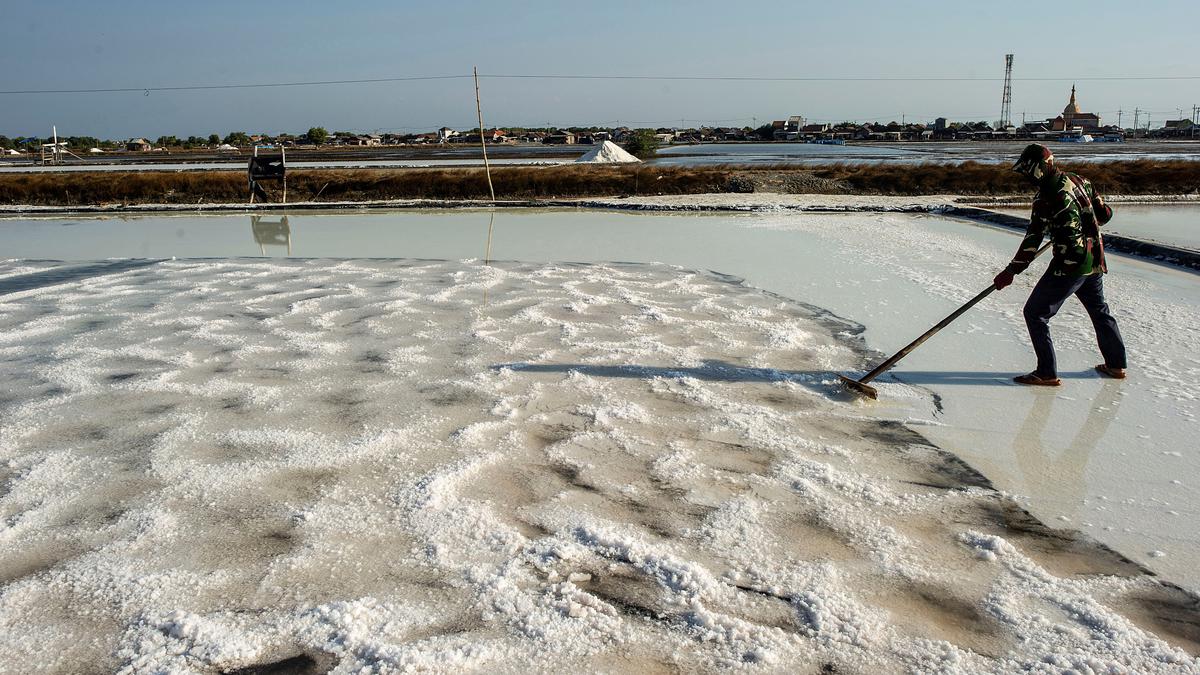
The policy debate comes as salt farmers in Brebes report a sharp deterioration in local prices. Kompas reported that the price had fallen from Rp 70,000 to Rp 40,000 per sack, with farmers saying quotations were declining almost daily even though warehouses were empty. The reported drop amounts to Rp 30,000 per sack and highlights the gap between higher national production ambitions and the commercial security available to producers.
A purchase mandate would not prohibit industrial imports under the proposals described by the sources. It would instead link imports to verified industrial requirements, quality differences and absorption of compliant domestic output. For producers, the central issue is guaranteed market access as output rises. For industrial buyers and importers, the key questions would be how quality compliance is measured, how purchase volumes are allocated and how authorities prevent industrial material from entering household channels. Those implementation details will determine whether the measure supports the 2027 self-sufficiency target without disrupting industrial supply.