Indonesia targets garlic self-sufficiency as imports dwarf domestic output
Indonesia plans to expand domestic garlic production and reduce dependence on imports. Imports reached about 536,000 tonnes in 2022, compared with domestic output of roughly 18,000 tonnes, leaving growers and policymakers with a substantial production gap to close.
Government puts garlic among priority commodities
Indonesia is seeking to reduce its reliance on imported garlic by expanding domestic production, placing the crop among four strategic food commodities targeted for lower import dependence. Agriculture Minister Amran Sulaiman identified wheat, corn, soybeans and garlic as the government's priorities, according to Pantau and the ANTARA news agency.
The initiative follows the government's decision to stop rice imports from 2025. Among the four priority commodities, officials see garlic as having potential for eventual self-sufficiency. No target date or production goal for reaching that position was specified in the source material.
Large supply gap underlines the challenge
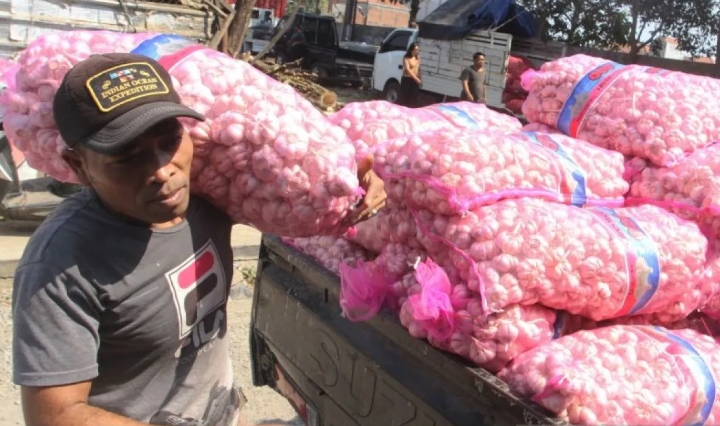
Indonesia imported about 536,000 tonnes of garlic in 2022, while domestic production reached only around 18,000 tonnes that year, according to both publications. Imports were therefore almost 30 times domestic output. The comparison does not provide a complete measure of national consumption, but it illustrates the scale of Indonesia's dependence on foreign supply.
Imported garlic sold for Rp30,000 to Rp40,000 per kilogram in 2023. Domestic prices can fluctuate with seasonal conditions and supply availability, making the timing and administration of imports important for consumers, traders and local growers.
ANTARA identified limited suitable land and Indonesia's humid tropical climate as major constraints. Garlic performs best on fertile land in relatively dry conditions, complicating large-scale expansion. Domestic productivity is also described as low compared with several other countries because of seed quality, cultivation methods, pests and disease.
Production costs present another obstacle. Indonesian growers face relatively high spending on seed, fertilizer and labor, while locally produced garlic must compete with imported product. Any rapid restriction on imports without a corresponding increase in reliable domestic supply could therefore tighten availability and increase price volatility.
Seeds, acreage and infrastructure shape feasibility
The government has already supported growers with seed and fertilizer assistance and efforts to increase planted area. ANTARA outlined additional measures including superior disease-resistant varieties, suitable agricultural technology, farmer training, incentives and regulation of garlic imports. Investment in irrigation and storage facilities could also improve farm efficiency and strengthen the supply chain.
For producers, the policy could create room to expand acreage and sales, provided yields and quality improve enough to compete. Importers and distributors face greater policy uncertainty as the government considers tighter import management. A gradual approach will be central: replacing a 2022 import volume of 536,000 tonnes against domestic production of 18,000 tonnes requires sustained gains in land, productivity and post-harvest capacity rather than a single-season increase.
ANTARA cited China as one of the world's largest garlic producers and noted that the United States also produces the crop on a broad scale. Indonesia's conditions differ, however, and the agency said self-sufficiency would require significant, comprehensive and consistent action. Until domestic output rises materially, imported garlic will remain critical to national availability and price stability.