Indonesia studies palm-based poultry feed to reduce soybean meal imports
Indonesia’s Agriculture Ministry is studying whether palm-derived ingredients can replace a larger share of imported soybean meal in poultry feed. Palm-based materials currently account for about 5% of feed formulations, while imported soybean meal represents 25% of broiler feed and 20% of layer feed.
Research targets a palm-based alternative
Indonesia’s Ministry of Agriculture is examining whether palm-derived ingredients can replace a larger portion of imported soybean meal in poultry feed, according to InfoSAWIT. The research is being conducted with the National Research and Innovation Agency, known as BRIN, and universities. The program aims to identify formulations that can reduce import dependence without compromising poultry nutrition, digestion or production performance.
Makmun, the ministry’s director of livestock downstream development and animal health, said the use of palm-based materials could reduce soybean meal imports if their share in feed formulations rises above 10%. He made the comments during a 2026 regional inflation-control coordination meeting monitored through the Indonesian Home Affairs Ministry’s YouTube channel on October 6, 2026. InfoSAWIT reported that palm-derived materials currently account for about 5% of the formulation.
The technical challenge is not limited to availability. Different palm-derived materials have characteristics that may restrict their use in poultry diets. Palm shells, for example, have a hard texture and require further assessment to ensure they do not disrupt chickens’ digestive systems. Researchers must therefore determine an appropriate composition and establish whether higher inclusion rates are nutritionally safe and technically viable.
Imported inputs remain central to broiler feed
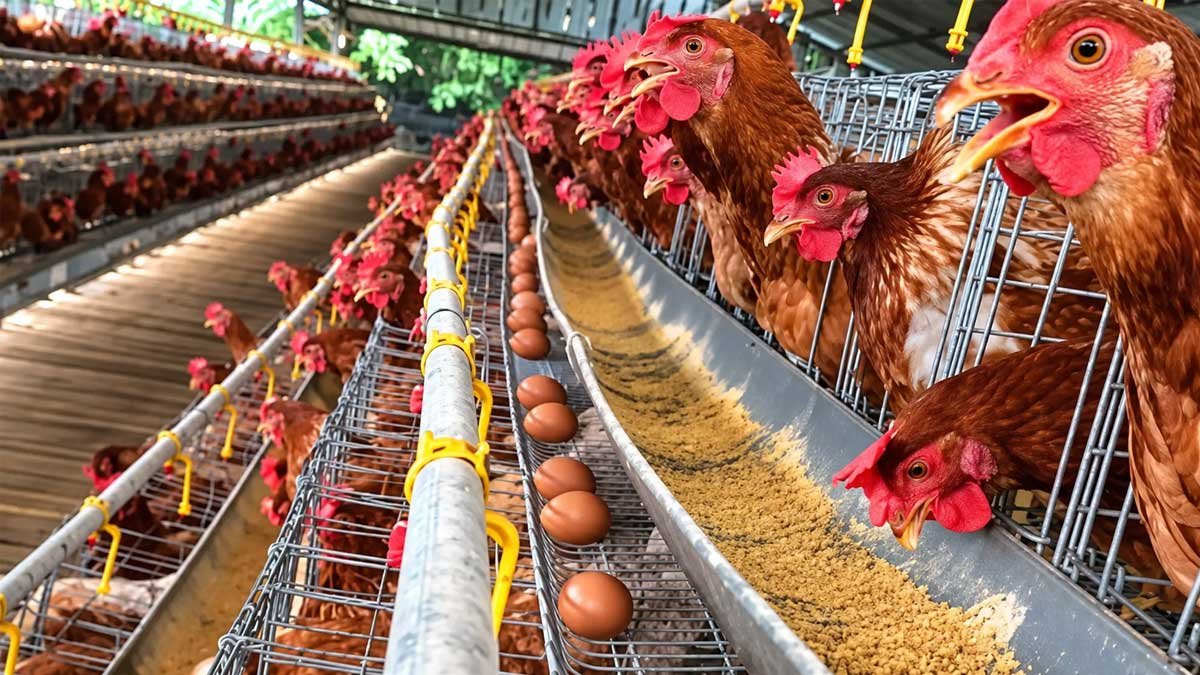
Local ingredients provide about 60% of Indonesia’s broiler feed formulation. Corn is the largest component at 45%, while rice bran or other local materials account for 5%. Palm kernel meal contributes another 5%, and crude palm oil or fat represents 5%. These figures show that the poultry sector already uses palm products, but at a much smaller scale than corn and imported protein ingredients.
Imported materials make up about 40% of broiler feed. Soybean meal is the largest imported component at 25%, followed by distillers dried grains with solubles at 5%, meat and bone meal at 3%, and corn gluten meal at 3%. Poultry by-product meal or hydrolyzed chicken feather meal supplies 2%, minerals or calcium 1%, and vitamins and feed additives 0.5% each. The size of soybean meal’s share means that any substitution would affect a core protein component rather than a marginal additive.
Layer diets have a slightly higher local share
Local raw materials account for 63% of layer feed. Corn again represents 45%, while rice bran or other domestic ingredients supply 8%. Palm kernel meal and crude palm oil or fat each contribute 5%. Imported inputs provide the remaining 37%, including soybean meal at 20%, distillers dried grains with solubles at 7%, meat and bone meal at 3%, corn gluten meal at 3%, and poultry by-product or hydrolyzed feather meal at 2%. Minerals or calcium account for 1%, with vitamins and feed additives at 0.5% each.
A successful formulation could create additional domestic demand for palm derivatives beyond vegetable oil and energy markets while lowering the poultry industry’s exposure to imported soybean meal. However, the ministry has not announced a commercial implementation date, expected import savings or a final substitution ratio. Progress will depend on research showing that a higher palm-based share can meet poultry nutrient requirements and preserve livestock performance. Until those results are available, soybean meal will remain a major part of both broiler and layer feed.