Indonesia Plans Presidential Regulation to Support Cocoa Strategy Through 2045
Indonesia is preparing a presidential regulation to coordinate its national cocoa strategy through 2045. The plan includes rejuvenating 100,000 hectares, mapping smallholder farms for traceability and strengthening 500 cooperatives.
Presidential framework to coordinate cocoa policy
Indonesia’s Coordinating Ministry for Food Affairs is preparing a presidential regulation to support the country’s national strategic cocoa program and coordinate policy across ministries and government agencies through 2045, ANTARA reported.
Radian Bagiyono, assistant deputy for improving the competitiveness of plantation and horticultural products at the ministry, said the regulation was intended to give government bodies and other stakeholders a common operational guide. The planned decree will support a long-term cocoa development strategy covering 2025-2045 and divided into four phases.
The initiative combines measures for cocoa production, smallholder organization, traceability, downstream processing and international market positioning. Its immediate priority is to stop the contraction of domestic output while preparing producers for sustainability requirements in global markets.
Replanting and traceability lead the first phase
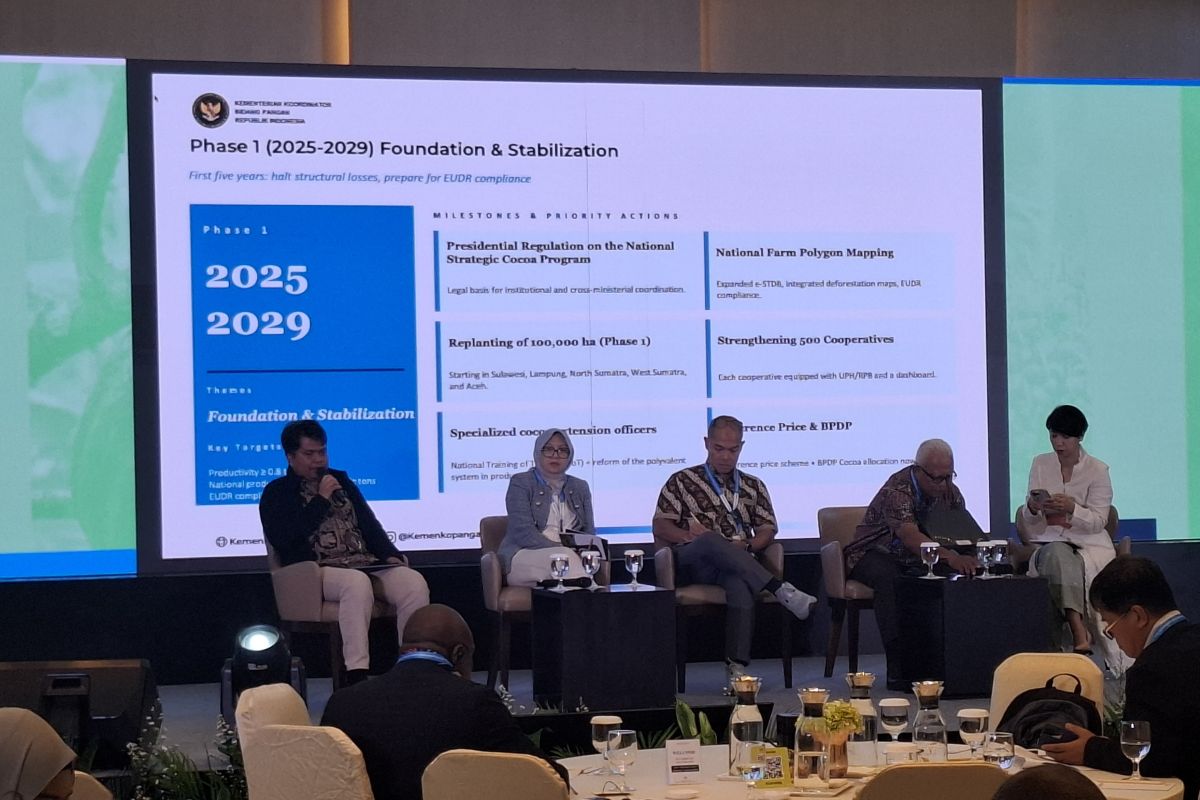
The first phase, covering 2025-2029, focuses on strengthening the sector’s foundations and stabilizing production. The government plans to rejuvenate 100,000 hectares of cocoa plantations, beginning in Sulawesi, Lampung, North Sumatra, West Sumatra and Aceh.
Authorities will also map smallholder cocoa farms to improve traceability, strengthen 500 cooperatives and expand assistance to farmers adopting good agricultural practices. Radian said traceability had been an obstacle for Indonesian growers seeking to market their cocoa abroad.
The program addresses a sector dominated by smallholders. Materials from the ministry show that about 99% of Indonesia’s cocoa plantation area is managed by small-scale growers. The total planted area declined from approximately 1.72 million hectares in 2015 to around 1.37 million hectares in 2025, a reduction of about 350,000 hectares over the period.
National cocoa productivity currently ranges from 0.7 to 0.9 tonnes per hectare. That is well below the potential yield of superior varieties, estimated at 1.5-2 tonnes per hectare. Closing even part of this yield gap would allow Indonesia to increase supply without relying entirely on an expansion of planted area, while raising income potential for farming households.
Processing and market positioning through 2045
The second phase, scheduled for 2030-2034, calls for faster and larger-scale rejuvenation, inclusive downstream development and stronger cooperatives and farmer institutions. The government also plans to develop geographical indications for cocoa, use plantation funds to reinforce upstream production and encourage greater participation by younger farmers.
During 2035-2039, the strategy aims to establish Indonesia as a regional reference point for cocoa in Asia. The final 2040-2045 phase seeks to position the country as a sustainable cocoa hub, with greater emphasis on specialty cocoa and international recognition for Indonesian cocoa brands.
The proposed regulation could give producers, processors and buyers a clearer policy timetable, but implementation will depend on coordination among agencies and delivery at farm level. Rejuvenating ageing trees can temporarily reduce harvestable area, making the sequence of planting, farmer support and financing important for processors that need reliable domestic bean supplies.
For exporters, traceability and better farm records could improve access to overseas customers with sustainability requirements. For domestic processors, higher yields and a more stable production base would strengthen raw-material availability. With smallholders controlling nearly all planted area, however, the strategy’s commercial impact will ultimately depend on whether cooperatives and extension services can translate the national framework into measurable gains in farm productivity and cocoa quality.