Indonesia Links Cocoa Farm Renewal to Processing Push
Indonesia is pairing cocoa downstream development with a large-scale renewal and expansion of smallholder plantations. The program targets 247,260 hectares through 2027 as domestic processors operate at only 51% of their combined 700,000-tonne capacity.
Government targets 247,260 hectares
Indonesia is linking its cocoa-processing ambitions to a three-year effort to rebuild the smallholder farms that supply the industry. Media Indonesia reports that the government’s 2025-2027 downstream-development program covers 247,260 hectares and combines the renewal of ageing plantations with the expansion of cocoa-growing areas.
The initiative responds to a sharp decline in Indonesia’s position among global cocoa producers. The country ranked third in 2010 but fell to seventh in 2025, with cocoa bean production of 200,000 tonnes in the 2024/2025 season. Average domestic yields stand at only 700-800 kilograms per hectare, compared with 1.5 tonnes per hectare in other producing countries, according to the publication.
Acceleration planned for 2026
The initial phase in 2025 delivered about 200 hectares of new cocoa area and renewed 4,066 hectares. For the mass-acceleration phase in 2026, the government is targeting 71,722 hectares of expansion and 102,488 hectares of renewal. A further 59,974 hectares are planned for the stabilization phase in 2027, comprising 19,700 hectares of expansion and 40,274 hectares of renewal.
Ebi Rulianti, director of plantation seed development at the Agriculture Ministry, said participating farmers would receive 1,000 seedlings per hectare as well as labor-cost assistance. The government is also revising Agriculture Ministerial Decree No. 25/Kpts/Kb.020/5/2017, which regulates the production, certification, distribution and supervision of cocoa planting material.
Processors face a raw-material gap
The upstream program is central to the economics of Indonesia’s existing processing base. The country has 11 cocoa-processing plants with combined capacity of 700,000 tonnes, but utilization is only 51%, according to Jefrey Haribowo of the Indonesian Cocoa Association-Cacao Sustainability Partnership. Indonesia has about 1.4 million hectares of cocoa land, although the area continues to decline and nearly 99% of plantations are owned by farmers.
The government has designated production gardens as sources of rootstock and scion material and is reactivating seed-source gardens that had become inactive. It is also encouraging industry stakeholders to seek official designation for seed-source and production gardens, while accelerating the issuance of the required decrees. Askindo CSP has called for faster access to high-quality planting material and more extension workers and facilitators focused on cocoa.
Funding extends from farms to commercial products
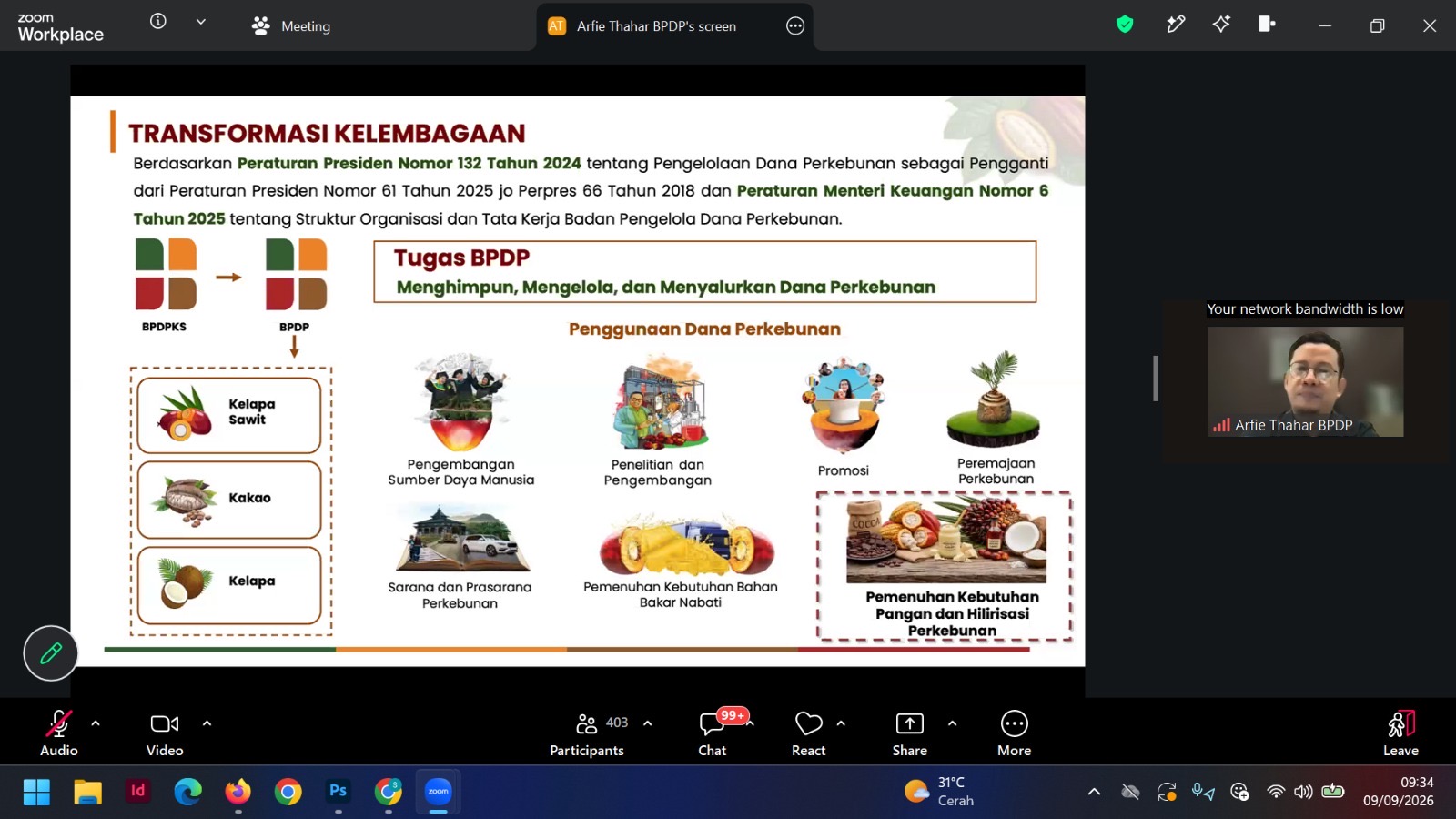
Arfie Thahar of the Plantation Fund Management Agency, or BPDP, said the agency supports renewal, infrastructure and workforce development through education and training. Upstream funding is coordinated with the Agriculture Ministry and follows technical recommendations from the Directorate General of Plantations.
For processing and market access, BPDP accepts proposals from companies, cooperatives, small and medium-sized enterprises, industry associations and research or higher-education institutions. Support can cover research intended to bring new cocoa products and technologies to the commercial stage. The program comes as global demand for cocoa and chocolate is rising by 2-3% annually, increasing the importance of securing enough domestic beans to raise plant utilization without weakening farmers’ position in the value chain.