Indonesia Debates a Dedicated Palm Oil Law to Untangle Overlapping Regulation
At a PWI-GAPKI journalism workshop in Yogyakarta on 28 August 2026, University of Jember law professor Ermanto Fahamsyah argued that Indonesia's palm oil sector is governed by six separate laws plus implementing regulations, producing overlap and weak enforcement. He renewed calls for a dedicated Palm Oil Law, stalled since 2015, and for an Indonesian Palm Oil Management Agency reporting directly to the President.
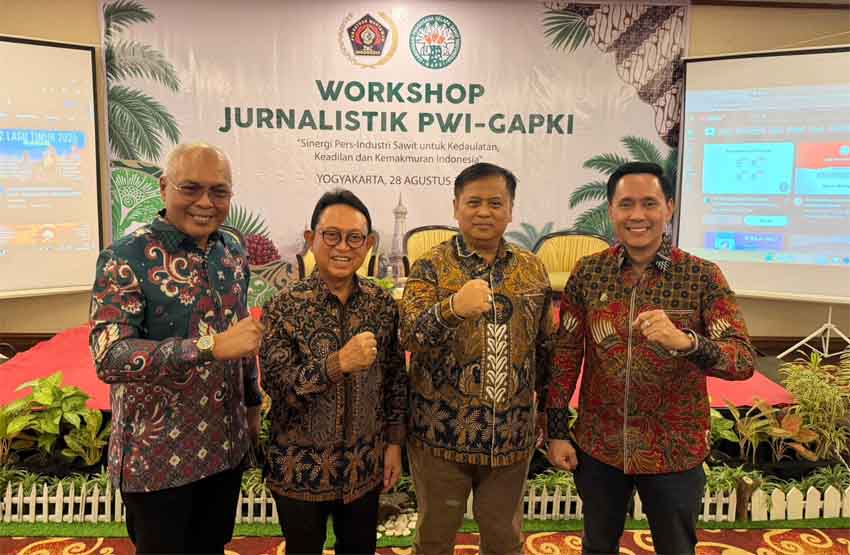
Indonesia's palm oil industry faces a legal problem no less serious than its production and market challenges: a body of rules that has grown dense without becoming coherent. That was the central message of a journalism workshop organised by the Indonesian Journalists Association (PWI) and the Indonesian Palm Oil Association (GAPKI) at the Loman Hotel in Yogyakarta on Friday, 28 August 2026, under the theme "Press-Palm Oil Industry Synergy for the Sovereignty, Justice and Prosperity of Indonesia", as reported by news.majalahhortus.com.
Speakers included PWI central board chairman Ahmad Munir, PWI Yogyakarta chapter head Hudono, GAPKI chairman Edy Martono, economic law expert Prof. Dr. Ermanto Fahamsyah of the University of Jember, INDEF economist Prof. Dr. Bustanul Arifin, and PWI deputy chairman for education Dr. Agus Sudibyo.
Six laws, none written for palm oil
Presenting on the legal position of palm oil and its implications for industry governance, Ermanto said the regulatory framework covering the sector is already extensive. It runs across the Investment Law, the Environmental Protection and Management Law, the Industry Law, the Trade Law, the Plantation Law and the Job Creation Law. At the implementing level, the government has issued Presidential Regulation No. 16 of 2025 on the Indonesian Sustainable Palm Oil (ISPO) certification system and Government Regulation No. 28 of 2025 on risk-based business licensing.
Volume has not delivered simplicity. According to Ermanto, the sector still contends with overlapping regulations, disharmony between rules and weak implementation on the ground. He argued that law functions not only as social control but as a tool of social engineering, and that a stronger legal system for palm oil must reorder the relationship between the state, the market and the public around social, economic and ecological fairness.
The complexity reflects the length of the industry chain, which covers plantation cultivation, processing into primary and downstream products, integrated plantation businesses, palm oil services and trade. Numerous ministries, government agencies, regional administrations, associations and professional bodies are involved, alongside a supporting ecosystem spanning fertiliser, seed, pesticide and farm machinery suppliers, financial institutions, insurers, digital services, transport and logistics, research and development, workforce training and certification bodies. That diversity can strengthen the sector through specialisation and institutional capacity, Ermanto said, but without adequate coordination cross-sector intervention produces regulatory overlap and fragmented governance.
EUDR raises the cost of fragmentation
Governance has become more consequential because of demands from export markets. The European Union Deforestation-Free Regulation (EUDR) lists palm oil among the regulated commodities. Under the rules set out in Ermanto's presentation, goods entering or leaving the EU must be deforestation-free, produced in accordance with the national legislation of the producing country, and covered by a due diligence statement.
That places legality, traceability, sustainability, environmental protection, human rights, labour standards and the protection of local and indigenous communities at the centre of Indonesian palm oil governance. Ermanto also stressed the need to strengthen implementation of Indonesia Sustainable Palm Oil (ISPO), which he described as more than a certification system: part of a commitment to ensure Indonesian palm oil is produced legally, transparently, traceably and free of deforestation.
A bill stalled since 2015 and a single-window agency
The proposal for a dedicated Palm Oil Law has been circulating since 2015. It entered the national legislation programme (Prolegnas) as a House of Representatives initiative in 2016 and 2017 and was designated a priority bill in the 2019 Prolegnas, but it has yet to secure political and legislative certainty. Ermanto argued its urgency has only increased as the industry's problems have grown more complex.
He proposed building the bill on philosophical, juridical and sociological foundations: social justice and sustainability as its purpose, a valid, integrated and nationally binding legal basis, and rules capable of answering real conditions on the ground. Its scope would cover planning, palm oil businesses, cultivation, processing industries, community protection and participation, standardisation, research and development, institutions, human resource development, financing, information systems, and guidance and supervision.
One idea on the table is an Indonesian Palm Oil Management Agency (BPPI), a non-structural institution reporting directly to the President and acting as a single-window policy centre integrating regulation, development and supervision from upstream to downstream. It is intended as a coordination node rather than an additional layer of bureaucracy, with functions including:
- harmonising regulations across ministries and agencies;
- strengthening protection for smallholder growers;
- accelerating sustainable palm oil certification;
- reinforcing Indonesia's position in global diplomacy and trade.
Ermanto's conclusion was that adding more regulation will not fix governance. "Overlapping regulation, weak institutional coordination, and environmental, human rights and global market challenges demand more integrated palm oil governance," the presentation stated.
