Indonesia's B50 mandate draws farmer and parliament calls to secure CPO supply
Indonesian palm oil smallholders and a member of parliament are pressing Jakarta to guarantee crude palm oil supply as the B50 biodiesel mandate lifts domestic feedstock demand to about 18.7 million tonnes in 2026. Farmer union SPKS wants periodic reviews of B50, flexible blending and mandatory partnerships with grower cooperatives, plus a review of the 12.5% export levy.
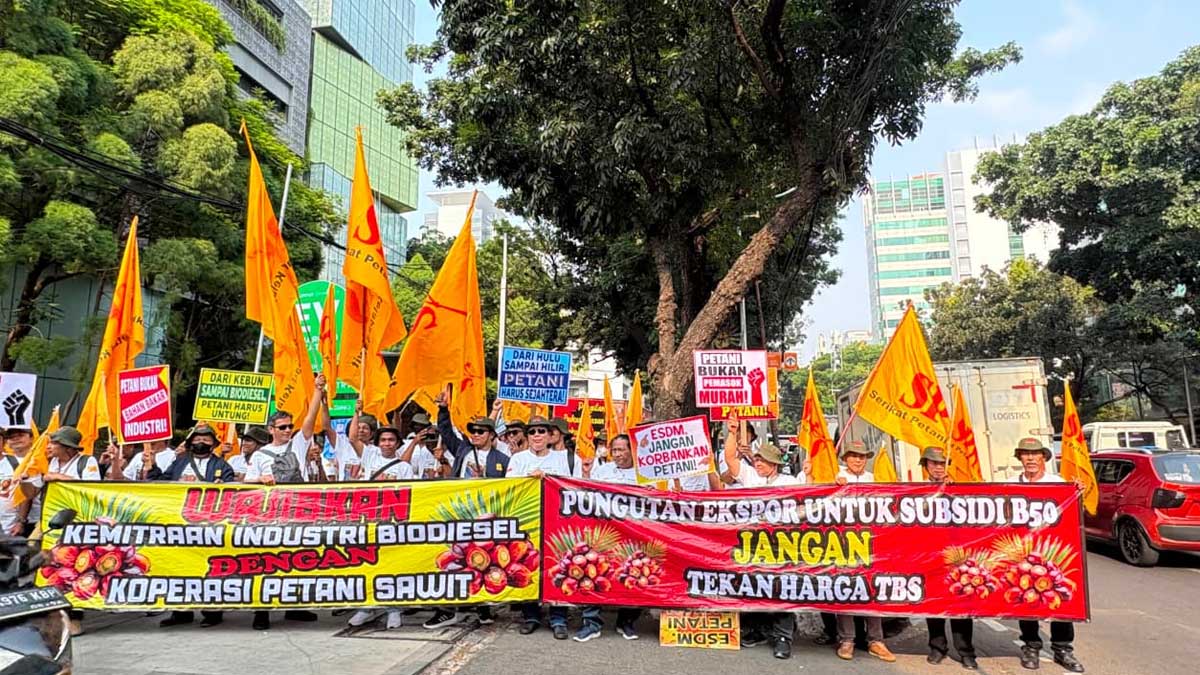
Palm oil smallholders and members of Indonesia's parliament are pressing the government to secure crude palm oil (CPO) supply and to review the B50 biodiesel blending mandate, which took effect on 1 July 2026 and is projected to absorb about 18.7 million tonnes of CPO this year.
The Indonesian Palm Oil Farmers Union (Serikat Petani Kelapa Sawit Indonesia, SPKS) set out its demands during National Farmers Day actions on 24 September 2026, InfoSAWIT reported on Saturday, 26 September 2026. In a separate statement carried by state news agency ANTARA, Novita Hardini, a member of Commission VII of the House of Representatives (DPR RI), asked the government to guarantee CPO availability as a raw material for national industry.
Farmers want cooperative quotas written into B50
SPKS campaigned under the theme “Farmer Inclusivity in the B50 Supply Chain and Cooperative-Based Biodiesel Downstreaming”. The union argues that rising feedstock demand for B50 has not automatically connected growers to the biodiesel supply chain. Many smallholders still sell fresh fruit bunches (FFB) through middlemen and intermediary traders, while supply relationships with biodiesel producers run through long trading chains that limit farmers' access to markets, price information, supply contracts and added value.
Its central demand is that the Ministry of Energy and Mineral Resources oblige biofuel business entities (Badan Usaha BBN) to build partnerships with grower cooperatives, so that part of the feedstock comes from smallholder production. SPKS also asks for:
- a quota or minimum requirement for farmer feedstock supplied through cooperatives in every B50 allocation, measurable and verifiable as part of allocation reviews;
- a legal route for grower cooperatives to become biofuel business operators, not only FFB collection points;
- periodic evaluation of B50 implementation and of the economic benefit reaching farmers;
- flexible blending, with the blend rate set against CPO availability, domestic needs and export market conditions.
Parliament presses on feedstock certainty and operating costs
Novita spoke after a Commission VII working visit to PT Multimas Nabati Asahan in the Wilmar Integrated Industrial Estate in Serang Regency, Banten, on Wednesday, 23 September, according to ANTARA. She questioned how much of industry's CPO requirement can be met from domestic plantations and pressed for stronger cooperation with plantation sources to secure continuity of supply.
“The state must be present to provide certainty of raw materials, cost efficiency, and policies that keep industry productive,” she said, warning that steadily rising operating costs could cost national industry its competitiveness. She also called for pollution oversight from the start of industrial expansion rather than after problems emerge, and asked the Ministry of Industry to set out export potential, the volumes international markets can absorb and the direction of policy.
Supply arithmetic behind the mandate
Indonesia is the world's largest CPO producer, with 2025 output of 51.66 million tonnes, up 7.26% from 48.16 million tonnes in 2024, ANTARA reported. Including palm kernel oil (PKO), total Indonesian palm oil production reached 56.55 million tonnes in 2025. Export volumes of palm products came to about 32.34 million tonnes, an increase of 9.51% on 2024, while domestic consumption was about 24.77 million tonnes.
Domestic demand comes from food, oleochemicals and biodiesel. Biodiesel consumption reached about 12.70 million tonnes in 2025 under the B40 mandate, and the Ministry of Agriculture projects roughly 18.7 million tonnes of CPO will be needed to support B50 in 2026. Imports offer little buffer: Directorate General of Estate Crops data show import volumes reached 10,590 tonnes in 2024 and declined in 2025.
Export levy and replanting funds
SPKS also wants the 12.5% CPO export levy reviewed. In its list of demands the union states that the levy depresses FFB prices while the majority of the funds collected are used for biodiesel incentives, and asks that the cost of financing biodiesel not end up as lower prices borne by farmers.
On plantation renewal, SPKS wants the Smallholder Palm Oil Replanting programme (PSR) simplified and accelerated, with support raised to Rp90 million per hectare including living-cost support during the replanting period. The union argues that biodiesel feedstock should be secured by raising productivity on existing smallholder plots rather than by opening new land. Separately, the government has been running a transition in export governance for strategic natural resource commodities through PT Danantara Sumberdaya Indonesia (DSI) since 1 June 2026, initially covering coal, CPO and ferroalloy, with full implementation targeted no later than 1 January 2027. Novita has previously asked that the change be handled carefully so it does not obstruct industries that have already built international market networks.
Full market analysis