Monsoon deficit of 15% cuts India's paddy area by 1.6 million hectares
A 15% shortfall in monsoon rainfall has reduced India's paddy sowing area by 1.6 million hectares, with Karnataka and Telangana worst affected. Retail food inflation is near 6% and fine rice prices have risen by up to 50% in some southern markets. India holds a 60 million tonne rice buffer stock, but the government may revisit the use of FCI rice in ethanol production.
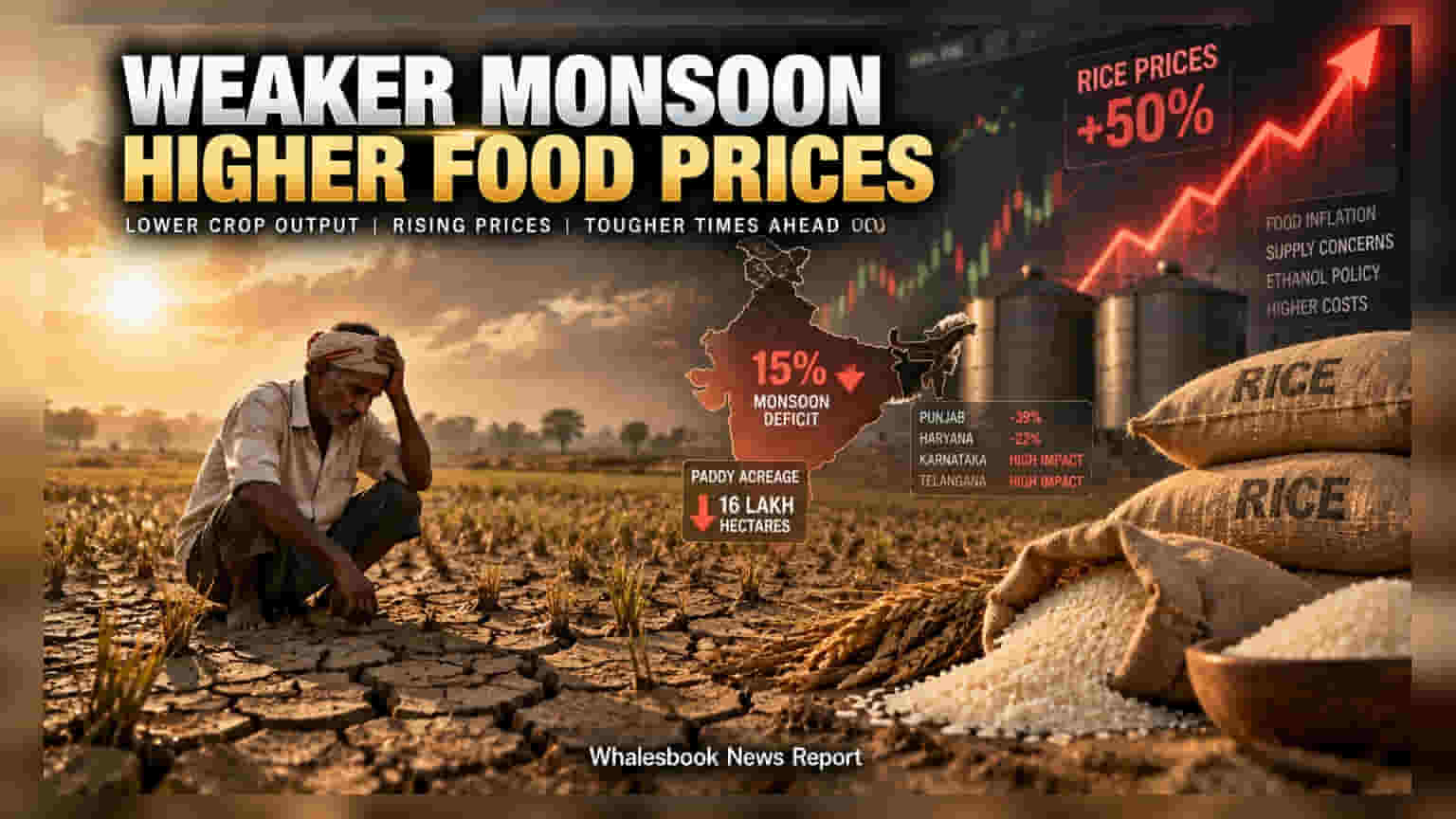
A 15% shortfall in monsoon rainfall has disrupted India's kharif season, cutting the area sown to paddy by 1.6 million hectares and pushing rice prices higher, according to a report by Whalesbook. The outlet said the deficit is already showing up in retail food inflation and could force the government to reopen decisions on its ethanol blending programme, with direct consequences for sugar and consumer goods (FMCG) companies.
Sowing losses concentrated in the south
Whalesbook cited data showing paddy acreage down by 1.6 million hectares, with Karnataka and Telangana the worst-hit states. The rainfall shortfall also extended to the northern grain belt, where Punjab recorded a 39% deficit and Haryana 22%.
- Monsoon rainfall deficit: 15%
- Reduction in paddy area: 1.6 million hectares
- Rainfall deficit: Punjab 39%, Haryana 22%
- Rice buffer stock: 60 million tonnes
Kharif paddy is the monsoon-sown crop and depends on rain arriving on time for transplanting, when fields need standing water. Where canal and tube-well irrigation is available, part of the gap can be covered, but that shifts cost onto power and groundwater and does not recover acreage that was never planted. A shortfall at that stage cannot be made up later in the season, because the transplanting window is fixed by the calendar and by water availability. The report did not quantify the expected fall in output, linking the smaller sown area directly to the rise in prices.
Prices move ahead of official inflation
Retail food inflation is already running close to 6%, according to the report, and prices for fine rice varieties have jumped by as much as 50% in some southern markets. Those increases are variety-specific and local rather than nationwide, but they set the tone for procurement costs facing millers, traders and packaged-food buyers.
The price signal is not reaching every farmer. Whalesbook noted that growers in areas such as Rajasthan are not obtaining fair prices for pulses and oilseeds, holding down farm incomes even as cereal prices climb. Pulses and oilseeds are the main kharif alternatives to paddy in drier districts, so weak realisations there remove the fallback that usually cushions a poor rice year. The report flagged the combination as a risk to consumer spending, since rural demand depends on realised crop prices rather than headline market quotes.
Ethanol blending becomes the swing factor
India holds a rice buffer stock of 60 million tonnes, which the report described as a cushion against shortage rather than a guarantee against inflation. A substantial volume of rice held by the Food Corporation of India (FCI) currently goes to ethanol production. If the government gives priority to food security, Whalesbook said, that raw material supply to ethanol producers could be interrupted abruptly.
That is the decision point for two sets of companies. Distilleries and sugar producers that run grain-based lines alongside cane-based capacity would face a feedstock question if FCI allocations are curtailed. FMCG manufacturers, which buy rice, flour and other grain-derived inputs, face the opposite problem: higher raw material costs compressing margins. Neither group has visibility until the government acts. The report advised investors in the sugar and FMCG sectors to track official decisions closely, since the timing and scale of any policy shift will determine how much of the cost increase reaches the consumer.