Honduras coffee exports climb 17.6% past $2 billion as value per bag falls
Honduras shipped about 6.49 million 46-kilogram bags of coffee through July 2026, up 17.6% year on year, with export earnings of $2,016.5 million, according to Banco Central de Honduras data cited by tunota.com. Revenue rose only $12.1 million, leaving average value per bag lower. Producers at the Honduran Coffee Expo in Comayagua are pressing to convert volume into higher-quality coffee.
Volume climbs 17.6%, revenue barely moves
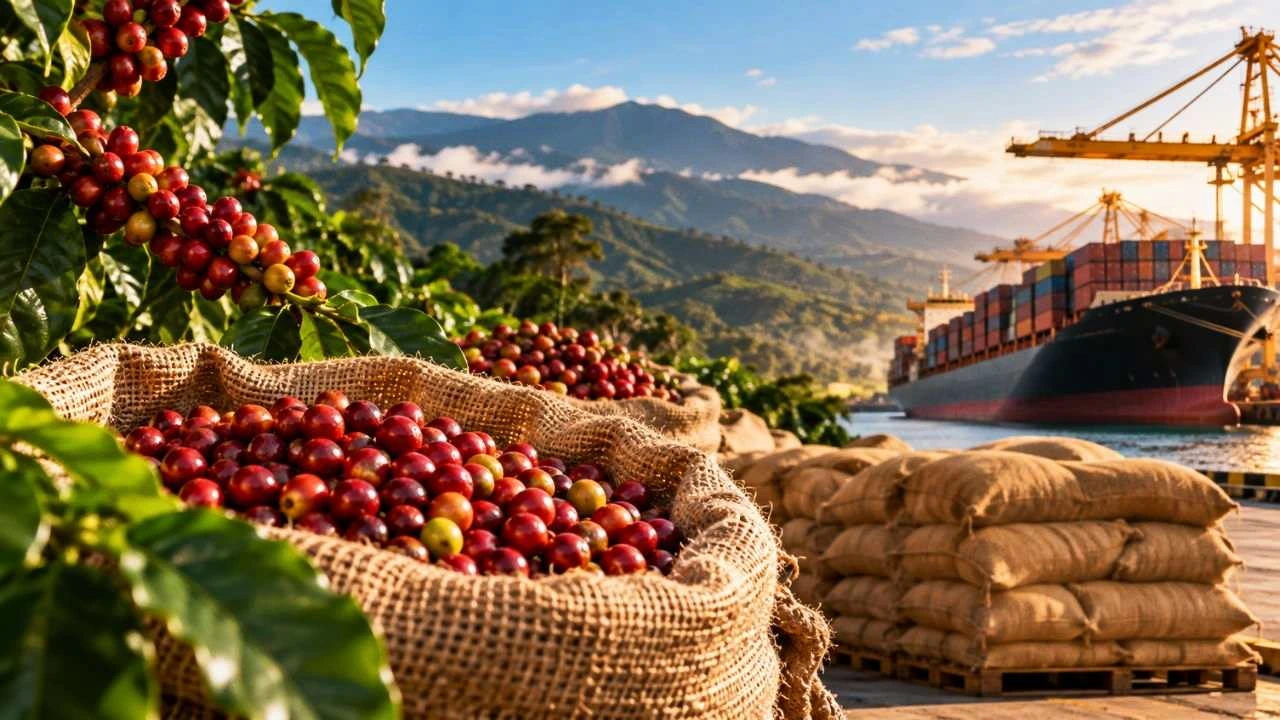
Honduras exported some 6.49 million 46-kilogram bags of coffee through July 2026, against roughly 5.52 million bags in the same period of 2025, according to Banco Central de Honduras (BCH) data cited by tunota.com. The 17.6% increase equals about 969,100 additional bags, or close to 298,500 tonnes of coffee shipped in the period.
Earnings did not follow volume. Shipments generated $2,016.5 million, only about $12.1 million more than the same period a year earlier — implying receipts of roughly $2,004.4 million in 2025 and revenue growth of about 0.6%. The result is a visibly lower average value per bag; tunota.com puts that decline at around 11%.
The gap between tonnage and takings frames the debate now running through the Honduran industry. The country has secured the hardest part of the business — millions of bags and buyers for them — but is capturing less per unit than a year ago.
Two markets absorb half of Honduran coffee
The United States accounts for 32.7% of Honduran coffee exports and Germany for a further 17.1%, tunota.com reported. Together the two destinations take practically half of shipments, and both are mature markets where differentiated and certified lots command premiums over commodity-grade coffee. Honduras remains among the largest producers in Latin America.
Speaking at the Honduran Coffee Expo in Comayagua, producer Leonel Enrique Ortez argued that the opportunity lies in converting a larger share of that volume into higher-quality coffee rather than abandoning the volume model. "We have an enormous amount of volume and lately we have a great many very good quality coffees. Unfortunately, what we have most of is volume," he said.
"If we turn that volume into quality volume, it would help us enormously to generate a great deal of foreign exchange and a great deal of resources for the country," Ortez added. He said Honduras is not starting from zero, since the country already has numerous coffees of very good quality; the challenge is widening that share inside a crop dominated by bulk.
Input costs and weather squeeze the farm gate
Moving up the quality ladder requires spending at a time when on-farm costs are rising. Producers face higher fuel prices that feed through into other inputs needed to maintain plantations, with agrochemicals and fertilizers forming part of a heavier bill, according to tunota.com. Weather adds a variable growers control even less:
- Fuel price increases passing through to other plantation inputs
- Rising agrochemical and fertilizer costs
- Lack of rain, which keeps plants under stress and can favour certain pests
- Excess rain, which also damages plantations and complicates work on yield and quality
Credit without training risks new debt
Ortez said raising quality does not depend on financing alone. Handing resources to smallholders in the interior of the country without accompanying knowledge can turn into a further problem, he argued, and he proposed pairing access to capital with financial education and technical assistance delivered on the farms themselves. A producer needs to know not only how to obtain money, but where to invest it and how to use it to strengthen production without ending up trapped by financial obligations.
The export data describe an industry able to move very large quantities of product and foreign exchange: more than six million bags shipped through July and $2,016.5 million in receipts. The challenge producers are now putting on the table is not to replace that volume model but to extract more value from it — so that each bag leaving Honduras is worth more, not merely that more bags leave.