Heat and drought stress hops and summer barley in Germany and Austria
Persistent heat and a lack of rainfall in Germany and Austria are weighing on hops and summer barley, the two raw materials brewers cannot substitute. Farmers and brewers are assessing whether the field stress will translate into tight supply around the Oktoberfest season. No harvest or price figures have been published so far.
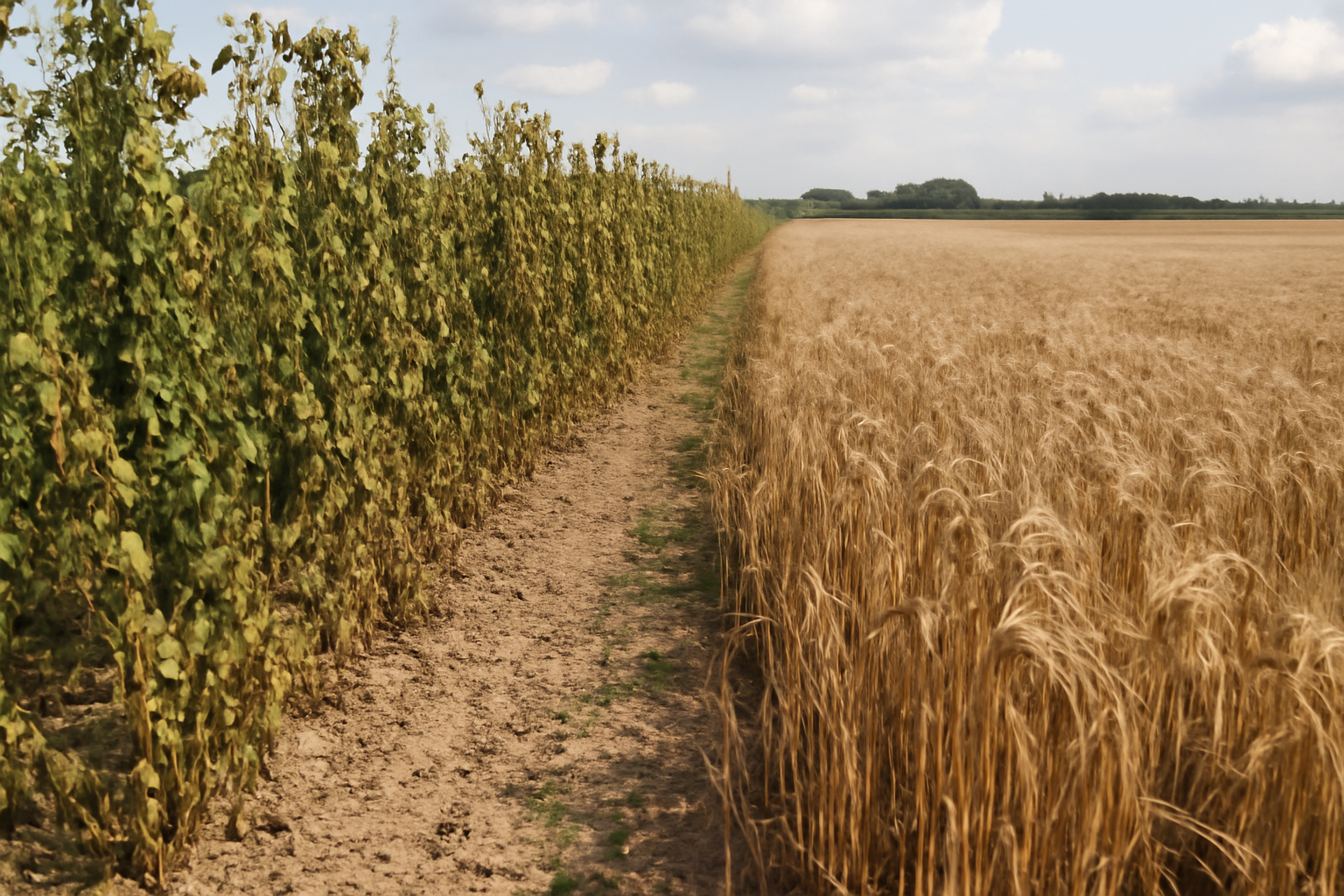
Persistent heat and a lack of rainfall in Germany and Austria are weighing on two crops that brewers have no way to substitute: hops and summer barley, the spring-sown grain behind brewing malt. Reporting from the German-speaking growing regions puts the issue bluntly — without hops there is no beer — and asks whether stress in the fields will reach the market as a supply squeeze around the Oktoberfest season. Farmers and brewers are still assessing the extent of the damage.
No hops, no beer
Hops are among the most weather-sensitive crops in European agriculture. The plant is a perennial climber that builds its entire yield within a narrow summer window and needs both water and moderate temperatures while the cones develop. Heat during that phase shortens the growing period and limits cone formation; drought compounds the effect, because the bines draw heavily on soil moisture exactly when demand peaks.
Geography sharpens the exposure. German hop production is concentrated in the Hallertau region of Bavaria, with smaller areas elsewhere, while Austrian growing is limited to a handful of districts. That concentration means a single regional weather event hits a large share of national output at once, rather than being averaged out across many growing areas.
The commercial issue for brewers is not only tonnage. Hops are bought for their bittering and aroma compounds, and field stress can move alpha-acid content as much as it moves harvest volume. A crop that looks acceptable by weight may still deliver less brewing value per kilogram, forcing brewers to adjust dosing rates or draw on contracted reserves. Because hop acreage cannot be expanded within a season — new plantings need years to reach full bearing — the supply response to a poor year is slow by design.
Summer barley decides the malt
The second pressure point is summer barley. Sown in spring and harvested in mid-summer, it has a short vegetation period and little buffer against a hot, dry stretch at the wrong moment. Malting barley is judged on specifications rather than tonnage alone: grain size, uniformity and protein content determine whether a lot is accepted by maltsters or diverted into the feed market at a lower price. Drought stress typically pushes protein up and kernel size down, which is precisely what malting contracts penalise.
That creates a two-layer risk for the malting chain. Even where harvested volumes hold up, the share of the crop meeting malting grade can fall, tightening the pool available to maltsters and lifting the premium malting barley commands over feed barley. Buyers working on annual contracts feel this with a lag; spot buyers feel it immediately.
What brewers are watching
- Harvest volumes and alpha-acid values from the German and Austrian hop regions once picking is complete.
- The malting-grade share of the summer barley crop and the resulting premium over feed barley.
- Contract coverage: brewers holding multi-year hop and malt contracts are insulated for the current season, uncontracted volumes are not.
- Whether shortfalls in one country can be covered from the other, or from hop and malting barley origins outside the German-speaking area.
A beer shortage is not the automatic outcome. Brewers hold malt and hop inventories, hop contracts commonly run several years forward, and the industry has absorbed weak harvests before by blending across crop years and origins. The nearer-term effect usually shows up in raw-material costs and in how much flexibility brewers retain over recipes and new product launches, rather than in empty taps.
No harvest figures, acreage data or price levels have been published alongside the current warnings, so the scale of any shortfall remains open. Until the hop crop is picked, dried and analysed, and until malting barley lots are tested, the assessment from farmers and brewers stays qualitative.