Export demand lifts 1509 basmati paddy to record 4,400 rupees per quintal in Haryana
Paddy arrivals have accelerated in Haryana's grain markets and the 1509 basmati variety is selling at 3,800 to 4,400 rupees per quintal, a record for the variety, Dainik Jagran reported from Kaithal. Exporters tie the level to firm domestic and overseas demand, with Iran described as the strongest destination and a 1.2 million tonne rice market. Procurement of 1509 is being done mainly by private agencies, while government agencies buy PR paddy at a support price of 2,461 rupees per quintal.
Record prices for the 1509 variety
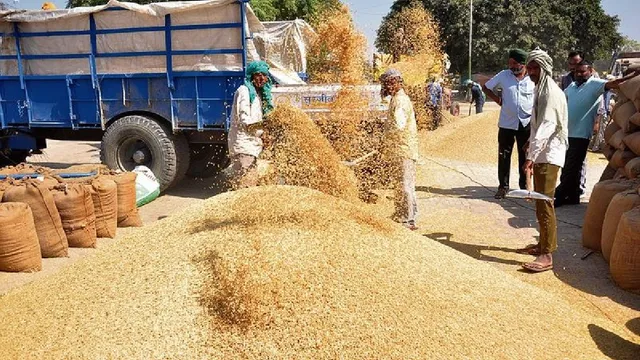
Paddy arrivals have accelerated in Haryana's grain markets and the 1509 basmati variety is proving the most profitable crop of the season for growers, Dainik Jagran reported from Kaithal. The variety has broken all of its previous price records: in Kaithal and in other mandis across the state, 1509 paddy is selling at between 3,800 and 4,400 rupees per quintal. Per-acre yields are also running well, according to the report.
Exporters quoted by the newspaper link the price level to firm demand for rice in both the domestic market and abroad. Individual lots have changed hands slightly above the quoted band: Madan, a farmer from Kakaut village, said his paddy sold at 4,460 rupees per quintal because the grain was dry and clean.
Iran leads the export pull
Iran currently shows the strongest demand, Dainik Jagran reported. The publication puts the Iranian market at 1.2 million tonnes across all rice varieties and says Iran is the largest destination for Indian rice exports. Milled-rice values for the variety are quoted at the same levels in export and domestic business:
- 1509 steam rice: 8,600 to 9,000 rupees per quintal
- 1509 sella (parboiled) rice: 8,400 rupees per quintal
- 1509 paddy in the mandis: 3,800 to 4,400 rupees per quintal
- PR paddy minimum support price: 2,461 rupees per quintal
At the mandi levels reported, 1509 paddy is trading roughly 1,300 to 1,900 rupees per quintal above the support price fixed for PR paddy, which is bought by government agencies. On the figures given by the growers quoted by Dainik Jagran, the variety is also worth around 1,200 rupees per quintal more than it was a year ago.
Farm-level returns
Satnarayan, a farmer from Roheriyan village, said he had planted 1509 on 10 acres and received 3,900 to 4,000 rupees per quintal. A year earlier he had sown paddy on 30 acres and was paid 2,700 to 2,800 rupees per quintal, which left him without meaningful profit. He said this season's returns have covered last year's losses, with earnings of more than 100,000 rupees per acre.
Madan said he had sown about three acres of the variety. Rainfall in the area was below average this season, but output in the fields has still been good, he said. His yield averaged 58 maund per acre and the crop brought in close to 100,000 rupees per acre, or more than 300,000 rupees from the three acres.
Private buyers, state procurement in the background
Shyam Bahadur Khurania, president of the old grain market, said arrangements had been put in place in the mandi for farmers. Procurement of basmati 1509 is being carried out mainly by private agencies and growers are receiving good prices in line with the market, he said. Purchases of PR paddy have also started in the mandi and are being handled by procurement agencies, with the minimum support price for PR paddy set at 2,461 rupees per quintal.
The current premium contrasts with the position a decade ago. In 2015, output of 1509 in Haryana was very high while demand for the rice was weak, and the variety found no buyers. Farmer unions and growers held protests over paddy procurement in the state's mandis, after which the state government bought 1509 at a minimum support price of 1,800 rupees per quintal. In 2020 it was decided that 1509 would be procured at the support price whenever its market rate fell below that of PR paddy.