Greek table olive exports fall in H1 2026, first decline in a decade
Greek table olive exports fell about 1% in value and 2.25% in volume in the first half of 2026, ending ten years of continuous growth. The decline follows a record 2025 of 282,000 tonnes worth 872 million euros and is attributed to US tariff turbulence, weaker EU demand and Egyptian price competition.
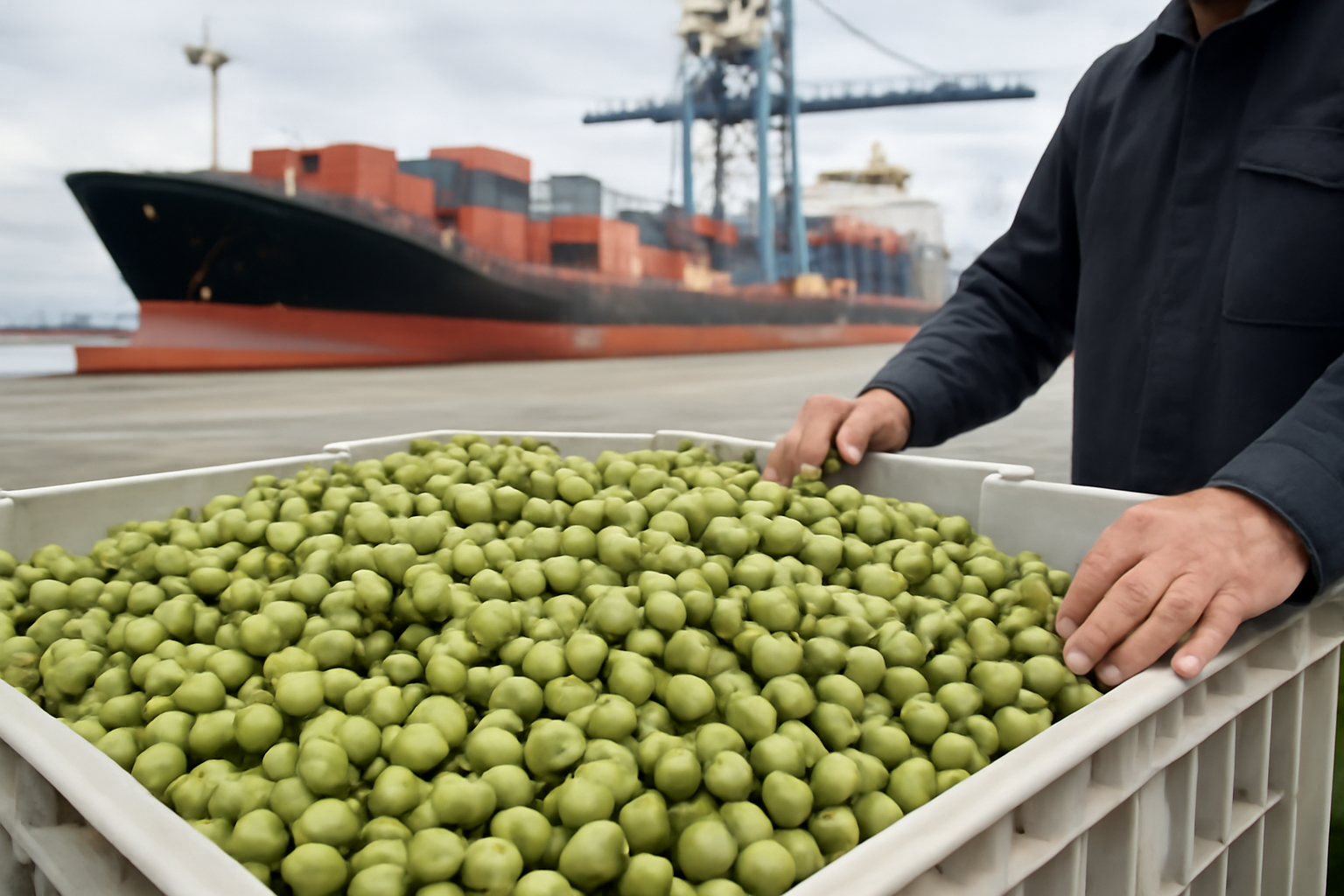
Greek exports of table olives declined in the first half of 2026, breaking a decade of continuous growth in what Kathimerini describes as the leading export product of the country's agri-food sector. Exports fell by roughly 1% in value and 2.25% in volume against the same period a year earlier, and estimates for the full year are not optimistic.
The figures were presented by Kostas Zoukas, president of the Panhellenic Union of Processors, Packers and Exporters of Table Olives (PEMETE), at the annual conference of the Panhellenic Exporters Association. The reversal follows a record year: in 2025 Greece exported 282,000 tonnes of table olives worth 872 million euros. Kathimerini describes the combination of pressures now facing the sector as a perfect storm.
Tariff turbulence in the biggest market
The United States is the largest market for the Greek product and the main source of the decline. US tariffs, and above all the disruption caused by the repeated changes in the tariff policy of the Trump administration, which has gone as far as order cancellations, cut exports of table olives to the US by 6%, according to Kathimerini. A further 5% decline was recorded in the first half of 2026.
Demand inside the European Union is the second drag on volumes. The inflationary crisis and the loss of purchasing power across the bloc have reduced orders from the largest markets, with Germany the clearest example. Weaker orders from major European buyers feed directly back into packing and processing volumes in Greece.
Egypt gains share in Australia
Greece has been the main supplier of table olives to Australia since 2007 and still holds 79% of that market by value. It is now losing ground to Egypt, whose table olives carry a considerably lower price. The Egyptian share has climbed to 17.5%, from just 3.1% three years ago, according to the data presented at the conference. That shift is the clearest sign that the sector's export position is being tested on cost rather than on quality or availability.
Mercosur deal closes a door, India opens a distant one
The EU agreement with the Mercosur countries is a further concern for the industry. The deal provides for the gradual elimination of tariffs on table olives originating in Mercosur countries over a seven-year period, starting from the current level of 12.8%. European table olives, by contrast, will continue to face duties of around 12.6%. Initial expectations that the agreement would open Brazil, the second-largest olive-consuming country after the United States, to Greek product have now faded.
Brazil's import mix underlines the distance still to be covered: Argentina accounts for 50% of the country's olive imports, Egypt for 25% and Peru for 20%, while Greece holds less than 1%.
Attention within the sector is now turning to India, following the signature last January of the free trade agreement between the European Union and India. India currently imports only 5,000 tonnes of olives, in a market Kathimerini describes as having 2 billion inhabitants, which implies substantial room for growth but only over a longer horizon.
High stocks meet the new season
The immediate consequence is that the new commercial season is opening with the sector holding high olive stocks, particularly of the Chalkidiki variety. That overhang is expected to push prices downwards as the new crop moves through processors and packers.
Separately, Greek feta production recorded a sharp decline, attributed to outbreaks of animal disease.