Greek food prices fall 0.2% in first full month of price-cut initiative
Greek food, alcohol and tobacco prices fell 0.2% year on year in September, the first full month of a national price-cut initiative covering 1,740 products. Dairy price increases introduced in October will test whether the improvement can last.
Food prices diverge from headline inflation
Greek prices for food, alcohol and tobacco fell 0.2% year on year in September, moving in the opposite direction from the country’s broader inflation trend. According to preliminary Eurostat data reported by Proto Thema, Greece’s harmonised headline inflation accelerated to 5.1% from 3.7% in August.
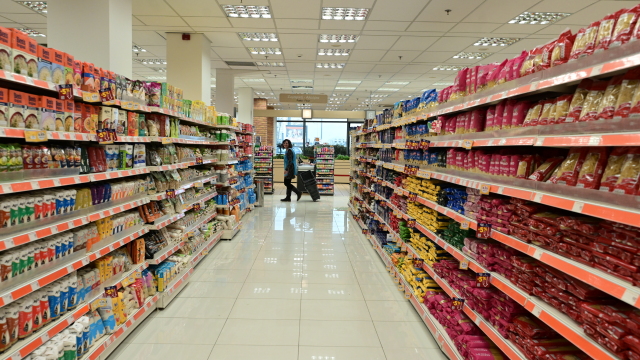
The September reading marked the first full month of Greece’s National Price Reduction Initiative. The program, promoted by Development Minister Takis Theodorikakos with the participation of manufacturers and retail chains, covers 1,740 product codes. Development Ministry sources cited by Proto Thema said the initial figures indicated that the initiative had made a positive contribution, although the data alone do not isolate its effect from other market forces.
Food inflation stabilises near zero
The food measure has remained close to zero since July. It declined from 2.2% in June to -0.3% in July, edged up to 0.1% in August and returned to -0.2% in September. Over the same period, headline harmonised inflation rose from 2.7% in July to 3.7% in August and 5.1% in September. The divergence suggests that food was not the source of the latest acceleration in Greece’s overall price index. Final data will provide a fuller breakdown of the components.
Greece was one of only four euro-area countries reporting negative inflation in the food, alcohol and tobacco category. Latvia registered -3.1%, Slovakia -1.9% and the Netherlands -0.6%, while the euro-area average was 1.4%. At the other end of the range, Cyprus recorded 3.4%, Luxembourg 3.3%, Bulgaria 2.5%, Malta 2.4% and Italy 2%.
Dairy increases create an October test
The wider inflation environment remains difficult. At euro-area level, energy inflation increased to 18.8% in September from 14.3% in August, while services inflation rose to 3.2% from 3%. This makes the decline in Greek food prices more notable, but it also means manufacturers, suppliers and retailers continue to face cost and demand pressures outside the grocery category.
The September food reading describes conditions before a new round of increases took effect. October began with higher prices for 100 dairy product codes, following an earlier round of increases in the same category in July. Proto Thema reported that manufacturers and suppliers are weighing cost pressures against competition and consumers’ ability to absorb further increases, particularly ahead of the holiday period, when consumption traditionally strengthens.
Retail rules may restrain broader increases
The market is now testing whether the stabilisation seen since July can continue. Under the current framework, a product whose price is increased cannot be placed on promotion for three months. That restriction creates an additional commercial disincentive to raise prices in a highly competitive retail market.
For producers and retailers, the key issue is whether the dairy revisions remain limited to the 100 affected codes or spread into a broader repricing cycle. For consumers, September brought measurable relief in food even as headline inflation climbed. October will show whether the national initiative and promotional restrictions can contain supplier cost pressures without weakening product availability or retail competition.