Ghana seeks investment in production and logistics to defend global yam export lead
Ghana’s exporters are calling for more investment in yam production, storage, finance and logistics to protect the country’s position in the international market. Industry data show a wide gap between Ghana’s large harvest and the relatively small volume reaching overseas buyers.
Exporters press for investment
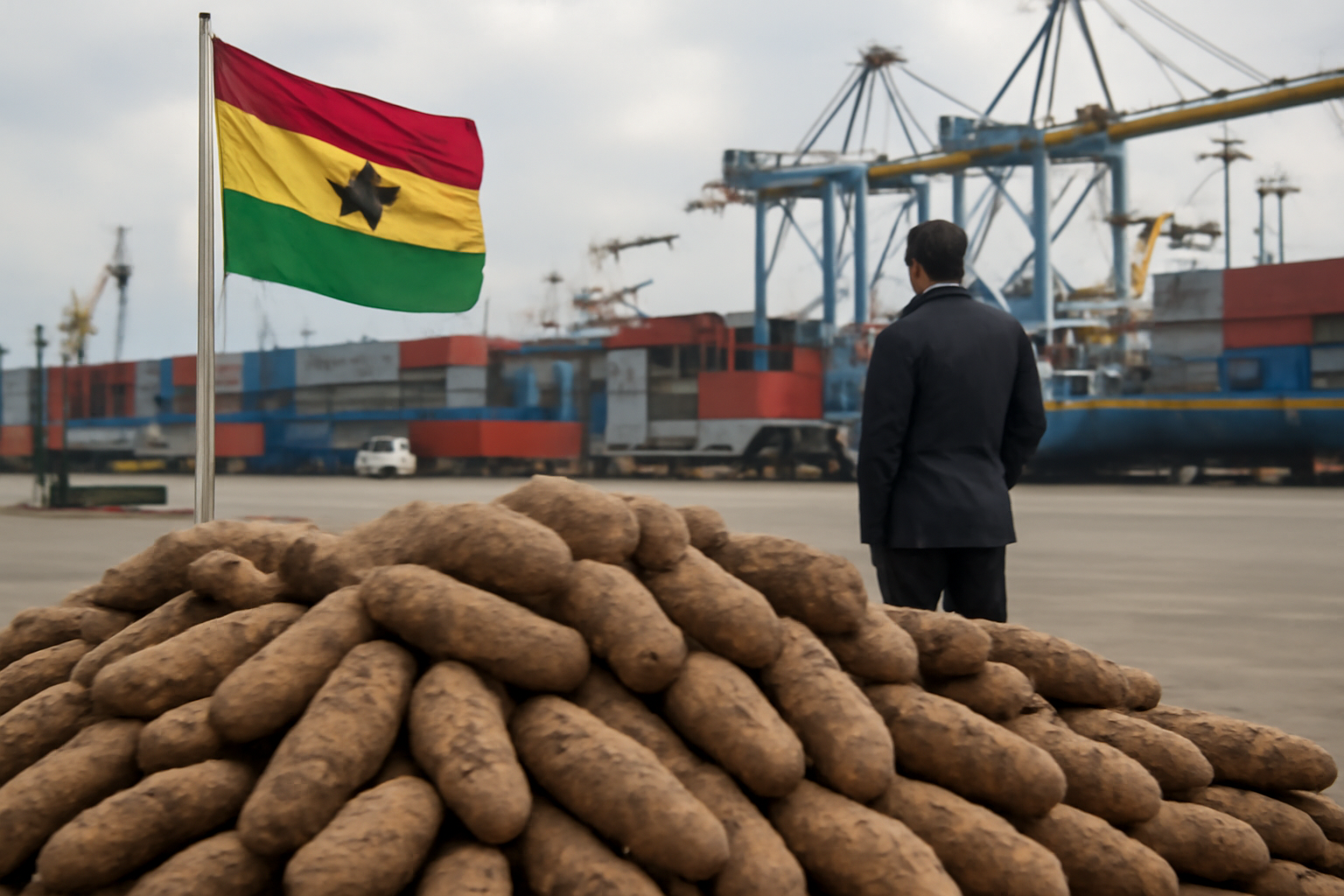
Ghana needs more investment in yam production and export infrastructure to maintain its position in the global market, according to Davies Narh Korboe, president of the Federation of Associations of Ghanaian Exporters. GhanaWeb reported that Korboe described the country as the world’s leading yam exporter and called for stronger financial support for the industry.
The claim is consistent with several industry assessments, although rankings vary by year and methodology. The Ghana Shippers’ Authority said Ghana ranked first by yam export value in 2021, with shipments worth $37.6 million, narrowly ahead of Jamaica at $37.5 million and the United States at $27.1 million. A separate industry profile citing Ghana Export Promotion Authority data recorded exports of $13.43 million in 2020 and $11.49 million in 2021, corresponding to 38,566 metric tonnes and 34,786 metric tonnes. The differing figures underline the need to distinguish between datasets, product definitions and reporting periods.
Production scale does not guarantee export supply
Ghana’s advantage rests on a large production base and established demand for its white yam varieties. An industry profile says the country produces about 8 million tonnes annually. Academic research published by IntechOpen places Ghana behind Nigeria in production but identifies it as the leading exporter, shipping approximately 21,000 metric tonnes a year to markets in Europe, the Americas and Africa.
Only a small share of the crop enters formal export channels. A Food and Agriculture Organization analysis found that yam exports represented less than 0.01% of national production in the period it examined. It identified weaknesses in production, handling and trading systems, while noting that poor coordination among traders contributed to oversupply and a collapse in international prices in 2006. Seasonal availability, fragmented smallholder production and tuber rot have also limited exporters’ ability to supply preferred white yam varieties throughout the year.
Finance, storage and cargo capacity are critical
Export associations have previously identified limited access to finance and inconsistent compliance with standards and specifications as urgent constraints. In 2022, Ghana Exim Bank announced a $10 million commitment for yam production and exports, while USAID was prepared to invest $25 million for the same purpose, according to the Ghana Shippers’ Authority. The authority also engaged cargo airlines over space for perishable shipments and participated in efforts to improve Ghana’s temperature-controlled cargo industry.
Investment priorities extend from quality seed and commercial farming to sorting, packaging, storage and transport. Better seed availability could raise yields and reduce disease, while improved warehouses and handling systems could limit rot and preserve export quality. Reliable air cargo remains important for faster deliveries, while efficient sea freight can support larger volumes at lower transport cost. For Ghanaian producers and exporters, defending market leadership will depend less on headline production than on delivering consistent grades, quantities and schedules to overseas buyers.