Germany Has EU’s Second-Largest Fruit and Vegetable Wholesale Sector
Germany has the EU’s second-largest fruit and vegetable wholesale sector after Spain, within a market of almost 45,000 companies. Despite gradual consolidation, the ten largest wholesalers account for only an estimated 12% of sales, while average EBITDA margins remain near 3%.
A large but fragmented European market
Germany has the European Union’s second-largest fruit and vegetable wholesale sector, behind Spain, according to FreshPlaza. Its position reflects the scale of the German consumer market and the breadth of businesses operating between growers, overseas suppliers and retailers. These companies do more than trade produce: their activities include cultivation, importing, ripening, sorting, cold storage, packing, logistics and supermarket delivery.
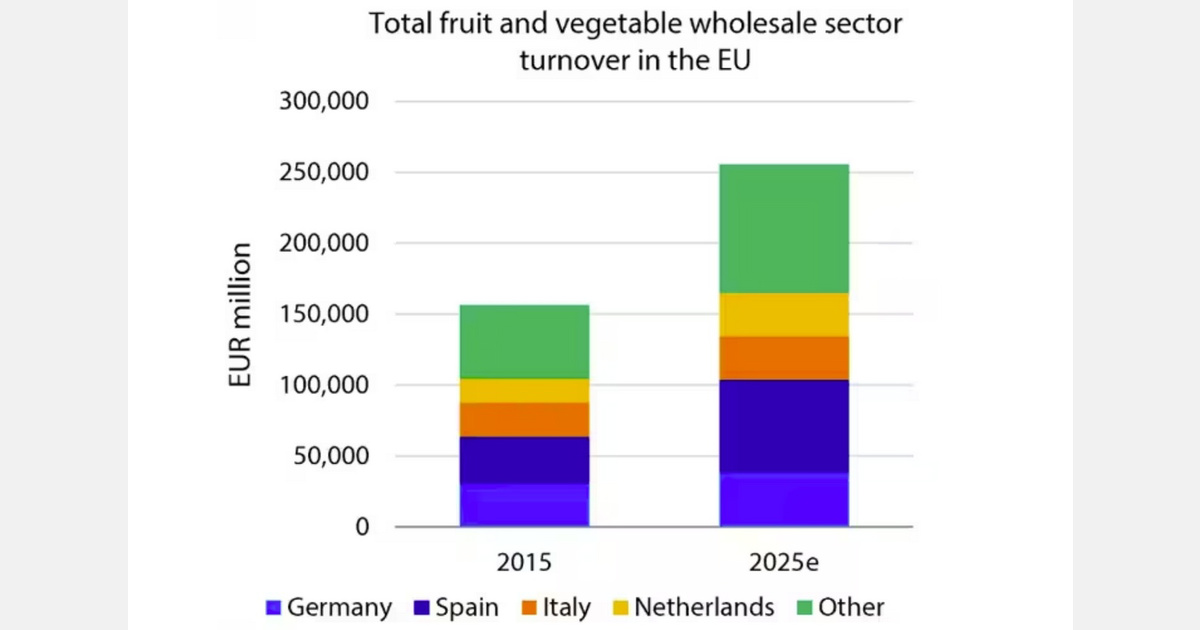
Eurostat data cited by FreshPlaza show that almost 45,000 companies operate in EU wholesale trade for fruit, vegetables and potatoes. Together, they employ about 450,000 full-time workers. Total sector revenue for 2025 was estimated at around $299 billion, making produce wholesaling a major part of Europe’s food distribution system.
Revenue has increased by an average of 5% annually over the past ten years. FreshPlaza attributes that growth primarily to higher imports, inflation and a shift toward higher-value fruit. Consumption has contributed less: per-capita fruit and vegetable demand has barely grown over the decade, although it recorded a modest increase during the latest three years.
Imports widen the field of suppliers
The market remains highly fragmented despite consolidation elsewhere in the food supply chain. The ten largest EU wholesalers are estimated to control only 12% of the market. The number of companies increased between 2012 and 2021 but has declined slowly since then, indicating gradual consolidation rather than a rapid concentration of sales among a few groups.
Growing overseas supply has also created room for new importers and specialized distributors. Peruvian customs data show that the number of EU companies importing blueberries from Peru rose from 30 in 2015 to more than 150 in 2025. The group includes European businesses as well as distribution subsidiaries established by exporters from Peru, Chile and South Africa.
Supply-chain integration is producing additional types of wholesalers. Grower-owned trading companies and retail procurement organizations now operate alongside traditional importers. At the same time, specialist providers are expanding services such as ripening, grading, refrigerated storage and packing. This division of functions helps explain why the sector can remain fragmented even as individual supply chains become more integrated.
Margins depend more on activity than size
An analysis of more than 10,000 European fruit, vegetable and potato wholesalers in the Moody’s Orbis database found an average EBITDA margin of about 3%. Company size had only a limited effect on profitability. Operating model, sales channels, crop mix and regional competition were more important determinants of margins.
Larger businesses nevertheless have advantages. They can spread technology, certification and logistics costs across higher volumes while diversifying procurement and distribution. Those capabilities are becoming more valuable as European sourcing faces declining cultivation area, climate change, regulation, restricted crop-protection options and shortages of water, land, energy and labor.
Retail pressure is adding to these challenges. Consumers are increasingly price-sensitive, supermarkets face pressure on their own margins, and online retailers and meal-delivery services provide additional competition. FreshPlaza expects the industry to develop toward a dual structure: larger companies will emphasize scale, efficiency, sourcing, logistics and market diversification, while specialists concentrate on particular crops, markets and sales channels. Germany’s position will therefore depend not only on wholesale volume, but also on how effectively its operators manage procurement risk and service-intensive distribution.