Food Prices Hit Three-Year High as Iran War Filters Through Supply Chains
Global food-commodity prices rose to their highest in more than three years in April, up 1.6% on the month, as the Iran war shut the Strait of Hormuz and squeezed diesel and fertilizer. Researchers at Purdue warn the energy-driven shock is broad, lagged and sticky, potentially adding 3-6 points to food inflation over 12-18 months.
Food prices hit three-year high as Iran war reaches supply chains
Global food-commodity prices climbed to their highest level in more than three years in April, as the war in Iran disrupted energy flows and the essential inputs behind modern food production. The United Nations Food and Agriculture Organization (FAO) said its food price index rose 1.6% from March, the third consecutive monthly gain, according to a May 8 report cited by Transport Topics. The index stood 2.5% above its level a year earlier.
The increase was led by vegetable oils, meat and cereals. The FAO's vegetable oils sub-index jumped 5.9% from March to its highest since July 2022, lifted by stronger demand for biofuels as crude oil prices rose. The meat index gained 1.2% to a record high, while the cereal index rose 0.8% on weather concerns and expectations of reduced wheat plantings in 2026, as farmers weigh sowing less fertilizer-intensive crops.
Energy, not harvests, is driving the shock
The war, now in its 10th week, has effectively closed the Strait of Hormuz, pinching flows of diesel and fertilizer and pushing crude oil toward $110 per barrel. Researchers at Purdue University stress that this makes the current episode different from a drought or crop disease: the shock starts in energy markets and hits every link of the food chain at once — transport, packaging, processing, refrigeration and retail.
That breadth removes the consumer's usual defence. When beef gets expensive, shoppers switch to chicken; when energy gets expensive, there is no affordable "non-energy" food. Diesel moves every truck, petrochemicals make the packaging, and higher oil prices pull corn toward ethanol and vegetable oils toward biodiesel, tightening supply for food use. Research across 36 OECD economies, cited by Purdue, finds energy inflation has a statistically significant effect on food inflation — larger where a country's energy dependency is higher.
A lagged but sticky pass-through
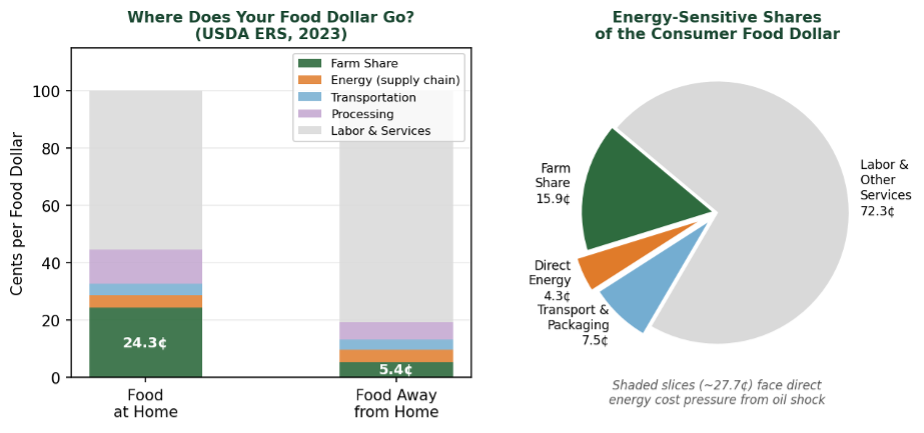
The farm-cost channel alone does not mechanically drive grocery bills. Purdue notes that for 2023 the farm share was only 15.9 cents of every consumer food dollar, rising to about 24 cents for food at home and falling to 5.4 cents for restaurant meals. A 20% jump in farm commodity costs would lift retail grocery prices by roughly 4-5%, and restaurant prices by about 1%.
The bigger issue is timing. Long supply chains and fixed-term contracts mean cost shocks take three to six months to reach shelves, and up to twelve months for stored commodities such as grains and canned goods. Once embedded, retail prices are slow to fall even after costs ease. Purdue estimates a sustained energy shock of this scale could add 3-6 percentage points to food-at-home inflation over 12-18 months; a quickly resolved conflict would leave a much smaller mark.
What importers and exporters face
FAO Chief Economist Máximo Torero said the agri-food industry is "resilient for now because they are selling what they already produced," but warned this "will change very quickly as commodity and energy costs are transmitted." If the war reaches day 90, he said, the risk of a food crisis rises significantly in late 2026 and 2027.
For importers and exporters, the near-term signal is in vegetable oils and cereals, where price gains are already visible and biofuel demand competes directly with food use. The burden falls hardest on lower-income households, who spend more of their income on food, and on energy-dependent importing countries least able to absorb broad-based food inflation. IFPRI has separately asked whether the Iran crisis will trigger another round of food price spikes — a question the April data begins to answer.