Flat-rate import premium on soft wheat used to shield flour prices from global volatility
A flat-rate premium paid on imported soft wheat is designed to absorb swings in international grain prices before they reach mills. The mechanism secures import flows and stabilises the cost of wheat and flour on the domestic market. Its fiscal cost rises precisely when world prices climb.
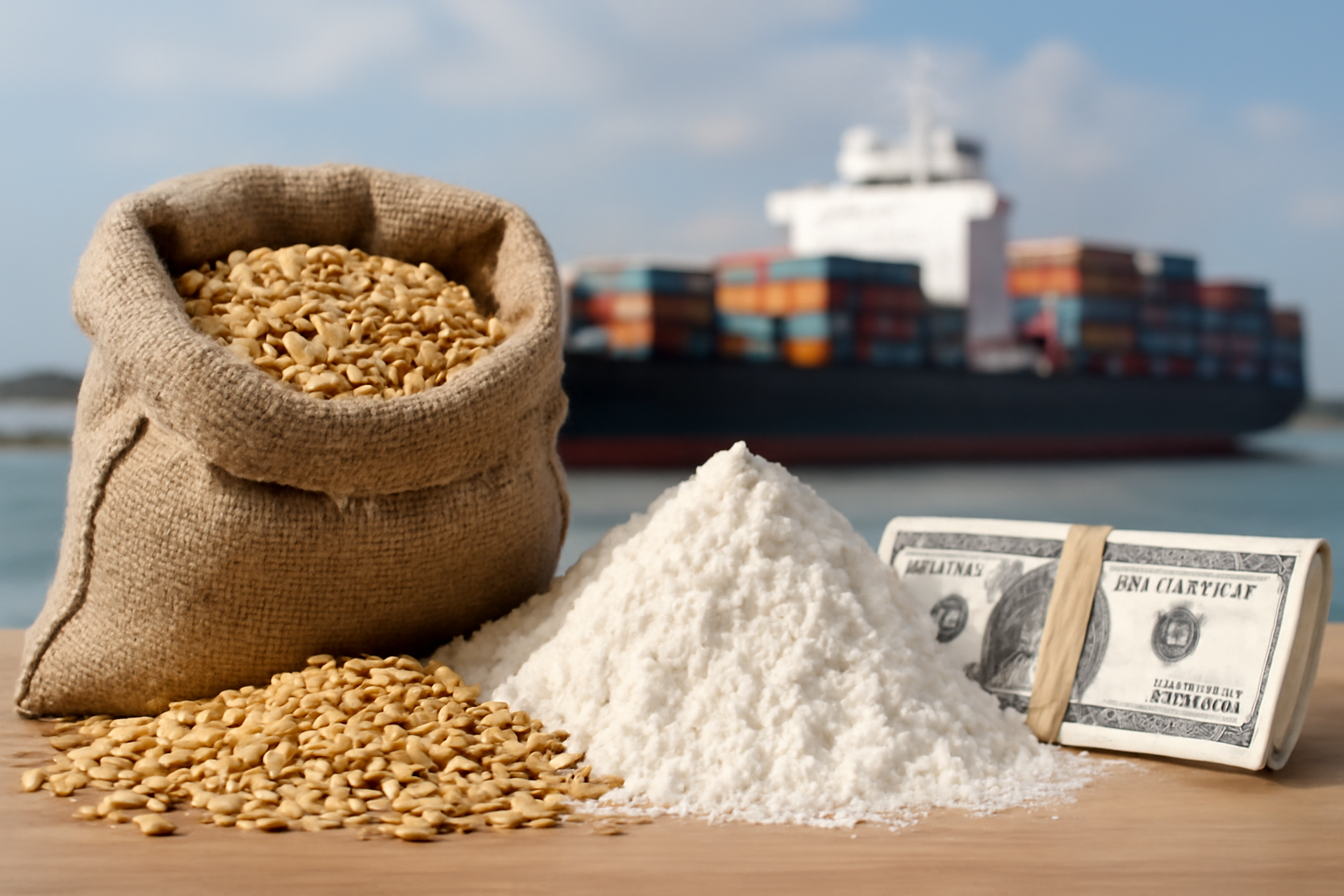
A flat-rate import premium on soft wheat is intended to work as a shield against international price volatility. By fixing the level of support granted on imported milling wheat, the measure secures import flows, stabilises the cost of wheat delivered to mills and, further down the chain, the price of flour.
The logic is straightforward for any market that covers a substantial part of its milling wheat requirement from abroad. World prices respond to harvests in the major exporting basins, to freight, to currency moves and to export policies decided elsewhere. Bread and flour prices, by contrast, are among the most closely watched consumer prices in any economy. A flat-rate premium is the instrument that separates the two.
How a flat-rate premium works
Instead of letting the landed cost of imported grain pass straight through to millers, the authorities set a fixed amount per unit imported. That payment absorbs the gap between the international purchase price and the reference cost at which wheat is supposed to reach the milling industry. When world quotations rise, the premium carries the difference, and the miller's input cost does not move with the market.
- The rate is flat: the same amount applies across eligible import volumes for a given period rather than being recalculated cargo by cargo.
- It targets soft wheat destined for milling, the raw material of bread flour, rather than durum or feed grain.
- It operates at the import stage, before the grain enters the domestic marketing chain, which is simpler to administer than downstream price controls.
- Its purpose is to stabilise the cost base of the milling industry, not to subsidise consumption directly.
What it changes for importers and millers
For importers and trading houses, the main effect is the transfer of price risk. Buying decisions on the international market, from origin and timing to vessel size and hedging, no longer carry the full exposure through to the domestic buyer, because the premium narrows the gap between what is paid abroad and what is recovered at home. That supports continuity of purchasing even when world prices spike, which is precisely the moment when shipments to price-sensitive destinations tend to thin out.
For mills, the benefit is a predictable input cost. Flour milling is a high-volume, low-margin business in which the grain bill dominates the cost structure. A stable wheat cost allows mills to hold flour prices, plan grinding schedules and keep long-term contracts with bakeries without repricing every time a crop report or an export restriction moves the market.
Trade-offs and points of attention
Mechanisms of this type carry a fiscal cost that moves against the market: the higher international prices climb, the more the premium has to cover, and the heavier the budgetary load becomes at exactly the moment when public finances are usually under other pressure as well. The level of the premium therefore has to be revised as market conditions change, and the timing of those revisions is what market participants watch.
There is also a signalling effect. A stabilised import cost weakens the transmission of world price signals to domestic growers and to the storage trade, which feeds into planting and carrying decisions in the local wheat crop. Set at the right level, the premium stabilises supply without displacing domestic grain; set too generously, it makes imported wheat permanently cheaper than local supply.
For the flour chain, the practical conclusion is that the cost of the main raw material is administered rather than market-determined. Commercial planning depends less on world wheat quotations than on the level of the premium and on the schedule for adjusting it.