EU regulatory reform could cut Moroccan tomato exports to zero, report warns
Moroccan tomato shipments to the European Union could fall to zero if Brussels applied the strictest version of a proposed regulatory reform and exporters made no changes to production and documentation. The scenario is presented as an extreme case rather than a base expectation, with no entry-into-force date, transition period or volume figures published so far. The exposure sits in the European winter window, where Moroccan supply is hardest to replace.
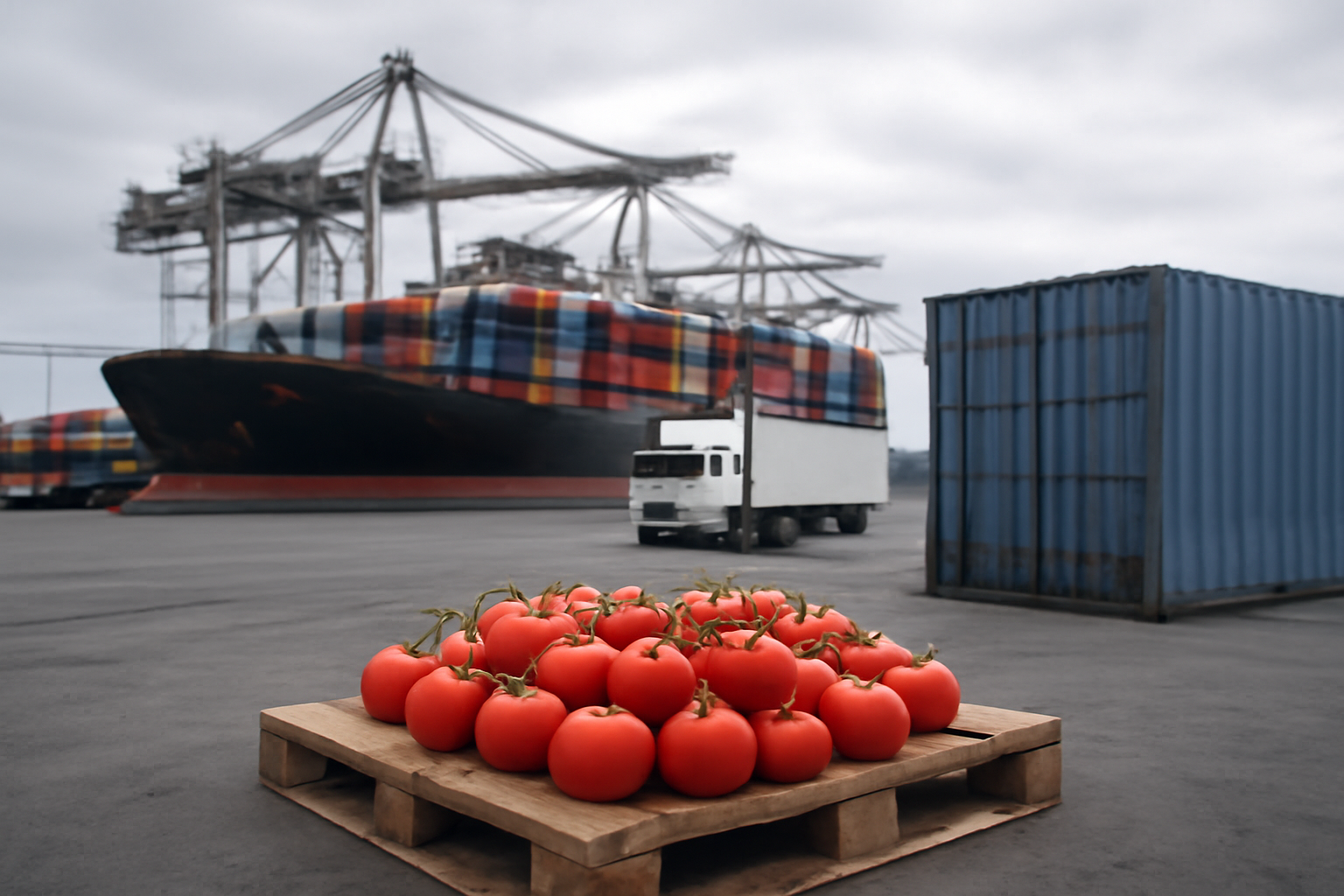
Moroccan tomato exports to the European Union could fall to zero if Brussels applied its strictest rules without a matching adaptation by producers. The scenario comes from a report on a proposed European regulatory reform, which presents it as an extreme case rather than a base expectation for one of Morocco's most prominent horticultural export lines.
A conditional scenario, not a forecast
The claim rests on two conditions holding at the same time: the European Union enforcing the most demanding reading of the new rules, and Moroccan exporters changing nothing about how the crop is grown, treated, packed and documented. Neither is presented as settled. The report does not state when the reform would take effect, whether a transition period would apply, or how enforcement would be divided between the European Commission and national authorities.
No volume, value or price figures accompany the scenario, and the specific requirements that would drive it are not itemised in the available material. For buyers and producers, the practical content of the story is therefore regulatory risk with an unquantified tail, not a supply or demand forecast.
Why tomatoes are the exposed line
Tomatoes sit at the centre of Morocco's fresh produce trade with Europe. The crop is grown largely under protected cultivation and shipped into the European winter window, when local greenhouse output is limited and imported supply sets the tone for wholesale prices. That seasonal concentration is what makes a rule change disproportionately powerful: a compliance failure at the border in mid-season hits a short marketing window that cannot be recovered later in the year.
The exposure is two-sided. Moroccan growers and exporters carry the cost of adaptation, while European importers, wholesalers and retail programmes that have built winter ranges around the origin carry the cost of substitution if volumes tighten. Processing demand is a secondary factor here; the trade in question is almost entirely fresh.
What adaptation would require
Absent a published reform text, the compliance work implied by a stricter EU regime follows a familiar pattern for third-country suppliers of fresh produce:
- Spray programmes rebuilt around EU maximum residue levels rather than domestic ones, with pre-harvest intervals enforced at farm level.
- Plant health controls tightened to reduce interceptions of regulated pests at the point of entry.
- Traceability from greenhouse block to pallet, with records that survive an audit rather than a paperwork check.
- Certification and third-party auditing aligned to what EU retail buyers, not only customs authorities, will accept.
- Contracts that state explicitly who bears the loss when a consignment is rejected at the border.
Each of those items is a cost line before it is a compliance line. Smaller growers without in-house agronomy and laboratory access are the ones most likely to exit the export channel rather than fund the upgrade.
What the trade should watch
Three things determine whether the zero-export scenario stays hypothetical. The first is the final legal text and how much discretion it leaves to member states. The second is the length of any transition period, which decides whether adaptation can be spread over several seasons or has to be funded in one. The third is enforcement consistency: uniform checks across entry points are manageable, divergent national practice is not, because it makes shipment planning impossible to price.
Until the text is published, importers are likely to treat Moroccan winter supply as a position requiring a hedge rather than a settled sourcing plan. That alone can move contracting behaviour ahead of any regulation entering force.