Corn rises in Paris and Chicago as European canola drops 5.1%
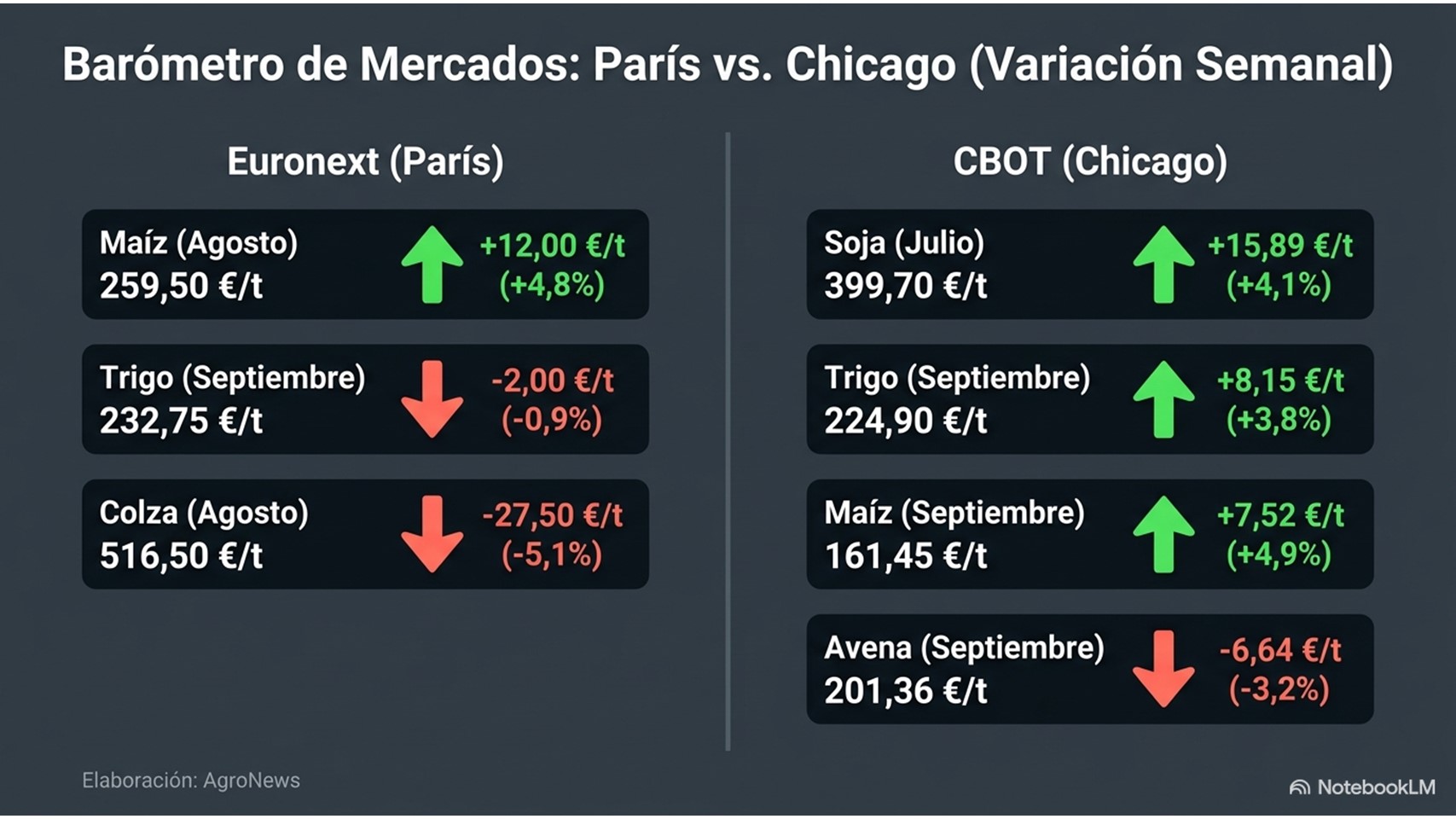
European corn gained €12 per tonne in the week of July 20-26, 2026, while Chicago corn and soybeans also advanced. European canola fell €27.50 per tonne as lower oil prices and profit-taking outweighed Black Sea supply concerns.
Corn and soybeans lead weekly gains
Grain and oilseed futures diverged sharply in Paris and Chicago during the week of July 20-26, 2026. According to Agronews Castilla y León, European corn recorded the largest gain on Euronext, while Chicago corn, wheat and soybeans also finished higher. European canola moved in the opposite direction, losing 5.1% over the week.
The August European corn contract closed at €259.50 per tonne, up €12 per tonne, or 4.8%. It was €49.75 per tonne above the €209.75 recorded in July 2025, an annual increase of 23.72%. Chicago corn for September settled at €161.45 per tonne after gaining €7.52, or 4.9%, during the week. That contract stood €23.55 per tonne, or 17.08%, above its level a year earlier.
US corn rose for five consecutive sessions and reached an approximately 15-month high before retreating on Friday. Profit-taking and lower oil prices interrupted the rally. Energy prices matter to the corn market because US grain is used in ethanol production, while weaker crude can also encourage speculative position liquidation.
Black Sea disruption supports cereals
Security and logistics in the Black Sea remained central to price formation. Agronews Castilla y León reported that Russian attacks on vessels and port infrastructure around Odesa prompted some shipowners to suspend calls for agricultural cargoes temporarily. Ukraine has lost approximately one-third of its Black Sea grain export capacity, although routes through the Danube and by rail remain available.
An attack on a corn-laden vessel near Odesa killed ten people and increased uncertainty over commercial routes. Disruption to Ukrainian shipments can redirect some demand toward European Union grain. Russia also restricted maritime transit through the Don-Azov Canal, a route used for a significant share of its wheat exports, raising the possibility that international buyers would seek alternative origins.
Paris wheat for September ended at €232.75 per tonne, down €2, or 0.9%, for the week but still €30.50, or 15.08%, above July 2025. It lost €10.25 per tonne on Friday alone after intraday declines exceeded 6%. Reports of possible mechanisms to protect ships using Odesa-region ports initially raised expectations that Ukrainian exports could continue without major interruption. A Ukrainian minister later denied that such talks were under way, allowing prices to recover part of their initial losses.
Chicago wheat advances while canola retreats
Chicago wheat for September rose €8.15 per tonne, or 3.8%, to €224.90. The contract reached its highest level since May 2024 and was €50.33 per tonne, or 28.83%, above July 2025. It retreated on Friday amid profit-taking, technical selling, weaker oil and forecasts for above-average hard red spring wheat yields in North Dakota despite recent heat and drought.
European canola for August fell €27.50 per tonne, or 5.1%, to €516.50. The contract lost as much as €28 per tonne on Friday, erasing a substantial part of its earlier gains. It nevertheless remained €43.50 per tonne, or 9.20%, above July 2025. Lower oil prices weakened support for vegetable oils used in biodiesel, while the market shed part of the risk premium accumulated earlier in the week.
Allseeds’ suspension of operations in the Odesa region had initially increased concern about vegetable-oil supplies. However, the late-week sell-off showed that energy prices, technical trading and profit-taking could outweigh immediate logistics risks. Agronews Castilla y León said indicative FOB wheat prices were converted at €1 to $1.1392, the European Central Bank rate published on July 23. Ukrainian wheat quotations were mainly nominal because of transport constraints, higher insurance costs and suspended vessel calls.