Competition and tighter standards push Vietnam’s livestock industry to restructure
Vietnam’s livestock industry largely meets domestic demand for meat, eggs and milk, but imported meat and foreign-invested producers are intensifying competition. Producers are being pushed toward technology, traceability, stronger supply-chain links and higher-value products.
Domestic supply meets a more competitive market
Vietnam’s livestock industry now largely meets domestic demand for meat, eggs and milk, while gradually expanding into export markets, according to Nguyễn Xuân Dương, chairman of the Vietnam Animal Husbandry Association. Chicken meat and veterinary vaccines have begun reaching markets with demanding requirements for quality, safety and disease control. The progress shows that the industry’s next stage will be defined less by production volume than by which products it can sell and where.
Competition at home is also becoming more intense. Large volumes of imported meat are putting direct pressure on domestic products, particularly those supplied by household farms. Local companies face competition from foreign-invested businesses and groups with advantages in capital, technology, breeding stock, management and integrated supply chains. Small producers have fewer opportunities to control costs or simultaneously comply with requirements covering product quality, food safety and traceability.
Technology shifts from the farm to the full chain
Consumer expectations are raising the value of verifiable production practices. Buyers increasingly consider how livestock was raised, whether products are safe and traceable, and what environmental impact production creates. Output remains important for food security, but expanding low-value production with high costs and limited competitiveness leaves progressively less room for growth. Competing primarily on price is therefore unlikely to provide household farms with a durable advantage.
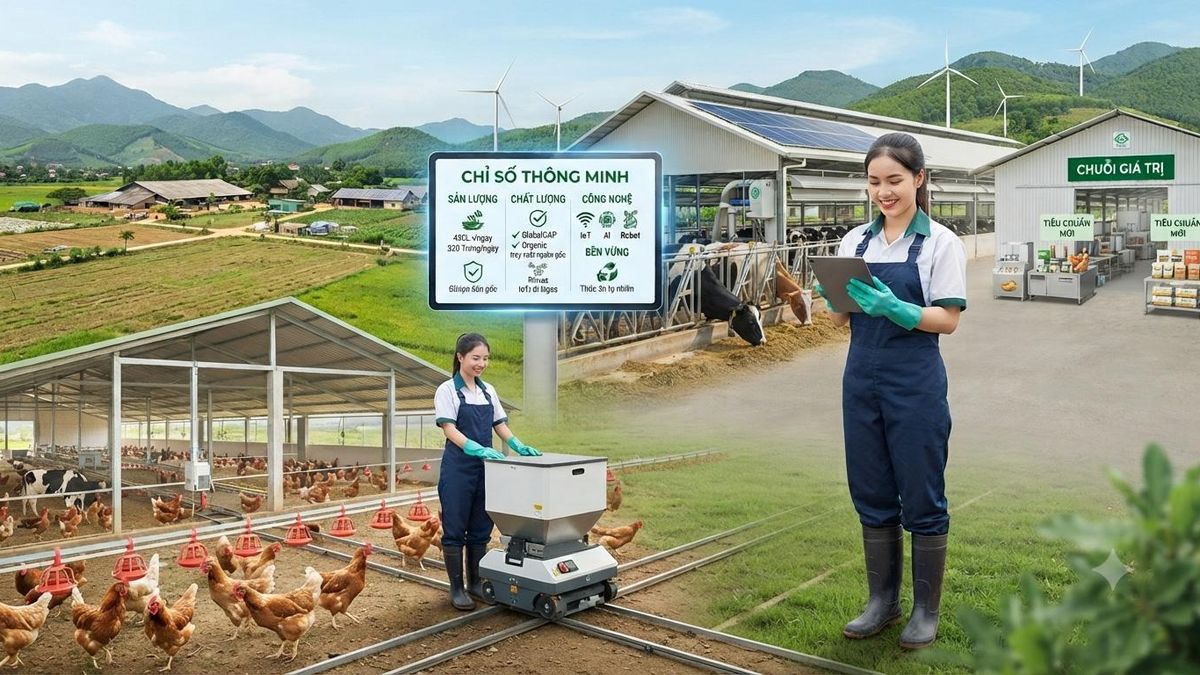
The industry is responding by moving from experience-based production toward management supported by data and technology. Lê Văn Phan of the Vietnam National University of Agriculture said strategic technologies should include breeding animals for product quality. Breeding decisions must address meat, egg and milk quality, adaptation to farming conditions, feed efficiency and the requirements of individual market segments, rather than merely increasing animal numbers.
Technology will consequently need to connect breeding, feed, animal care, veterinary services and disease control with slaughtering, processing and distribution. Integrated data would allow producers to adjust output to market demand instead of seeking buyers only after production. Better information could also reduce the recurring cycle in which farmers expand supply in response to current prices or the previous season, only to encounter falling prices once additional output reaches the market.
Supply-chain links determine the future of small farms
Modernisation risks widening the gap between large companies and household producers. GREENFEED Vietnam said major businesses can invest in technology, raw-material zones, laboratories, quality-control systems and brands, while most households cannot meet all these requirements independently. The company argues that supply-chain cooperation must function as a market solution: businesses need stable sourcing areas, and farmers need buyers, defined standards and clear benefit-sharing mechanisms.
Cooperatives could aggregate small farms into production zones large enough to adopt technology, traceability and common standards. Participation in organised chains can also improve access to breeding stock, feed, technical support, veterinary services and markets while reducing production risk. Without such links, households that produce independently and find their own buyers will face increasing difficulty as market requirements tighten.
The industry’s export progress indicates opportunities beyond domestic consumption, but further gains will depend on concentrating investment in competitive products. Thời Báo Ngân Hàng reports that the priorities include improving breeding quality, expanding advanced processing, building brands and meeting international standards. Disease control, traceability and lower production emissions will also influence market access. More efficient feed use, fewer disease losses and greater use of by-products can lower costs as well as environmental pressure, making the shift from volume to quality an economic requirement for companies and household farms alike.