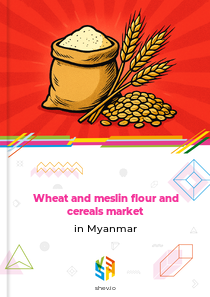







Earlier Report Observations
The market volume for wheat and meslin flour and cereals in Myanmar increased from 346.8 thousand tons in 2018 to 436.6 thousand tons in 2020, marking a period of substantial growth.
After peaking in 2020, the market contracted to 365.5 thousand tons in 2021 and then dropped sharply to 248.1 thousand tons in 2022, before partially recovering to 285.3 thousand tons in 2023.
Domestic production followed a similar pattern, rising to 408.1 thousand tons in 2020, declining to 210.0 thousand tons in 2022, and rebounding to 280.9 thousand tons in 2023, while imports fell from a high of 71.8 thousand tons in 2019 to much lower levels in subsequent years.
Table of content
- 1. Disclaimer
- 2. Terms of use of the report
- 3. Product codes in the statistical classifications used in the report
-
4. Key Market Indicators and Trends
-
4.1. Key Market Indicators
-
4.1.1. In kind
- 4.1.1.1. Production, 2018-2023
- 4.1.1.2. Imports, 2018-2024
- 4.1.1.3. Exports, 2018-2024
- 4.1.1.4. Market size, 2018-2023
-
4.1.1. In kind
- 4.2. Market Trends and Factors
-
4.1. Key Market Indicators
-
5. Production
-
5.1. Production in Myanmar
- 5.1.1. Annual dynamics of production in Myanmar in kind, 2018-2023, K t
- 5.1.2. Annual dynamics of production in Myanmar in value, 2018-2023, $ US
-
5.2. Global production by Country, 2018-2023
- 5.2.1. Annual dynamics of production by macroregions in kind, 2018-2023, K t
- 5.2.2. Dynamics of production structure by macroregions in kind, 2018-2023
- 5.2.3. Annual dynamics of production by country in kind, 2018-2023, K t
- 5.2.4. Structure of production by countries in kind, 2018-2023
- 5.2.5. Dynamics of peoduction structure by countries in kind, 2018-2023
-
5.1. Production in Myanmar
-
6. Exports
-
6.1. Exports (Direct Data)
- 6.1.1. Exports - Total information
-
6.1.2. Exports in kind, t
- 6.1.2.1. Annual dynamics of product's exports from Myanmar in kind, 2018-2024, t
- 6.1.2.2. Dynamics of product's exports in kind from Myanmar by countries, 2018-2024, t
- 6.1.2.3. Structure of product's exports in kind by countries, 2018-2024
-
6.1.3. Exports in value, K $ US
- 6.1.3.1. Annual dynamics of product's exports from Myanmar in value, 2018-2024, K $ US
- 6.1.3.2. Dynamics of product's exports in value from Myanmar by countries, 2018-2024, K $ US
- 6.1.3.3. Structure of product's exports in value by countries, 2018-2024
-
6.1.4. Average price of product's exports, $ US/t
- 6.1.4.1. Annual dynamics of average price of product's exports from Myanmar, 2018-2024, $ US/t
- 6.1.4.2. Dynamics of average price of product's exports from Myanmar by countries, 2018-2024, $ US/t
-
6.2. Exports (Mirror Data)
- 6.2.1. Exports - Total information
-
6.2.2. Exports in kind, t
- 6.2.2.1. Annual dynamics of product's exports from Myanmar in kind, 2018-2024, t
- 6.2.2.2. Dynamics of product's exports in kind from Myanmar by countries, 2018-2024, t
- 6.2.2.3. Structure of product's exports in kind by countries, 2018-2024
-
6.2.3. Exports in value, K $ US
- 6.2.3.1. Annual dynamics of product's exports from Myanmar in value, 2018-2024, K $ US
- 6.2.3.2. Dynamics of product's exports in value from Myanmar by countries, 2018-2024, K $ US
- 6.2.3.3. Structure of product's exports in value by countries, 2018-2024
-
6.2.4. Average price of product's exports, $ US/t
- 6.2.4.1. Annual dynamics of average price of product's exports from Myanmar, 2018-2024, $ US/t
- 6.2.4.2. Dynamics of average price of product's exports from Myanmar by countries, 2018-2024, $ US/t
-
6.1. Exports (Direct Data)
-
7. Imports
-
7.1. Imports (Direct Data)
- 7.1.1. Imports - Total information
-
7.1.2. Imports in kind, t
- 7.1.2.1. Annual dynamics of product's imports to Myanmar in kind, 2018-2024, t
- 7.1.2.2. Dynamics of product's imports in kind to Myanmar by countries, 2018-2024, t
- 7.1.2.3. Structure of product's imports in kind by countries, 2018-2024
-
7.1.3. Imports in value, K $ US
- 7.1.3.1. Annual dynamics of product's imports to Myanmar in value, 2018-2024, K $ US
- 7.1.3.2. Dynamics of product's imports in value to Myanmar by countries, 2018-2024, K $ US
- 7.1.3.3. Structure of product's imports in value by countries, 2018-2024
-
7.1.4. Average price of product's imports, $ US/t
- 7.1.4.1. Annual dynamics of average price of product's imports to Myanmar, 2018-2024, $ US/t
- 7.1.4.2. Dynamics of average price of product's imports to Myanmar by countries, 2018-2024, $ US/t
-
7.2. Imports (Mirror Data)
- 7.2.1. Imports - Total information
-
7.2.2. Imports in kind, t
- 7.2.2.1. Annual dynamics of product's imports to Myanmar in kind, 2018-2024, t
- 7.2.2.2. Dynamics of product's imports in kind to Myanmar by countries, 2018-2024, t
- 7.2.2.3. Structure of product's imports in kind by countries, 2018-2024
-
7.2.3. Imports in value, K $ US
- 7.2.3.1. Annual dynamics of product's imports to Myanmar in value, 2018-2024, K $ US
- 7.2.3.2. Dynamics of product's imports in value to Myanmar by countries, 2018-2024, K $ US
- 7.2.3.3. Structure of product's imports in value by countries, 2018-2024
-
7.2.4. Average price of product's imports, $ US/t
- 7.2.4.1. Annual dynamics of average price of product's imports to Myanmar, 2018-2024, $ US/t
- 7.2.4.2. Dynamics of average price of product's imports to Myanmar by countries, 2018-2024, $ US/t
-
7.1. Imports (Direct Data)
-
8. Trade balance
-
8.1. Trade balance (Direct Data)
- 8.1.1. In kind, t
- 8.1.2. In value, K $ US
-
8.2. Trade balance (Mirror Data)
- 8.2.1. In kind, t
- 8.2.2. In value, K $ US
-
8.1. Trade balance (Direct Data)
-
9. Top buying and selling countries, 2018-2024
-
9.1. Direct Data
- 9.1.1. Import in Value by Countries-buyers
- 9.1.2. Export in Value by Countries-suppliers
-
9.2. Mirror Data
- 9.2.1. Import in Value by Countries-buyers
- 9.2.2. Export in Value by Countries-suppliers
-
9.1. Direct Data
Production wheat and meslin flour and cereals in Myanmar
In kind, 2017-2020, K t
Top producers of wheat and meslin flour and cereals, 2017-2020
World map of production of wheat and meslin flour and cereals, 2017-2020
Myanmar's production of wheat and meslin flour and cereals has increased for the second consecutive year. In 2020, the country produced 408.1 thousand tons, marking a solid year-on-year growth of 24.2%. The lowest production level was recorded in 2018 at 302.7 thousand tons, which also saw the largest decline of 26.6%.
Annual dynamics of production in Myanmar in kind, 2017-2020, K t
| Parameter | 2018 | 2019 | 2020 | CAGR | |
|---|---|---|---|---|---|
| 1 | Change from last year | (26.6%) | 8.6% | 24.2% | (0.4%) |
Exports wheat and meslin flour and cereals from Myanmar
Exports in kind, t
The market showed an unstable trend throughout the period. Exports reached their lowest point in 2019 at 22 tons, which represented the largest decline of 81.2%. They then peaked in 2017, with a 7.6-fold difference between these years. In 2020, Myanmar exported 52 tons of wheat and meslin flour and cereals, a significant increase of 139.3% compared to 2019.
Annual dynamics of product's exports from Myanmar in kind, 2017-2020, t
| Parameter | 2018 | 2019 | 2020 | CAGR | |
|---|---|---|---|---|---|
| 1 | Change from last year | (29.7%) | (81.2%) | 139.3% | (31.8%) |
From 2017 to 2020, Thailand, China, and Malaysia were the main destinations for Myanmar's exports in kind. Thailand accounted for 50.0% of exports, China for 25.1%, and Malaysia for 24.8%. Together, these three countries comprised 99.9% of total export flows.
Structure of product's exports in kind by countries, 2017-2020
World map of product's exports from Myanmar in kind, 2017-2020
Exports in value, K $ US
Wheat and meslin flour and cereals shipments from Myanmar abroad have declined for the third consecutive year. In 2020, exports totaled 20 thousand US dollars, down by 15.6% compared to the previous year. Between 2017 and 2020, exports decreased by 84.2%, equating to an annualized rate of 46.0%.
Annual dynamics of product's exports from Myanmar in value, 2017-2020, K $ US
| Parameter | 2018 | 2019 | 2020 | CAGR | |
|---|---|---|---|---|---|
| 1 | Change from last year | (51.0%) | (61.9%) | (15.6%) | (46.0%) |
From 2017 to 2020, Thailand and Malaysia remained the key destinations for Myanmar's exports in value terms, jointly accounting for 81.4% of total flows. Other trading partners were much less significant individually during this period.
Structure of product's exports in value by countries, 2017-2020
World map of product's exports from Myanmar in value, 2017-2020
Imports wheat and meslin flour and cereals to Myanmar
Imports in kind, t
After a two-year advance, Myanmar's volume of wheat and meslin flour and cereals imports declined. The maximum value was recorded in 2019 at 71 847 tons, which also saw the largest increase of 62.5%. In 2020, imports dropped to 28 509 tons, reflecting a sharp decrease of 60.3% compared to 2019. Over the period from 2017 to 2020, imports decreased by 18.7%, with a compound annual growth rate of 6.7%.
Annual dynamics of product's imports to Myanmar in kind, 2017-2020, t
| Parameter | 2018 | 2019 | 2020 | CAGR | |
|---|---|---|---|---|---|
| 1 | Change from last year | 26.1% | 62.5% | (60.3%) | (6.7%) |
Throughout 2017 to 2020, Malaysia, Turkey, and the Philippines were the key sources for Myanmar's imports in kind. Malaysia accounted for 43.6% of imports, Turkey for 22.0%, and the Philippines for 8.9%. Together, these three countries made up 74.6% of total import flows.
Structure of product's imports in kind by countries, 2017-2020
World map of product's imports to Myanmar in kind, 2017-2020
Imports in value, K $ US
After a two-year rise, wheat and meslin flour and cereals imports into Myanmar declined. The maximum value was recorded in 2019 at 25 747 thousand US dollars, which also saw the largest increase of 54.3%. In 2020, imports amounted to 9 788 thousand US dollars, corresponding to a steep drop of 62.0% compared to the previous year. Over the period from 2017 to 2020, imports decreased by 29.2%, with a compound annual growth rate of 10.9%.
Annual dynamics of product's imports to Myanmar in value, 2017-2020, K $ US
| Parameter | 2018 | 2019 | 2020 | CAGR | |
|---|---|---|---|---|---|
| 1 | Change from last year | 20.7% | 54.3% | (62.0%) | (10.9%) |
From 2017 to 2020, Malaysia, Turkey, and the Philippines remained the principal suppliers of wheat and meslin flour and cereals to Myanmar in value terms. Malaysia accounted for 48.3% of imports, Turkey for 18.6%, and the Philippines for 8.9%. Jointly, these three countries accounted for 75.8% of total imports in value terms.
Structure of product's imports in value by countries, 2017-2020
World map of product's imports to Myanmar in value, 2017-2020
Related Reports

2026-03-28

2026-03-28

2026-03-28
Why Choose Us?
Only Verified Data
No Hidden Costs or Separate Fees
Smarter Subscription Pricing
Contact Our Team
Submit your inquiry using the form below — our team will get back to you within 24 hours.