






"Southern Asia" region includes following countries:
 Afghanistan
 Bangladesh
 Bhutan
 Sri Lanka
 India
India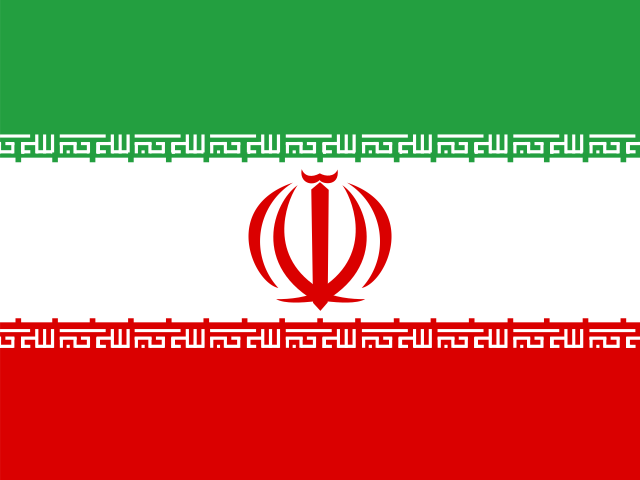 Iran
Iran Maldives
 Nepal
Nepal Pakistan
Earlier Report Observations
The market for watermelons and melons in Southern Asia expanded from 7.2 million tons in 2018 to over 10.1 million tons by 2023. Initial growth was fueled by the emergence of new varieties and hybrids, including seedless watermelons, which attracted consumer interest and supported category expansion. Technological advancements in production and supply chains further optimized efficiency, helping the market reach a peak of 10.6 million tons in 2020 even amid global supply chain disruptions from the coronavirus crisis.
Market volume contracted to 9.5 million tons in 2021 as the prolonged effects of pandemic-related disruptions affected operations. Recovery followed in 2022, with volume rising to 9.6 million tons, supported by advancements in cold chain logistics and freezing technologies that enhanced export potential and product quality. During this period, increasing consumer demand for sustainability and transparency also began influencing market practices.
Growth continued in 2023, with the market exceeding 10.1 million tons. This was bolstered by significant export growth in fresh fruits and vegetables, driven by government support and expanding international demand. Policy changes, such as export restrictions on other crops, indirectly benefited fruit production, while consumer trends emphasizing health consciousness and local produce further shaped strategies.
Table of content
- 1. Disclaimer
- 2. Terms of use of the report
- 3. Product codes in the statistical classifications used in the report
-
4. Key Market Indicators and Trends
-
4.1. Key Market Indicators
-
4.1.1. In kind
- 4.1.1.1. Production, 2018-2023
- 4.1.1.2. Imports, 2018-2024
- 4.1.1.3. Exports, 2018-2024
- 4.1.1.4. Market size, 2018-2023
-
4.1.2. In value
- 4.1.2.1. Production, 2018-2023
- 4.1.2.2. Imports, 2018-2024
- 4.1.2.3. Exports, 2018-2024
- 4.1.2.4. Market size, 2018-2023
-
4.1.1. In kind
- 4.2. Market Trends and Factors
-
4.1. Key Market Indicators
-
5. Production
-
5.1. Production in Southern Asia
- 5.1.1. Annual dynamics of production in Southern Asia in kind, 2018-2023, K t
-
5.2. Global production by Country, 2018-2023
- 5.2.1. Annual dynamics of production by macroregions in kind, 2018-2023, K t
- 5.2.2. Dynamics of production structure by macroregions in kind, 2018-2023
- 5.2.3. Annual dynamics of production by country in kind, 2018-2023, K t
- 5.2.4. Structure of production by countries in kind, 2018-2023
- 5.2.5. Dynamics of peoduction structure by countries in kind, 2018-2023
-
5.1. Production in Southern Asia
-
6. Imports
-
6.1. Imports (Direct Data*)
- 6.1.1. Imports - Total information
-
6.1.2. Imports in kind, K t
- 6.1.2.1. Annual dynamics of product's imports to Afghanistan in kind, 2018-2024, K t
- 6.1.2.2. Dynamics of product's imports in kind to Afghanistan by countries, 2018-2024, K t
- 6.1.2.3. Structure of product's imports in kind by countries, 2018-2024
-
6.1.3. Imports in value, M $ US
- 6.1.3.1. Annual dynamics of product's imports to Afghanistan in value, 2018-2024, M $ US
- 6.1.3.2. Dynamics of product's imports in value to Afghanistan by countries, 2018-2024, M $ US
- 6.1.3.3. Structure of product's imports in value by countries, 2018-2024
-
6.1.4. Average price of product's imports, $ US/t
- 6.1.4.1. Annual dynamics of average price of product's imports to Afghanistan, 2018-2024, $ US/t
- 6.1.4.2. Dynamics of average price of product's imports to Afghanistan by countries, 2018-2024, $ US/t
-
6.2. Imports (Mirror Data)
- 6.2.1. Imports - Total information
-
6.2.2. Imports in kind, K t
- 6.2.2.1. Annual dynamics of product's imports to Afghanistan in kind, 2018-2024, K t
- 6.2.2.2. Dynamics of product's imports in kind to Afghanistan by countries, 2018-2024, K t
- 6.2.2.3. Structure of product's imports in kind by countries, 2018-2024
-
6.2.3. Imports in value, M $ US
- 6.2.3.1. Annual dynamics of product's imports to Afghanistan in value, 2018-2024, M $ US
- 6.2.3.2. Dynamics of product's imports in value to Afghanistan by countries, 2018-2024, M $ US
- 6.2.3.3. Structure of product's imports in value by countries, 2018-2024
-
6.2.4. Average price of product's imports, $ US/t
- 6.2.4.1. Annual dynamics of average price of product's imports to Afghanistan, 2018-2024, $ US/t
- 6.2.4.2. Dynamics of average price of product's imports to Afghanistan by countries, 2018-2024, $ US/t
-
6.1. Imports (Direct Data*)
-
7. Exports
-
7.1. Exports (Direct Data*)
- 7.1.1. Exports - Total information
-
7.1.2. Exports in kind, K t
- 7.1.2.1. Annual dynamics of product's exports from Afghanistan in kind, 2018-2024, K t
- 7.1.2.2. Dynamics of product's exports in kind from Afghanistan by countries, 2018-2024, K t
- 7.1.2.3. Structure of product's exports in kind by countries, 2018-2024
-
7.1.3. Exports in value, M $ US
- 7.1.3.1. Annual dynamics of product's exports from Afghanistan in value, 2018-2024, M $ US
- 7.1.3.2. Dynamics of product's exports in value from Afghanistan by countries, 2018-2024, M $ US
- 7.1.3.3. Structure of product's exports in value by countries, 2018-2024
-
7.1.4. Average price of product's exports, $ US/t
- 7.1.4.1. Annual dynamics of average price of product's exports from Afghanistan, 2018-2024, $ US/t
- 7.1.4.2. Dynamics of average price of product's exports from Afghanistan by countries, 2018-2024, $ US/t
-
7.2. Exports (Mirror Data)
- 7.2.1. Exports - Total information
-
7.2.2. Exports in kind, K t
- 7.2.2.1. Annual dynamics of product's exports from Afghanistan in kind, 2018-2024, K t
- 7.2.2.2. Dynamics of product's exports in kind from Afghanistan by countries, 2018-2024, K t
- 7.2.2.3. Structure of product's exports in kind by countries, 2018-2024
-
7.2.3. Exports in value, M $ US
- 7.2.3.1. Annual dynamics of product's exports from Afghanistan in value, 2018-2024, M $ US
- 7.2.3.2. Dynamics of product's exports in value from Afghanistan by countries, 2018-2024, M $ US
- 7.2.3.3. Structure of product's exports in value by countries, 2018-2024
-
7.2.4. Average price of product's exports, $ US/t
- 7.2.4.1. Annual dynamics of average price of product's exports from Afghanistan, 2018-2024, $ US/t
- 7.2.4.2. Dynamics of average price of product's exports from Afghanistan by countries, 2018-2024, $ US/t
-
7.1. Exports (Direct Data*)
-
8. Trade balance
-
8.1. Trade balance (Direct Data)
- 8.1.1. In kind, K t
- 8.1.2. In value, M $ US
-
8.2. Trade balance (Mirror Data)
- 8.2.1. In kind, K t
- 8.2.2. In value, M $ US
-
8.1. Trade balance (Direct Data)
-
9. Top buying and selling countries, 2018-2024
-
9.1. Direct Data
- 9.1.1. Import in Value by Countries-buyers
- 9.1.2. Export in Value by Countries-suppliers
-
9.2. Mirror Data
- 9.2.1. Import in Value by Countries-buyers
- 9.2.2. Export in Value by Countries-suppliers
-
9.1. Direct Data
Production watermelons and melons in Southern Asia
In kind, 2017-2020, K t
Top producers of watermelons and melons, 2017-2020
World map of production of watermelons and melons, 2017-2020
Southern Asia's production of watermelons and melons has grown for the second year in a row. In 2020, the region produced 11 512 K t, marking a 15.3% year-over-year increase. Over the 2017-2020 period, production rose by 30.5%, with a compound annual growth rate of 9.3%. The lowest production volume was recorded in 2018 at 8 058 K t, which also saw the largest decline of 8.7%. In contrast, 2019 experienced the biggest increase at 23.9%.
Annual dynamics of production in Southern Asia in kind, 2017-2020, K t
| Parameter | 2018 | 2019 | 2020 | CAGR | |
|---|---|---|---|---|---|
| 1 | Change from last year | (8.7%) | 23.9% | 15.3% | 9.3% |
In value, 2017-2020, M $ US
Following two years of growth, Southern Asia's production value for watermelons and melons declined. In 2020, output was valued at 2 556 M $ US, reflecting a 7.3% decrease from the previous year. Between 2017 and 2020, however, production value increased by 37.6%, equating to an annualized rate of 11.2%. The peak value was recorded in 2019 at 2 757 M $ US, which also saw the largest increase of 32.9%.
Annual dynamics of production in Southern Asia in value, 2017-2020, M $ US
| Parameter | 2018 | 2019 | 2020 | CAGR | |
|---|---|---|---|---|---|
| 1 | Change from last year | 11.6% | 32.9% | (7.3%) | 11.2% |
Exports watermelons and melons from Southern Asia
Exports in kind, K t
In 2020, Southern Asia's export volume of watermelons and melons reached 902.9 K t, showing a modest increase of 2.2% compared to 2019. Over the 2017-2020 period, exports grew by 4.6%, with a compound annual growth rate of 1.5%. The largest decline occurred in 2019 at 1.4%, while the biggest increase was in 2018 at 3.8%.
Annual dynamics of product's exports from Southern Asia in kind, 2017-2020, K t
| Parameter | 2018 | 2019 | 2020 | CAGR | |
|---|---|---|---|---|---|
| 1 | Change from last year | 3.8% | (1.4%) | 2.2% | 1.5% |
From 2017 to 2020, Iraq, the United Arab Emirates, and Turkey were the key partners for Southern Asia's exports of watermelons and melons in kind. Iraq accounted for 55.8% of exports, the United Arab Emirates for 20.2%, and Turkey for 6.2%, together representing 82.2% of total flows.
Structure of product's exports in kind by countries, 2017-2020
World map of product's exports from Southern Asia in kind, 2017-2020
Exports in value, M $ US
After two years of improvement, Southern Asia's export value for watermelons and melons declined. In 2020, exports were recorded at 200.5 M $ US, which is 17.9% lower than in 2019. Over the 2017-2020 period, however, export value increased by 10.2%, with a compound annual growth rate of 3.3%. The highest value was in 2019 at 244.1 M $ US, while the largest increase occurred in 2018 at 26.9%.
Annual dynamics of product's exports from Southern Asia in value, 2017-2020, M $ US
| Parameter | 2018 | 2019 | 2020 | CAGR | |
|---|---|---|---|---|---|
| 1 | Change from last year | 26.9% | 5.8% | (17.9%) | 3.3% |
Between 2017 and 2020, Iraq, the United Arab Emirates, and Turkey led the structure of Southern Asia's exports in value terms. Iraq represented 58.1% of exports, the United Arab Emirates 18.9%, and Turkey 5.7%, together accounting for 82.7% of total flows.
Structure of product's exports in value by countries, 2017-2020
World map of product's exports from Southern Asia in value, 2017-2020
Imports watermelons and melons to Southern Asia
Imports in kind, K t
Market performance showed noticeable fluctuations during this period. Import volumes varied significantly, with a 3.1-fold difference between the low in 2018 and the high in 2020. In 2020, foreign supplies of watermelons and melons to Southern Asia totaled 28.1 K t, a sharp increase of 123.0% from the previous year. The lowest volume was in 2018 at 9.1 K t, which also saw the largest decline of 45.6%.
Annual dynamics of product's imports to Southern Asia in kind, 2017-2020, K t
| Parameter | 2018 | 2019 | 2020 | CAGR | |
|---|---|---|---|---|---|
| 1 | Change from last year | (45.6%) | 38.1% | 123.0% | 18.7% |
From 2017 to 2020, the United Arab Emirates consistently held the largest share of imports in kind of watermelons and melons to Southern Asia, accounting for 1.0% of total flows.
Structure of product's imports in kind by countries, 2017-2020
World map of product's imports to Southern Asia in kind, 2017-2020
Imports in value, M $ US
Southern Asia's import value for watermelons and melons increased for the second consecutive year. In 2020, import volume reached 18.9 M $ US, up by 37.6% compared to 2019. Between 2017 and 2020, imports grew by 44.5%, equating to an annualized rate of 13.0%. The lowest value was recorded in 2018 at 9.9 M $ US, which also experienced the largest decline of 23.9%. The biggest increase occurred in 2019 at 38.0%.
Annual dynamics of product's imports to Southern Asia in value, 2017-2020, M $ US
| Parameter | 2018 | 2019 | 2020 | CAGR | |
|---|---|---|---|---|---|
| 1 | Change from last year | (23.9%) | 38.0% | 37.6% | 13.0% |
The country composition of imports in value terms from 2017 to 2020 was dispersed. The United Arab Emirates accounted for 13.2% of imports, Thailand for 6.9%, and Australia for 3.5%, together forming just 23.6% of total flows. The remaining 76.4% was split among a wide range of other destinations.
Structure of product's imports in value by countries, 2017-2020
World map of product's imports to Southern Asia in value, 2017-2020
Related Reports

Watermelons and melons market in Polynesia
2026-03-28
Watermelons and melons market in CIS
2026-03-28
Watermelons and melons market Turkey
2026-03-28
Watermelons and melons market in Lebanon
2026-03-28

Cashew nuts market in Southern Asia
2026-03-28

2026-03-28

Fresh grapes market in Southern Asia
2026-03-28

Areca nuts market in Southern Asia
2026-03-28
Why Choose Us?
Only Verified Data
No Hidden Costs or Separate Fees
Smarter Subscription Pricing
Contact Our Team
Submit your inquiry using the form below — our team will get back to you within 24 hours.